Daily Generative AI Brief — September 29, 2026
Published: September 29, 2026
Coverage period: 24-hour primary window ending at 2026-09-29T19:03:07.131932-05:00; recency fallback used for reviewed items outside the primary window.
IN THIS EDITION · 6 ARTICLES / 2 VIDEOS / 2 PODCASTS
Choose what matters to your work
- Firebase packages domain expertise and recommended workflows as reusable Agent Skills for CodexArticle · Source reading time unavailable
- AWS brings GPT-6.1 Sol to Bedrock for everyday agent and professional workflowsArticle · Source reading time unavailable
- Google Vids upgrades AI voiceovers with Gemini 3.8 Flash Lite TTSArticle · Source reading time unavailable
- Microsoft frames Agent Builder adoption as a change-management program, not a feature rolloutArticle · Source reading time unavailable
- NVIDIA’s TensorRT Model Connect treats coding agents as an engineering system, not a code generatorArticle · Source reading time unavailable
- Microsoft Research’s Quine links biological models, tools, literature, and scientists in one research harnessArticle · Source reading time unavailable
- Prompt to Production: The Future of AI Code WorkflowsVideo · 7:15
- Microsoft Copilot Just Got a Massive UpgradeVideo · 7:51
- Ep 872: AI Cost Control 101: Why Your Chatbot Bill Is Becoming a Board-Level Problem (Start Here Series Vol 31)Podcast
- Opus 5.5 is our favorite AI model (so far).Podcast
1. Firebase packages domain expertise and recommended workflows as reusable Agent Skills for Codex
Focus: Agents for Everyone
Date: September 29, 2026
Topics: Agent Skills, Firebase, Codex, reusable workflows, domain expertise
Evidence: Official Primary Source
Availability: Published
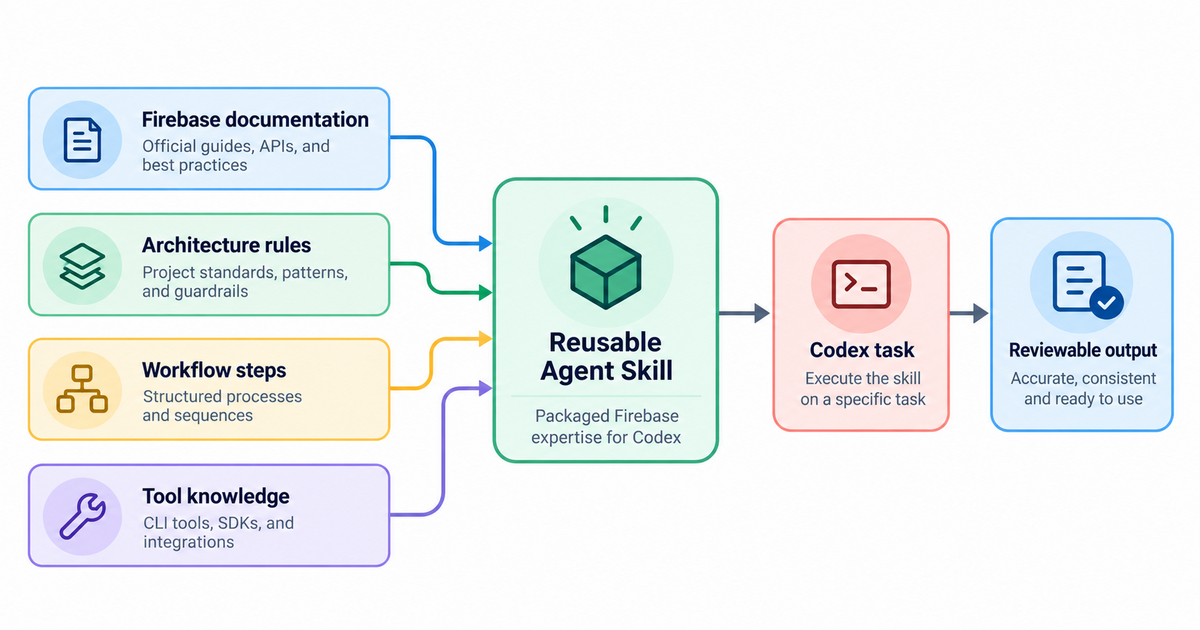
Summary: Firebase’s Codex plugin includes Firebase Agent Skills that provide domain expertise, up-to-date documentation, recommended workflows, and tool knowledge. Firebase says the skills are intended to help Codex follow Firebase-recommended configuration and architecture patterns instead of relying only on a general model’s background knowledge.
Why it matters: This is a concrete example of Agent Skills as reusable operating knowledge. A product team can package current domain guidance and preferred procedures once, then let an agent apply that context repeatedly across tasks without each user rebuilding the same prompt or workflow from scratch.
What to do now — Treat reusable skills as maintained operating knowledge: For one recurring domain workflow, package the current rules, preferred sequence, tool guidance, and review expectations as a versioned skill, then assign an owner to update it as the underlying product or policy changes.
Source: Firebase packages domain expertise and recommended workflows as reusable Agent Skills for Codex
2. AWS brings GPT-6.1 Sol to Bedrock for everyday agent and professional workflows
Focus: Agents for Everyone
Date: September 29, 2026
Topics: Amazon Bedrock, GPT-6.1 Sol, enterprise agents, professional workflows, model evaluation
Evidence: Official Primary Source
Availability: Published
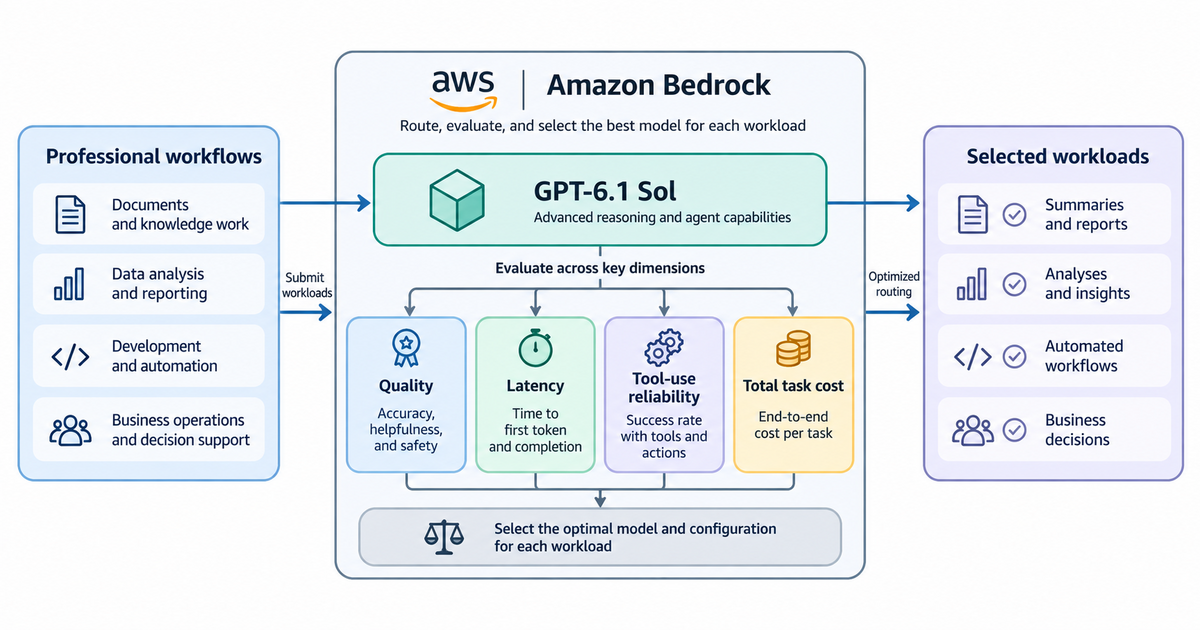
Summary: AWS says GPT-6.1 Sol is generally available on Amazon Bedrock for coding, computer-use, and professional workloads. The announcement describes using supported Bedrock APIs for internal tools that synthesize documents, agents that coordinate work across systems, and customer-facing applications that evaluate multiple inputs.
Why it matters: A stronger general model becomes operationally relevant when it can be placed inside existing enterprise infrastructure and used for repeatable workflows rather than only interactive chat. The practical question shifts from raw model capability to which bounded tasks justify migration and how teams will measure the change.
What to do now — Benchmark one bounded workflow before migrating: Choose a representative agent or knowledge-work task, compare quality, latency, tool-use reliability, and total task cost against the current model, and migrate only where the measured workflow benefit is material.
Source: AWS brings GPT-6.1 Sol to Bedrock for everyday agent and professional workflows
3. Google Vids upgrades AI voiceovers with Gemini 3.8 Flash Lite TTS
Focus: Applied Generative AI for Knowledge Workers
Date: September 29, 2026
Topics: Google Vids, text to speech, knowledge work, AI voiceovers, content creation
Evidence: Official Primary Source
Availability: Published
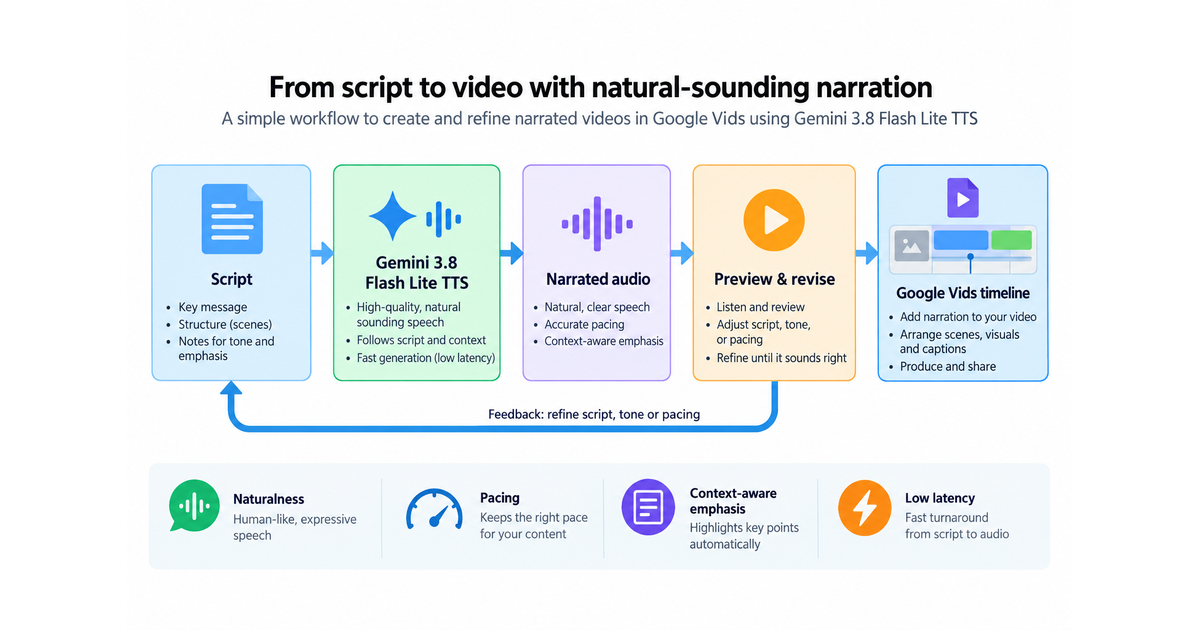
Summary: Google Workspace says Google Vids is moving AI voiceovers and avatar narration to Gemini 3.8 Flash Lite TTS. The update is intended to improve naturalness, pacing, context-aware emphasis, and generation latency so creators can iterate on scripts and narration more quickly inside the video workflow.
Why it matters: Generative AI adoption often depends on reducing small production frictions rather than adding a new standalone tool. Better narration quality and faster iteration can make AI-assisted video more practical for internal training, presentations, explainers, and other routine knowledge-work communication.
What to do now — Compare one real narration workflow before and after the upgrade: Use a representative internal video, compare pacing, pronunciation, edit time, and regeneration frequency, and decide whether the upgraded voice workflow reduces total production effort without lowering communication quality.
Source: Google Vids upgrades AI voiceovers with Gemini 3.8 Flash Lite TTS
4. Microsoft frames Agent Builder adoption as a change-management program, not a feature rollout
Focus: Applied Generative AI for Knowledge Workers
Date: September 29, 2026
Topics: Agent Builder, change management, AI adoption, Microsoft 365 Copilot, workflow transformation
Evidence: Official Primary Source
Availability: Published
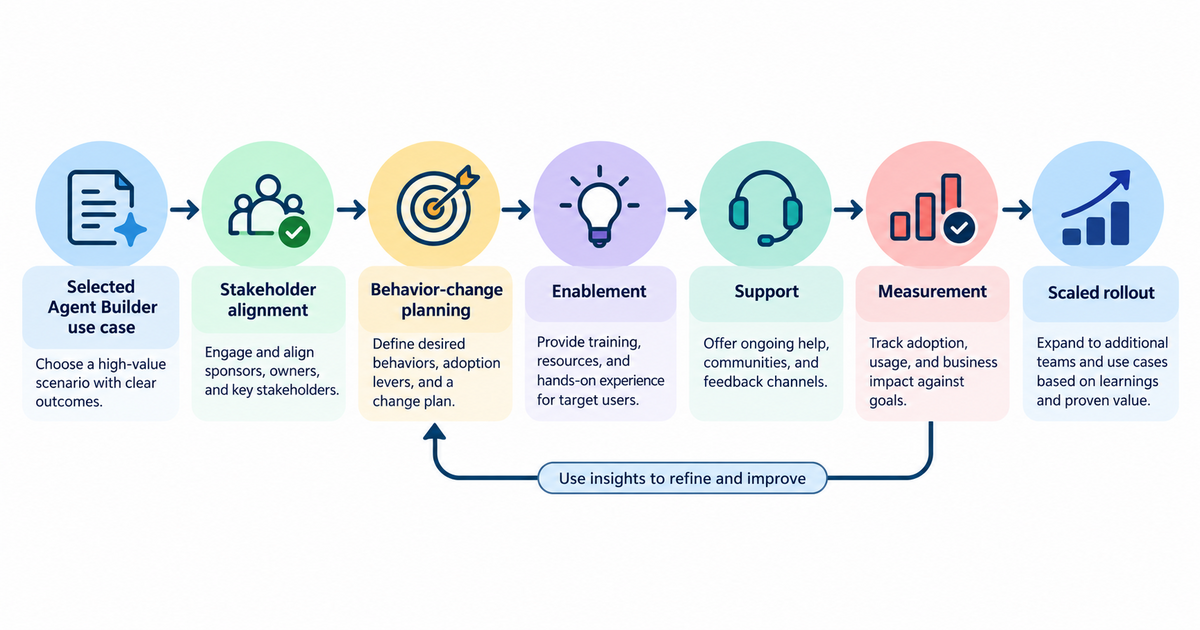
Summary: Microsoft’s Copilot team describes an operating model for scaling Agent Builder through structured change management, using an HCLTech customer example to illustrate how organizations can combine Microsoft 365 Copilot innovation with an explicit adoption program rather than relying on one-off team deployments.
Why it matters: The bottleneck for internal agents is increasingly organizational. Reusable agents create value only when people know which work should change, how new behavior is supported, who owns the rollout, and how adoption is measured across teams instead of being treated as a collection of isolated experiments.
What to do now — Give one agent rollout an explicit change-management owner: For a bounded Agent Builder use case, define the target behavior, stakeholder groups, enablement plan, support path, and adoption measures before expanding access, so the rollout is managed as a workflow change rather than a software launch.
Source: Microsoft frames Agent Builder adoption as a change-management program, not a feature rollout
5. NVIDIA’s TensorRT Model Connect treats coding agents as an engineering system, not a code generator
Focus: Technical AI Engineering
Date: September 29, 2026
Topics: coding agents, TensorRT, software architecture, parallel development, validation
Evidence: Official Primary Source
Availability: Published
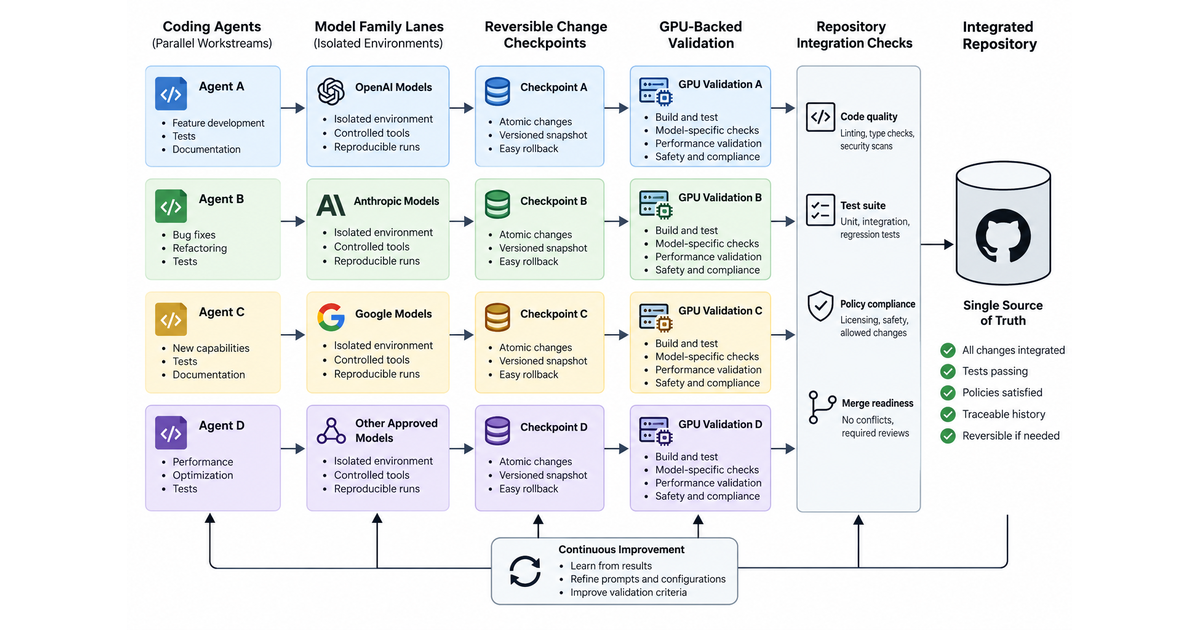
Summary: NVIDIA describes TensorRT Model Connect as an open-source collection of C++ model reference implementations designed around coding-agent workflows. Its account emphasizes parallel work, model-family isolation, reversible changes, and GPU-backed validation as engineering patterns for letting agents contribute without collapsing project structure or verification.
Why it matters: The useful lesson is architectural: agentic coding becomes more reliable when repositories are organized for bounded parallelism, changes can be reversed cleanly, and hardware-backed validation is part of the normal loop. Those controls matter more than simply giving a coding agent a larger task.
What to do now — Design the repository for reversible agent work: When testing coding agents, isolate model or feature work, require reversible commits, and make executable validation part of the handoff so parallel agent activity cannot silently bypass engineering controls.
Source: NVIDIA’s TensorRT Model Connect treats coding agents as an engineering system, not a code generator
6. Microsoft Research’s Quine links biological models, tools, literature, and scientists in one research harness
Focus: Technical AI Engineering
Date: September 29, 2026
Topics: AI for science, multimodal world models, research agents, biology, tool orchestration
Evidence: Official Primary Source
Availability: Published
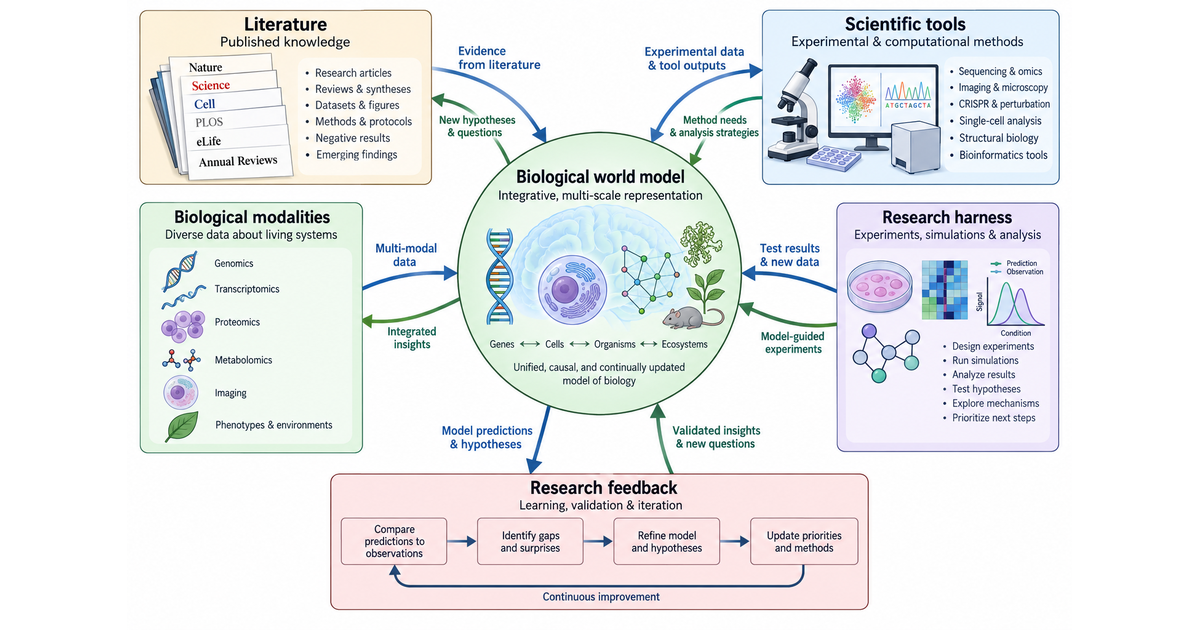
Summary: Microsoft Research introduced Quine as an early-stage research effort to build a multimodal world model of biology together with an interactive harness connecting models, scientific tools, literature, and researchers. A Quine Fellows program is intended to give scientists access to the system and generate scientific feedback from real research use.
Why it matters: The architecture points beyond single-model scientific assistants. Complex research domains may benefit more from systems that coordinate representations, external tools, literature, and expert feedback than from asking one model to answer every question from its internal knowledge.
What to do now — Watch how integrated scientific AI systems are evaluated: Track whether systems like Quine publish evidence on hypothesis quality, tool-use reliability, researcher oversight, and reproducibility, because integration breadth alone does not demonstrate scientific value.
Worth Watching
7. General
Prompt to Production: The Future of AI Code Workflows
Open the permanent video page
Channel: YouTube
Date: September 28, 2026
Runtime: 7:15
Format: Video
Summary: A concise prompt-to-production workflow that complements the day’s agent-ready engineering coverage.
Why it matters: Connects directly to repeatable engineering workflows and bounded production use.
Source: Watch on YouTube
8. Agents for Everyone
Microsoft Copilot Just Got a Massive Upgrade
Open the permanent video page
Channel: YouTube
Date: September 28, 2026
Runtime: 7:51
Format: Video
Summary: A short current overview of Copilot changes relevant to everyday agent and knowledge-work use.
Why it matters: Complements the day’s Agent Builder and workflow-adoption coverage.
Source: Watch on YouTube
Worth Listening — Podcasts
9. Ep 872: AI Cost Control 101: Why Your Chatbot Bill Is Becoming a Board-Level Problem (Start Here Series Vol 31)
Open the permanent podcast page
Show: Everyday AI Podcast – An AI and ChatGPT Podcast
Host / guest: Everyday AI
Focus: Applied Generative AI for Knowledge Workers
Date: September 29, 2026
Duration: Not independently verified · No episode time limit
Topics: AI cost control, enterprise AI, chatbots
Summary: A same-day discussion of AI cost control and operating considerations.
Why it matters: Adds operating-cost context to model and workflow choices.
Connection to the brief: Adds cost discipline to model adoption decisions.
Coverage: Reused the completed September 29 media checkpoint; no selection or source-content rediscovery.
Evidence: Practitioner analysis. Locked September 29 media preflight verified the official Apple Podcasts listing dated September 29 and reachable at HTTP 200.
Listen / watch: Apple Podcasts
10. Opus 5.5 is our favorite AI model (so far).
Open the permanent podcast page
Show: AI For Humans: Weekly AI News, Tools & Trends
Host / guest: AI For Humans
Focus: Agents for Everyone
Date: September 24, 2026
Duration: Not independently verified · No episode time limit
Topics: AI models, agents, tools
Summary: A recent independent-source model discussion retained by the locked media selection.
Why it matters: Provides a contrasting practical model-selection perspective.
Connection to the brief: Useful context for evaluating model choice rather than assuming a stronger model is automatically the right workflow fit.
Coverage: Reused the completed September 29 source-diverse fallback media checkpoint; no selection or source-content rediscovery.
Evidence: Practitioner analysis. Locked September 29 media preflight verified the official Apple Podcasts listing dated September 24 and reachable at HTTP 200.
Listen / watch: Apple Podcasts
Emerging AI Watchlist
0 new today · 2 updated · 14 carried forward.
Changed today:
- Reusable agent skills become observable
- AI harness engineering becomes a first-class layer
Help choose what we investigate next. Explore emerging ideas and tell us which interest you.
Editorial takeaway
The day’s strongest signal is the shift from isolated AI features toward repeatable operating systems: agent-ready engineering practices, workflow-level adoption, reusable skills, and stronger general models are becoming useful only when teams pair them with explicit process, context, and control.