← Daily Brief for September 29, 2026
NVIDIA’s TensorRT Model Connect treats coding agents as an engineering system, not a code generator
Focus: Technical AI Engineering
Date: September 29, 2026
Topics: coding agents, TensorRT, software architecture, parallel development, validation
Evidence: Official Primary Source
Availability: Published
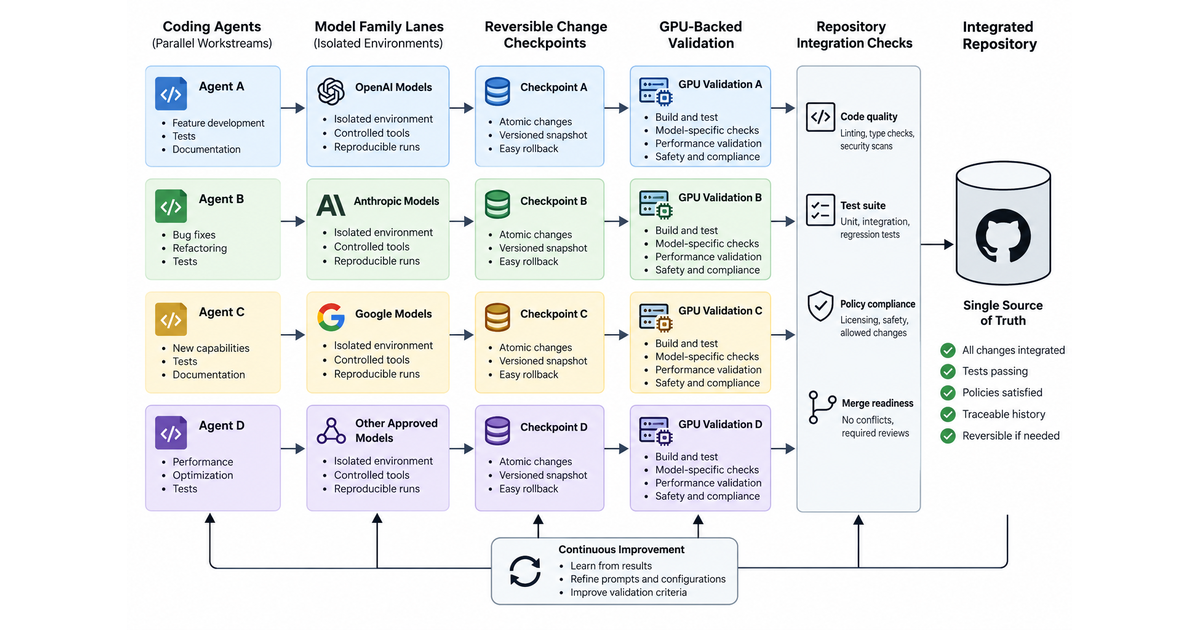
Summary: NVIDIA describes TensorRT Model Connect as an open-source collection of C++ model reference implementations designed around coding-agent workflows. Its account emphasizes parallel work, model-family isolation, reversible changes, and GPU-backed validation as engineering patterns for letting agents contribute without collapsing project structure or verification.
Why it matters: The useful lesson is architectural: agentic coding becomes more reliable when repositories are organized for bounded parallelism, changes can be reversed cleanly, and hardware-backed validation is part of the normal loop. Those controls matter more than simply giving a coding agent a larger task.
What to do now
Design the repository for reversible agent work: When testing coding agents, isolate model or feature work, require reversible commits, and make executable validation part of the handoff so parallel agent activity cannot silently bypass engineering controls.
Source: NVIDIA’s TensorRT Model Connect treats coding agents as an engineering system, not a code generator