Daily Generative AI Brief — September 14, 2026
Published: September 14, 2026
Coverage period: Verified primary-source developments published September 10–14, 2026; weekend publication volume was limited.
IN THIS EDITION · 6 ARTICLES / 2 VIDEOS / 1 PODCAST
Choose what matters to your work
- OpenAI’s Habitat turns storage scale into a centralized control planeArticle · about 15 min source read
- Google Cloud packages reusable Agent Skills for four coding-agent hostsArticle · about 6 min source read
- Codex supports antimicrobial search, but experiments still set ground truthArticle · about 7 min source read
- ChatGPT Work’s Data agent connects plain-language questions to governed actionArticle · about 8 min source read
- Microsoft turns conversation into governed business appsArticle · about 5 min source read
- Salesforce frames agents as long-running job systems, not chatbotsArticle · about 9 min source read
- Use Deep Research with ChatGPT for TeachersVideo · 4:26
- Use Plugins with ChatGPT for TeachersVideo · 8:46
- How a 700-Person Bank Is Using AI to Build Apps, Agents, and Digital EmployeesPodcast
1. OpenAI’s Habitat turns storage scale into a centralized control plane
Focus: Technical AI Engineering
Date: September 11, 2026
Topics: distributed systems, storage architecture, tail latency, AI-assisted migration
Evidence: Official Announcement
Availability: Reported
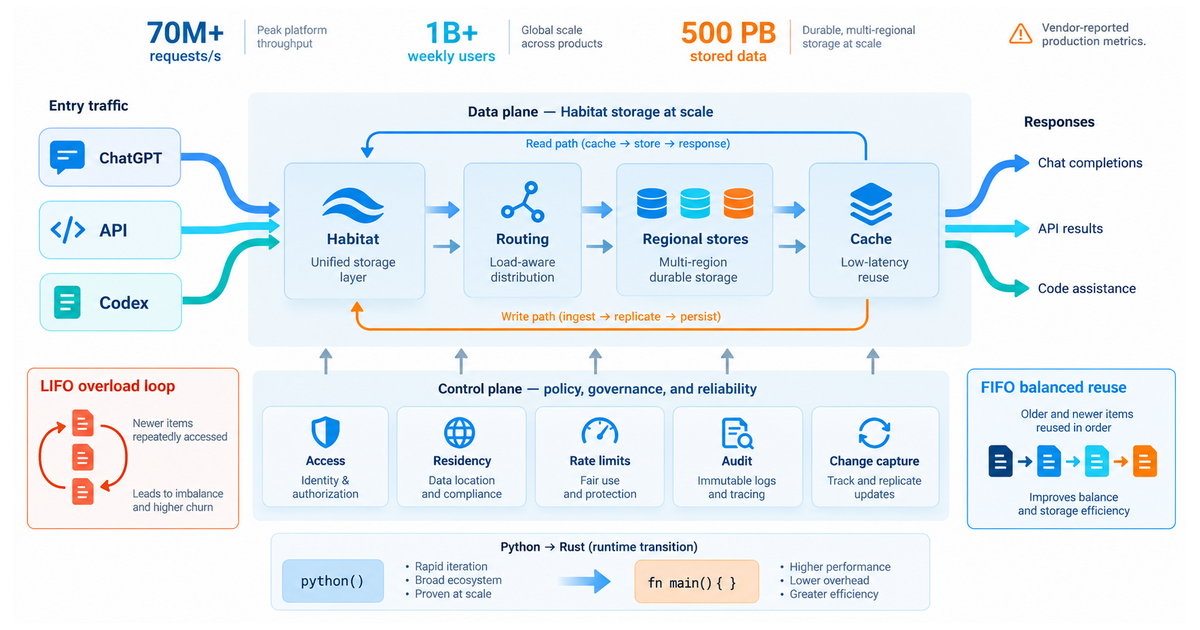
Summary: OpenAI describes Habitat, its online storage platform, as serving more than 70 million requests per second, more than 1 billion weekly users, and over 500 petabytes across nearly 40 regions. The engineering account explains why OpenAI centralized routing, authorization, audit logging, request shaping and data-residency logic; how LIFO connection reuse created a metastable overload loop that FIFO reuse broke; and how two engineers used Codex and GPT-5.5 to rewrite the service from Python to Rust.
Why it matters: The durable lesson is not a language benchmark but a systems pattern: constrain the API, centralize policy and observability, measure tail latency, and test feedback loops under burst traffic. OpenAI reports the Rust service now handles 95% of production requests with 6× CPU and 15× memory efficiency versus Python; those are vendor-reported production measurements without an independently reproducible workload.
What to do now — Stress-test feedback loops: Replay burst traffic while tracing connection reuse, tail latency, downstream fan-in and recovery behavior.
Source: Rapidly scaling online storage to serve over 1 billion ChatGPT users
2. Google Cloud packages reusable Agent Skills for four coding-agent hosts
Focus: Technical AI Engineering
Date: September 10, 2026
Topics: Agent Skills, MCP, grounded documentation, cloud governance
Evidence: Official Announcement
Availability: General Availability
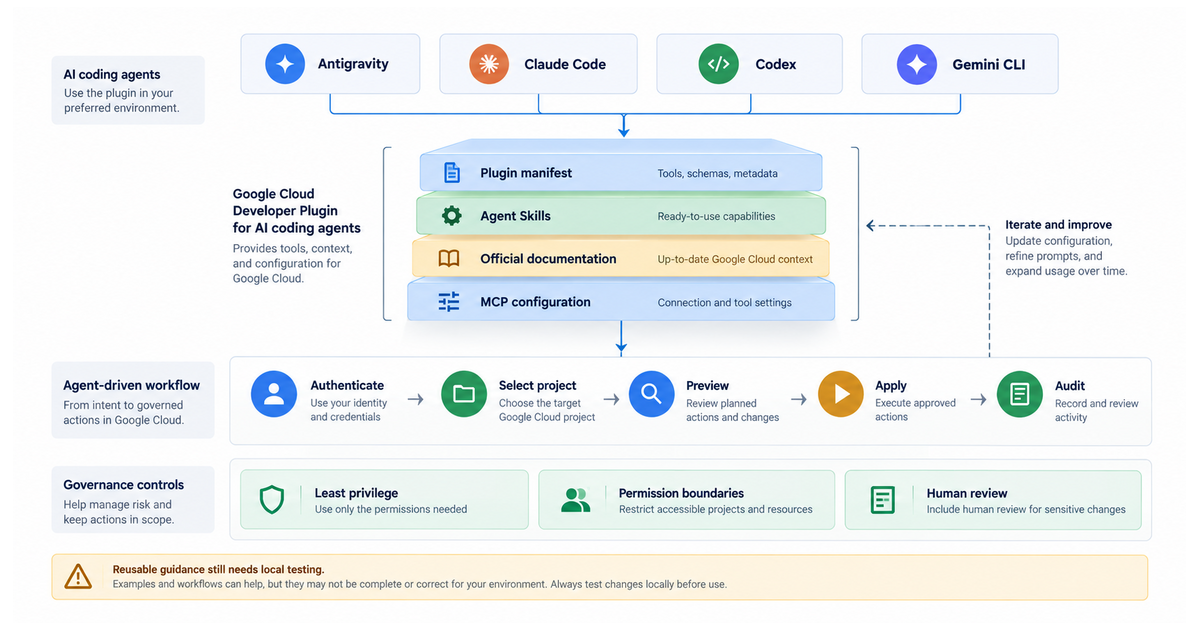
Summary: Google Cloud released an open-source Developer Plugin that bundles Agent Skills, official documentation grounding and MCP configuration for Antigravity, Claude Code, Codex and Gemini CLI. The package is designed to give coding agents reusable Google Cloud procedures and current platform context while using existing authentication and project configuration.
Why it matters: This is the edition’s single reusable Agent Skills story: it shows how instructions, references and tool configuration can travel as one inspectable package across agent hosts. Portability does not establish correctness or least privilege; teams still need to review the skill files, pin versions, scope credentials, preview changes and test each target environment.
What to do now — Audit one portable skill: Inspect its instructions, references, MCP settings, permissions and version behavior in two agent hosts.
Source: Introducing the Google Cloud Developer Plugin for AI Coding Agents
3. Codex supports antimicrobial search, but experiments still set ground truth
Focus: Applied Generative AI for Knowledge Workers
Date: September 10, 2026
Topics: scientific discovery, AI-assisted coding, evidence trace, human validation
Evidence: Official Announcement
Availability: Reported
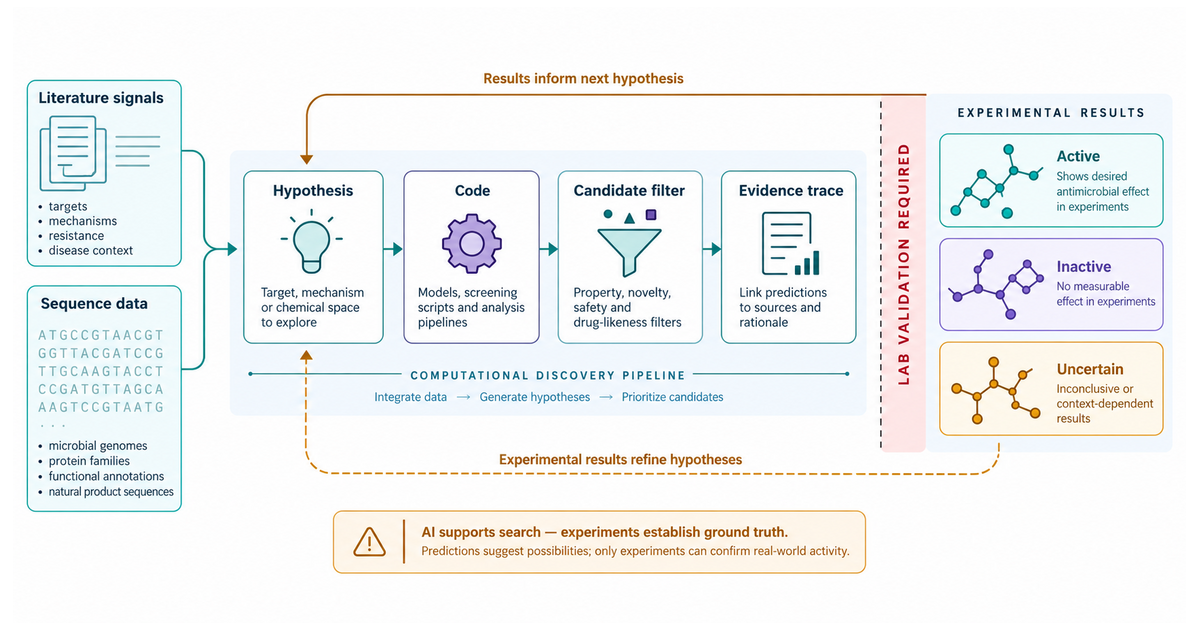
Summary: OpenAI profiles César de la Fuente’s lab using ChatGPT and Codex to brainstorm hypotheses, write and refine code, process datasets, analyze results and connect ideas across disciplines while custom deep-learning models search genome and protein data for candidate antimicrobial molecules. AI narrows the search; experimental testing must still establish biological activity, toxicity, resistance, manufacturability and eventual clinical evidence.
Why it matters: The useful pattern for knowledge work is a tight loop between literature, computation, evidence and domain tests—not replacing experts with generated conclusions. The source is an OpenAI customer profile, and reported acceleration in early candidate search does not prove that a candidate becomes a safe or effective medicine.
What to do now — Mark the ground-truth boundary: In every AI-assisted research workflow, label which outputs are hypotheses and which require independent expert or experimental verification.
Source: How a researcher uses Codex and ChatGPT to search for new antimicrobial molecules
4. ChatGPT Work’s Data agent connects plain-language questions to governed action
Focus: Applied Generative AI for Knowledge Workers
Date: September 10, 2026
Topics: data analysis, semantic layers, grounding, human approval
Evidence: Official Announcement
Availability: General Availability
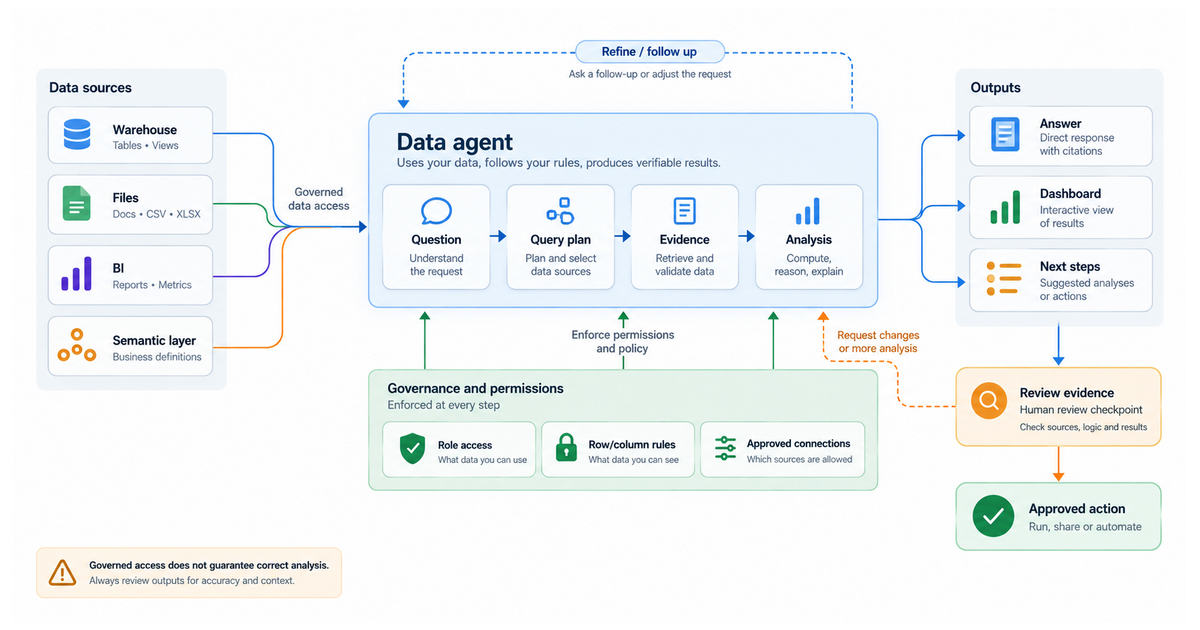
Summary: OpenAI introduced a Data agent in ChatGPT Work that can connect to approved warehouses, files, semantic layers and BI tools; investigate business questions; expose evidence; build refreshable dashboards; and carry out connected actions a user approves. Administrators control connections and roles, while underlying table, row and column permissions continue to apply.
Why it matters: The product moves conversational analysis closer to governed operational work, but semantic grounding and access controls do not guarantee correct joins, causal explanations or recommendations. Availability depends on workspace installation, configured plugins and connected accounts; the customer outcomes in the announcement are vendor-selected examples rather than comparative evaluation.
What to do now — Reconcile one governed analysis: Compare the agent’s result with an existing trusted report and inspect evidence, definitions and permissions before reuse.
Source: Now everyone can put data to work
5. Microsoft turns conversation into governed business apps
Focus: Agents for Non-Technical People
Date: September 10, 2026
Topics: vibe coding, no-code apps, Copilot Studio, deployment governance
Evidence: Official Announcement
Availability: Public Preview
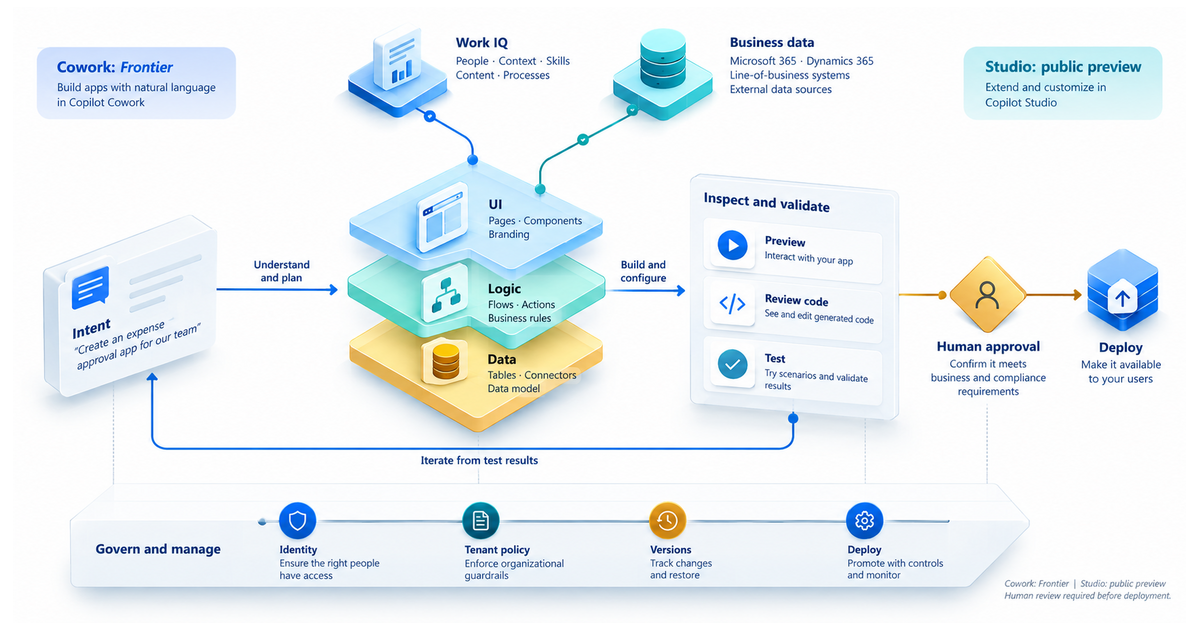
Summary: Microsoft is adding natural-language app building to Copilot Cowork through an /app skill in the Frontier program and to Copilot Studio through a public preview. Users can describe a business app, connect organizational context and data, preview it, inspect generated code, revise it conversationally and move through governed deployment stages.
Why it matters: Accessible app generation can let subject-matter experts turn process knowledge into working prototypes, but generated full-stack code still creates security, data-quality, maintenance and ownership obligations. Cowork and Studio have different availability paths, and Microsoft’s announcement is not evidence that an unreviewed prototype is production-ready.
What to do now — Prototype one governed app: Use test data, review the generated code and connectors, and assign an owner before any production deployment.
Source: Build business apps with Copilot Cowork and Copilot Studio
6. Salesforce frames agents as long-running job systems, not chatbots
Focus: Agents for Non-Technical People
Date: September 11, 2026
Topics: long-horizon agents, durable execution, human steering, availability
Evidence: Official Announcement
Availability: Announced
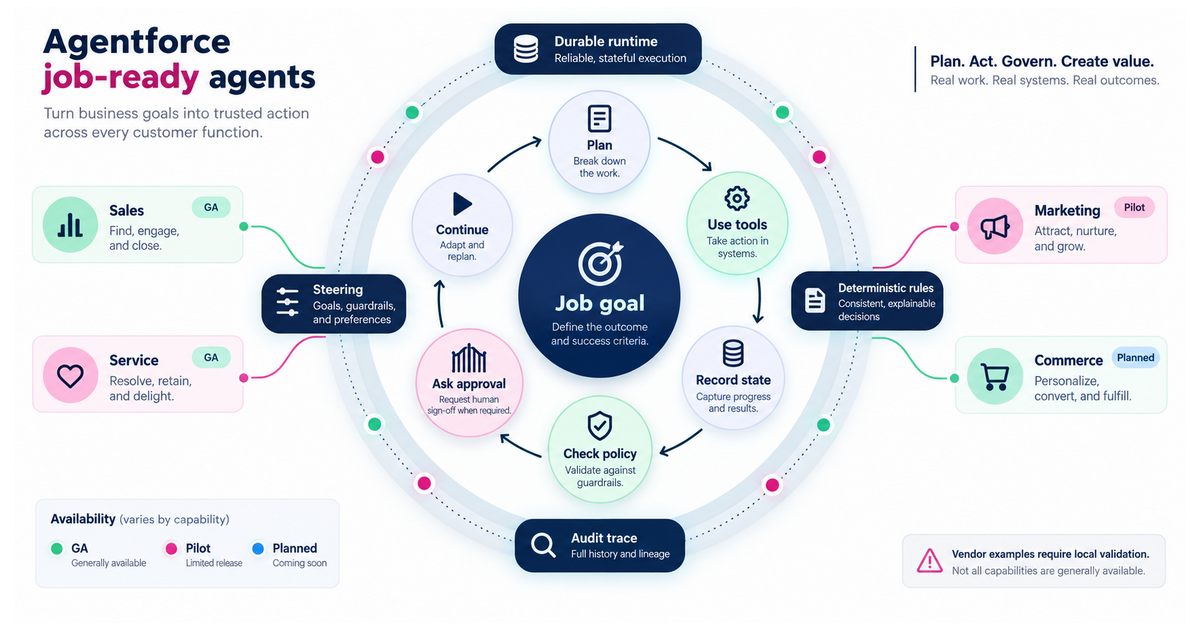
Summary: Salesforce announced a set of Agentforce capabilities organized around complete jobs across sales, service, marketing and commerce. Its product description emphasizes durable execution, persistent state, steering, deterministic rules, auditability and human approvals so agents can continue multi-step work rather than answer only one prompt.
Why it matters: The shift from chat to jobs makes failure handling, ownership and availability more important: a long-running system needs checkpoints, resumable state, permissions and a clear human override. The announcement mixes generally available, pilot and planned capabilities, and its performance examples are vendor-reported; buyers must verify the exact feature and release status they need.
What to do now — Map one job as states: Document triggers, tools, checkpoints, exception paths, approvals and completion evidence before choosing an agent product.
Source: Salesforce expands Agentforce with new job-ready AI agents
Worth Watching
7. General
Use Deep Research with ChatGPT for Teachers
Open the permanent video page
Channel: OpenAI Academy
Date: September 11, 2026
Runtime: 4:26
Format: Video
Summary: A concise official walkthrough of researching school policy and lesson plans, checking sources and exporting a report.
Why it matters: It reinforces today’s evidence-handoff theme: useful research artifacts still depend on source review.
Source: Watch on OpenAI Academy
8. Agents for Non-Technical People
Use Plugins with ChatGPT for Teachers
Open the permanent video page
Channel: OpenAI Academy
Date: September 11, 2026
Runtime: 8:46
Format: Video
Summary: An eight-minute official example of invoking a reusable domain plugin for translation and exit-ticket tasks using teaching materials.
Why it matters: It gives non-technical readers a concrete companion to today’s portable Agent Skills story.
Source: Watch on OpenAI Academy
Worth Listening — Podcast
9. How a 700-Person Bank Is Using AI to Build Apps, Agents, and Digital Employees
Open the permanent podcast page
Show: The Artificial Intelligence Show
Host / guest: Mike Kaput
Focus: Agents for Non-Technical People
Date: September 10, 2026
Duration: 38:31 · No episode time limit
Topics: AI transformation, AI champions, build versus buy, agent governance
Summary: Mike Kaput interviews Peapack Private CTO John Kowal about moving from employee chat access to governed internal applications and named “digital employees,” supported by a data warehouse, an AI engineering team and 29 business-line AI champions.
Why it matters: The interview connects technology to operating-model choices: prerequisites, embedded champions, business-owned use cases, deterministic steps and explicit human relationships.
Connection to the brief: It extends today’s app-building, data-agent and long-running-job stories with one organization’s implementation path and reported outcomes.
Coverage: A mandatory and core-source search found no newer verified, unused podcast within the preferred 48-hour window, so the documented seven-day fallback was used.
Evidence: Practitioner analysis. The publisher page identifies the episode, host and September 10 date; its transcript ends at 38:31, used as the runtime.
Listen / watch: Publisher show notes and transcript
Emerging AI Watchlist
Help choose what we investigate next. Explore emerging ideas and tell us which interest you.
Editorial takeaway
This weekend-window edition converges on one operating principle: make the surrounding system more explicit as AI becomes more capable. Constrained interfaces, governed context, evidence handoffs, resumable state and human approval matter more than a compelling demo.