← Daily Brief for September 14, 2026
OpenAI’s Habitat turns storage scale into a centralized control plane
Focus: Technical AI Engineering
Date: September 11, 2026
Topics: distributed systems, storage architecture, tail latency, AI-assisted migration
Evidence: Official Announcement
Availability: Reported
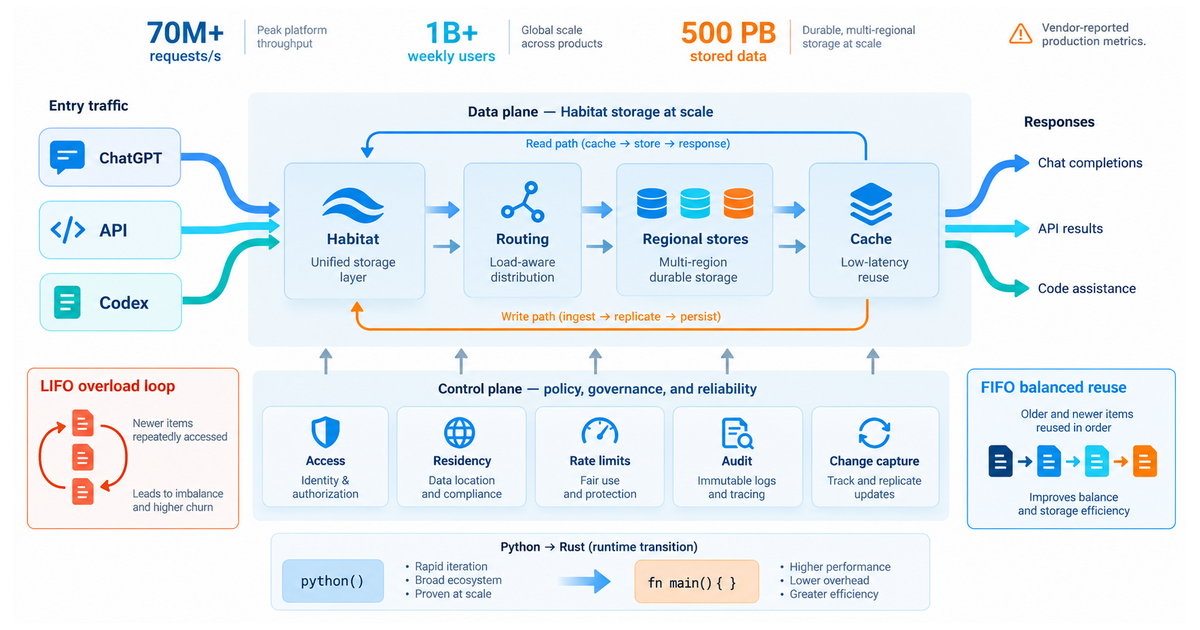
Summary: OpenAI describes Habitat, its online storage platform, as serving more than 70 million requests per second, more than 1 billion weekly users, and over 500 petabytes across nearly 40 regions. The engineering account explains why OpenAI centralized routing, authorization, audit logging, request shaping and data-residency logic; how LIFO connection reuse created a metastable overload loop that FIFO reuse broke; and how two engineers used Codex and GPT-5.5 to rewrite the service from Python to Rust.
Why it matters: The durable lesson is not a language benchmark but a systems pattern: constrain the API, centralize policy and observability, measure tail latency, and test feedback loops under burst traffic. OpenAI reports the Rust service now handles 95% of production requests with 6× CPU and 15× memory efficiency versus Python; those are vendor-reported production measurements without an independently reproducible workload.
What to do now
Stress-test feedback loops: Replay burst traffic while tracing connection reuse, tail latency, downstream fan-in and recovery behavior.
Source: Rapidly scaling online storage to serve over 1 billion ChatGPT users