← Daily Brief for September 14, 2026
Codex supports antimicrobial search, but experiments still set ground truth
Focus: Applied Generative AI for Knowledge Workers
Date: September 10, 2026
Topics: scientific discovery, AI-assisted coding, evidence trace, human validation
Evidence: Official Announcement
Availability: Reported
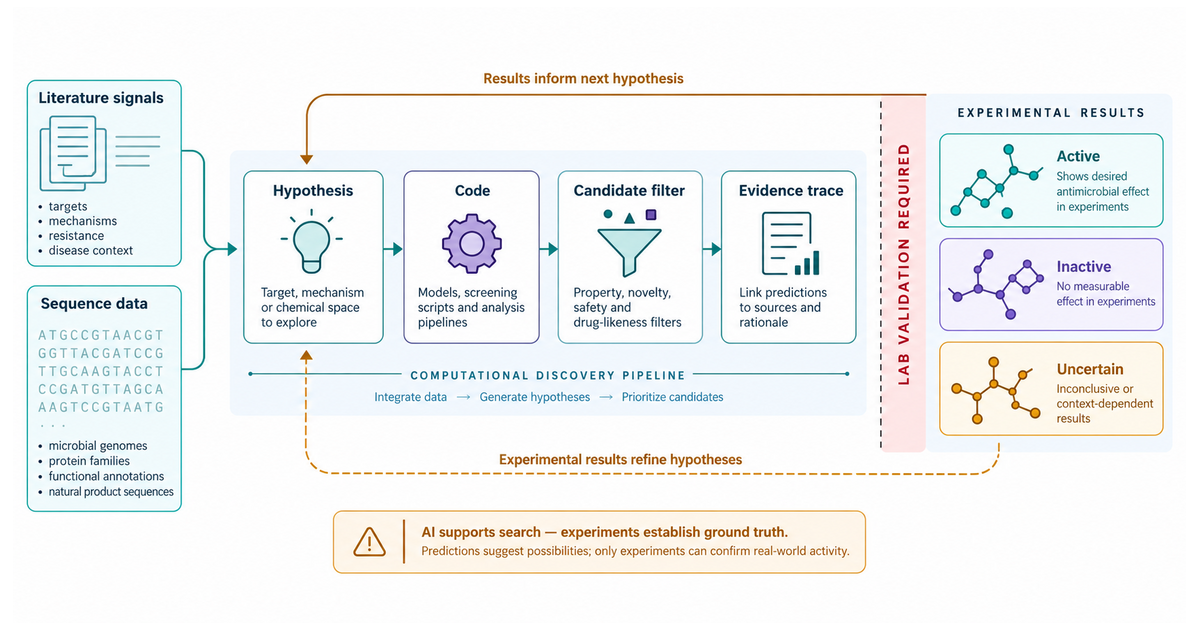
Summary: OpenAI profiles César de la Fuente’s lab using ChatGPT and Codex to brainstorm hypotheses, write and refine code, process datasets, analyze results and connect ideas across disciplines while custom deep-learning models search genome and protein data for candidate antimicrobial molecules. AI narrows the search; experimental testing must still establish biological activity, toxicity, resistance, manufacturability and eventual clinical evidence.
Why it matters: The useful pattern for knowledge work is a tight loop between literature, computation, evidence and domain tests—not replacing experts with generated conclusions. The source is an OpenAI customer profile, and reported acceleration in early candidate search does not prove that a candidate becomes a safe or effective medicine.
What to do now
Mark the ground-truth boundary: In every AI-assisted research workflow, label which outputs are hypotheses and which require independent expert or experimental verification.
Source: How a researcher uses Codex and ChatGPT to search for new antimicrobial molecules