← Daily Brief for September 18, 2026
Google gives a household agent its own identity, permissions, shared memory, and isolated computer
Focus: Agents for Non-Technical People
Date: September 17, 2026
Topics: consumer agents, identity, permissions, shared memory, isolated execution, Gemini
Evidence: Official Announcement
Availability: Experimental Waitlist
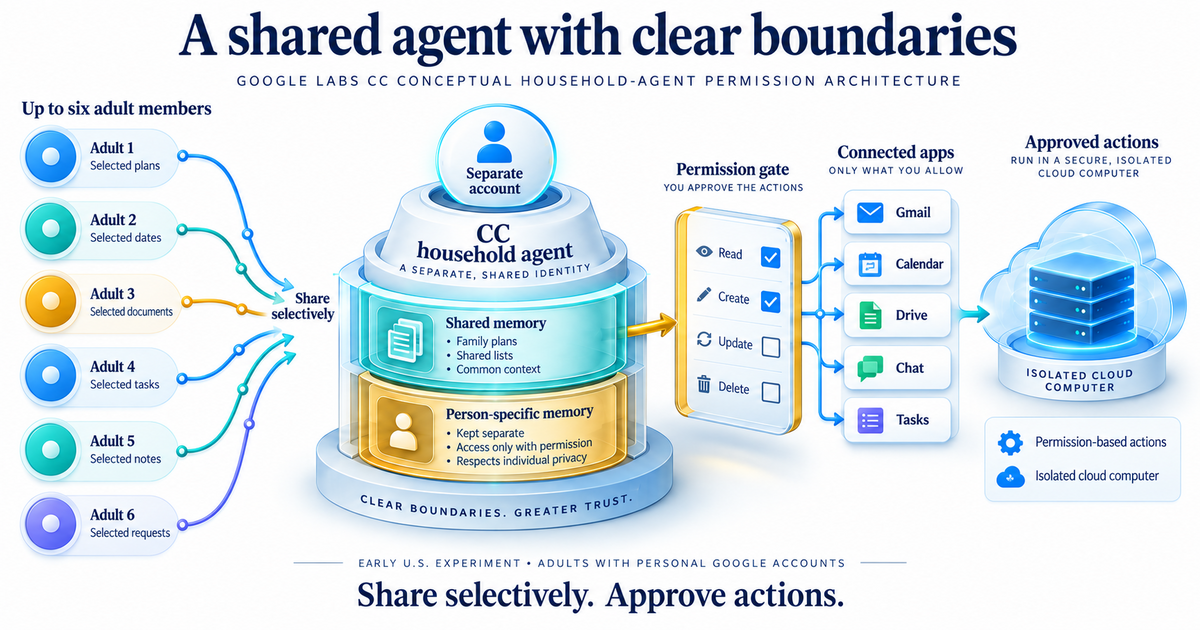
Summary: Google Labs expanded CC into an experimental household agent for up to six members. CC has its own Google Account, only sees information each person chooses to share, can connect to Gmail, Chat, Drive, Calendar and Tasks, can fill forms with permission, keeps shared and person-specific memory, and runs on an isolated cloud computer using Google’s agentic harness.
Why it matters: The design exposes governance concepts that are often hidden in consumer agents: a distinct agent identity, scoped sharing, explicit permissions, shared versus private memory, and isolated execution. Those are useful patterns for any multi-user agent, not just household logistics.
What to do now
Use CC’s controls as an agent design checklist: For any shared agent, specify who the agent is, who may instruct it, what each member shares, which actions require approval, how shared and private memory differ, and where execution is isolated.
Source: The new CC, an AI agent built for families