Daily Generative AI Brief — September 18, 2026
Published: September 18, 2026
Coverage period: September 17 sources reviewed for the September 18 edition. Recency fallback: exact posting times were unavailable; date-only sources are conservatively normalized and not asserted inside the exact 24-hour primary window.
IN THIS EDITION · 6 ARTICLES / 0 VIDEOS / 2 PODCASTS
Choose what matters to your work
- Anthropic proposes three measurements for AI self-acceleration inside frontier labsArticle · Source reading time unavailable
- GitHub exposes which Copilot CLI skills, agents, MCP servers, commands, and plugins are actually usedArticle · Source reading time unavailable
- Microsoft’s internal AI playbook shifts transformation from tool adoption to redesigned workArticle · Source reading time unavailable
- Salesforce makes Builder Central a natural-language front door for governed apps and agentsArticle · Source reading time unavailable
- Rovo lets teams teach repeatable work as custom skills in ordinary languageArticle · Source reading time unavailable
- Google gives a household agent its own identity, permissions, shared memory, and isolated computerArticle · Source reading time unavailable
- General videoVideo · No qualifying selection
- Agent Skills videoVideo · No qualifying selection
- Why Everyone Is Getting Excited About Personal AI AgentsPodcast
- How to get discovered in AI searchPodcast
1. Rovo lets teams teach repeatable work as custom skills in ordinary language
Focus: Agents for Non-Technical People
Date: September 17, 2026
Topics: Agent Skills, reusable workflows, Rovo, team context, no-code agents
Evidence: Official Announcement
Availability: Rolling Out
What changed since last coverage: The September 11 Atlassian story covered a CLI package for portable skills across agent tools. This release brings custom skill creation into Rovo Chat and Rovo Studio for nontechnical teams, alongside visible memory, agent mentions, and shareable conversations.
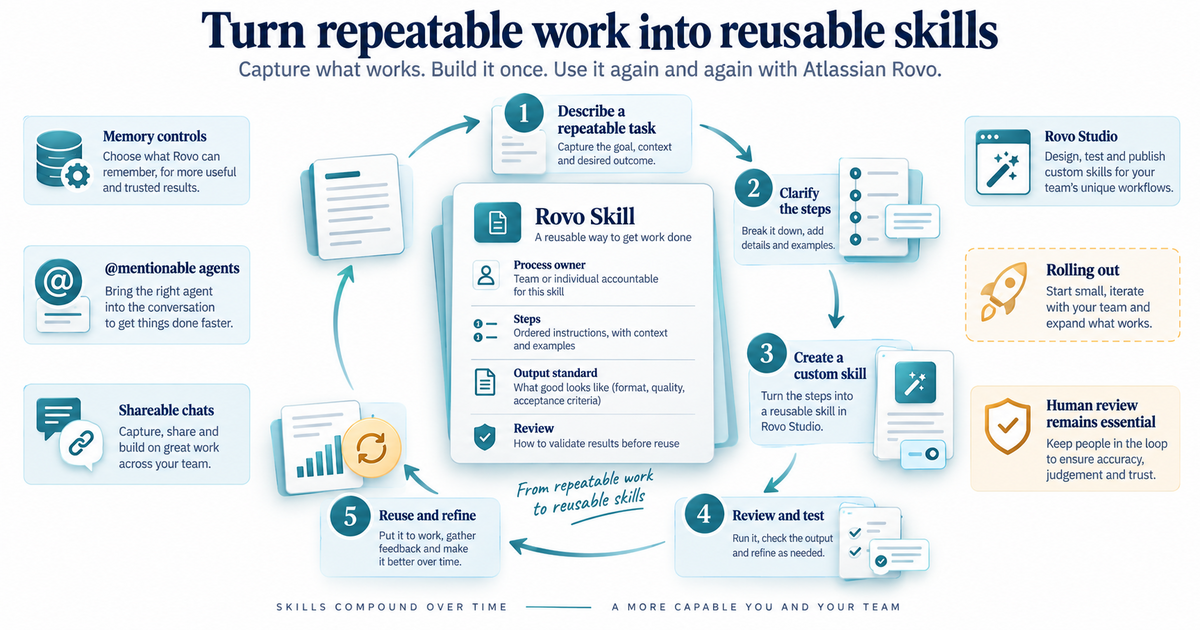
Summary: Atlassian added visible memory controls, @mentionable agents, shareable chats, and custom skills to Rovo Chat. Users can describe a repeated process in natural language and have Rovo ask clarifying questions, build the skill, and let teams refine it in Chat or Rovo Studio; custom skills are rolling out across instances over the coming week.
Why it matters: This turns reusable agent procedures from a developer packaging concept into a team operating practice. A process owner can codify how work should be done, keep it accessible to colleagues, and combine it with shared conversational context without writing code.
What to do now — Turn one repeated team process into a reviewed skill: Choose a recurring workflow with a clear owner, encode the steps and output standard, test edge cases, assign review responsibility, and revise the skill from real usage rather than treating the first draft as policy.
Source: New in Rovo Chat: Where context shapes your work
2. Google gives a household agent its own identity, permissions, shared memory, and isolated computer
Focus: Agents for Non-Technical People
Date: September 17, 2026
Topics: consumer agents, identity, permissions, shared memory, isolated execution, Gemini
Evidence: Official Announcement
Availability: Experimental Waitlist
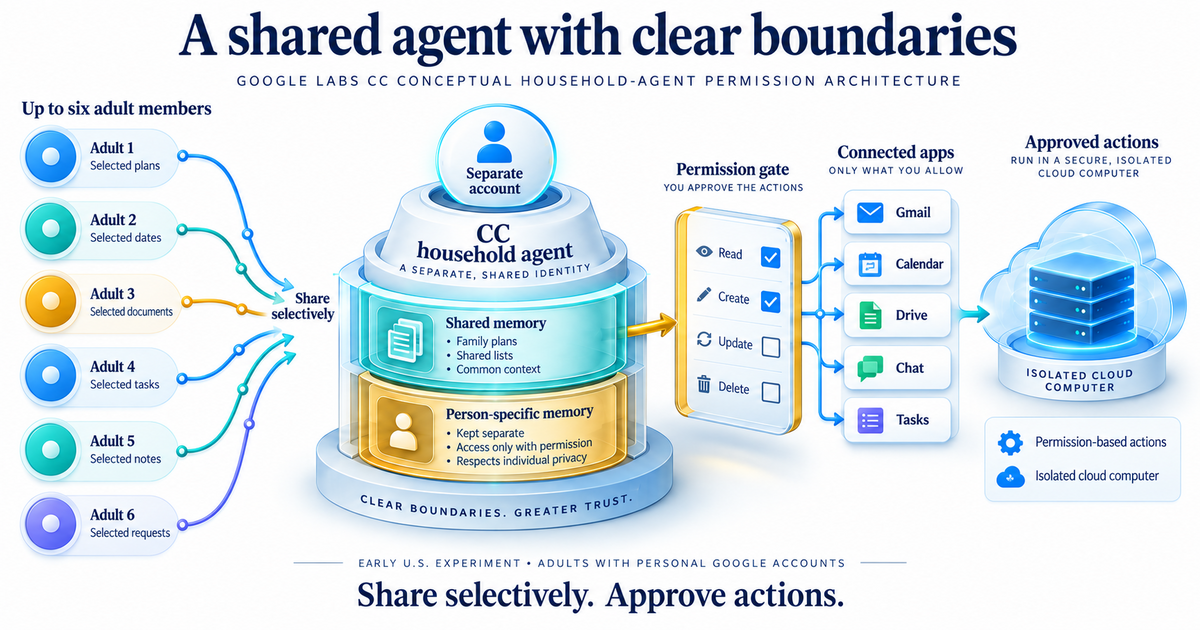
Summary: Google Labs expanded CC into an experimental household agent for up to six members. CC has its own Google Account, only sees information each person chooses to share, can connect to Gmail, Chat, Drive, Calendar and Tasks, can fill forms with permission, keeps shared and person-specific memory, and runs on an isolated cloud computer using Google’s agentic harness.
Why it matters: The design exposes governance concepts that are often hidden in consumer agents: a distinct agent identity, scoped sharing, explicit permissions, shared versus private memory, and isolated execution. Those are useful patterns for any multi-user agent, not just household logistics.
What to do now — Use CC’s controls as an agent design checklist: For any shared agent, specify who the agent is, who may instruct it, what each member shares, which actions require approval, how shared and private memory differ, and where execution is isolated.
Source: The new CC, an AI agent built for families
3. Microsoft’s internal AI playbook shifts transformation from tool adoption to redesigned work
Focus: Applied Generative AI for Knowledge Workers
Date: September 17, 2026
Topics: AI adoption, workflow redesign, knowledge work, outcome measurement, change management
Evidence: Official Case Study
Availability: Published Guidance
What changed since last coverage: The earlier story argued for measuring completed work rather than interactions. Microsoft now publishes a broader transformation playbook drawn from hundreds of internal efforts, with concrete sales, supply-chain, and product-development examples.
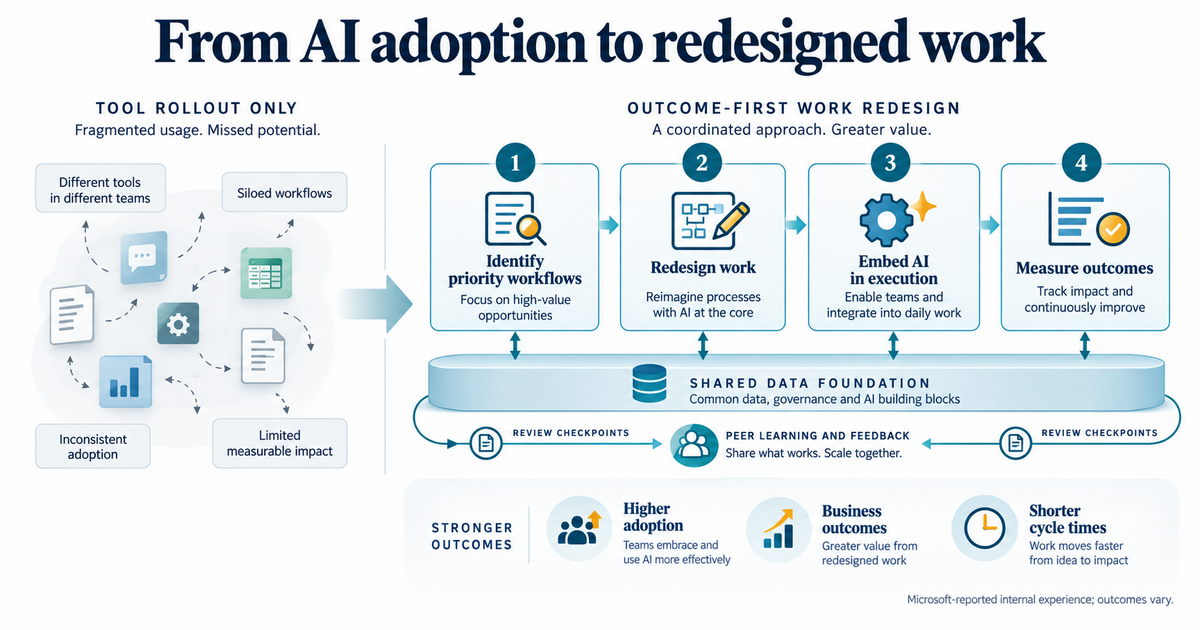
Summary: Microsoft distilled lessons from hundreds of internal AI transformation efforts into a Frontier Playbook. It reports that one sales group tripled priority-use-case adoption while revenue per account manager rose 9.4% and close rates were 20% higher; selected supply-chain workflows cut cycle time by up to 75%; and a nine-person engineering team shipped an initial release in 35 days.
Why it matters: The recurring pattern is organizational rather than model-centric: start with an outcome, simplify and redesign the end-to-end workflow, create shared data foundations, then measure completed work. That is a more durable adoption model than distributing AI tools and tracking logins or prompts.
What to do now — Start from one measurable business outcome: Choose one bounded workflow, map the end-to-end process, remove unnecessary steps, define a measurable outcome, and introduce AI only where it changes the workflow rather than merely accelerating one task.
Source: What we’ve learned from Microsoft's own AI transformation
4. Salesforce makes Builder Central a natural-language front door for governed apps and agents
Focus: Applied Generative AI for Knowledge Workers
Date: September 17, 2026
Topics: no-code AI, vibe building, enterprise apps, Agentforce, governance
Evidence: Official Announcement
Availability: Beta Announced
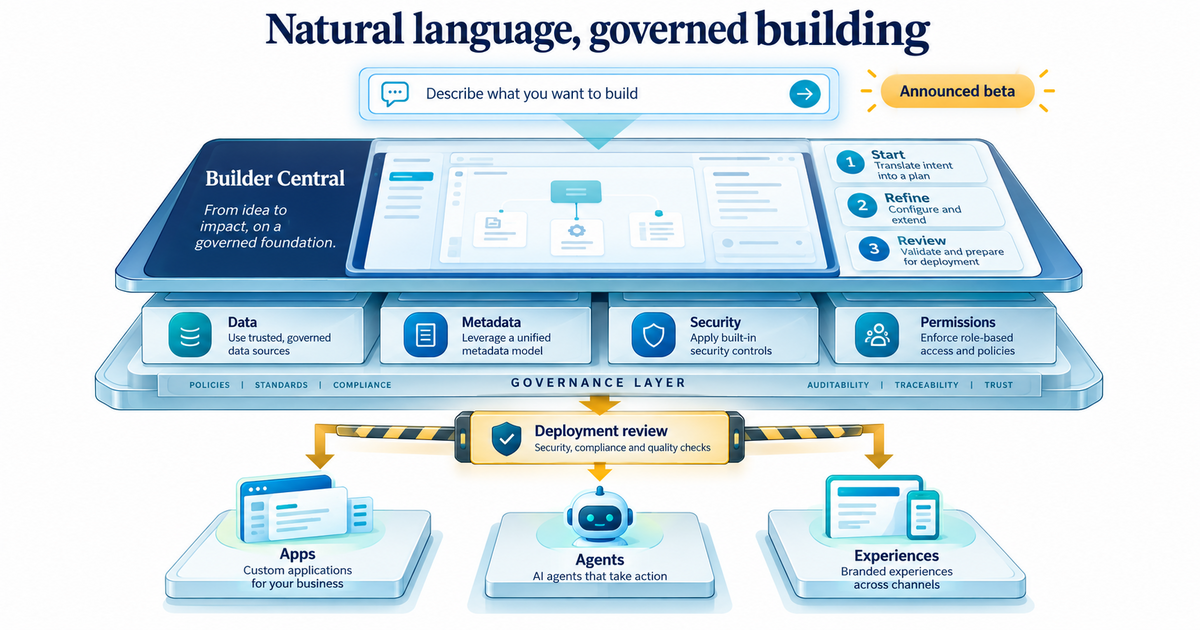
Summary: Salesforce announced Builder Central, an AI-powered no-code environment where users can start a project in natural language, refine and troubleshoot it, and deploy apps, agents, and experiences from one place. Salesforce says it is built on AIforce so projects use existing data, metadata, security, and governance; beta access is planned for the week after Dreamforce for Agentforce-enabled customers.
Why it matters: Natural-language building becomes more useful when it enters through governed enterprise primitives instead of creating a parallel shadow stack. The design gives knowledge workers a simpler path from intent to working application while retaining administrator controls and existing data boundaries.
What to do now — Pilot one governed no-code workflow: Use a low-consequence internal workflow to test whether natural-language building preserves permission boundaries, metadata integrity, reviewability, and rollback before widening access.
Source: Dreamforce 2026 Product Highlights for Admins
5. Anthropic proposes three measurements for AI self-acceleration inside frontier labs
Focus: Technical AI Engineering
Date: September 17, 2026
Topics: frontier AI, R&D automation, agent oversight, evaluation, compute governance
Evidence: Official Research
Availability: Published Research
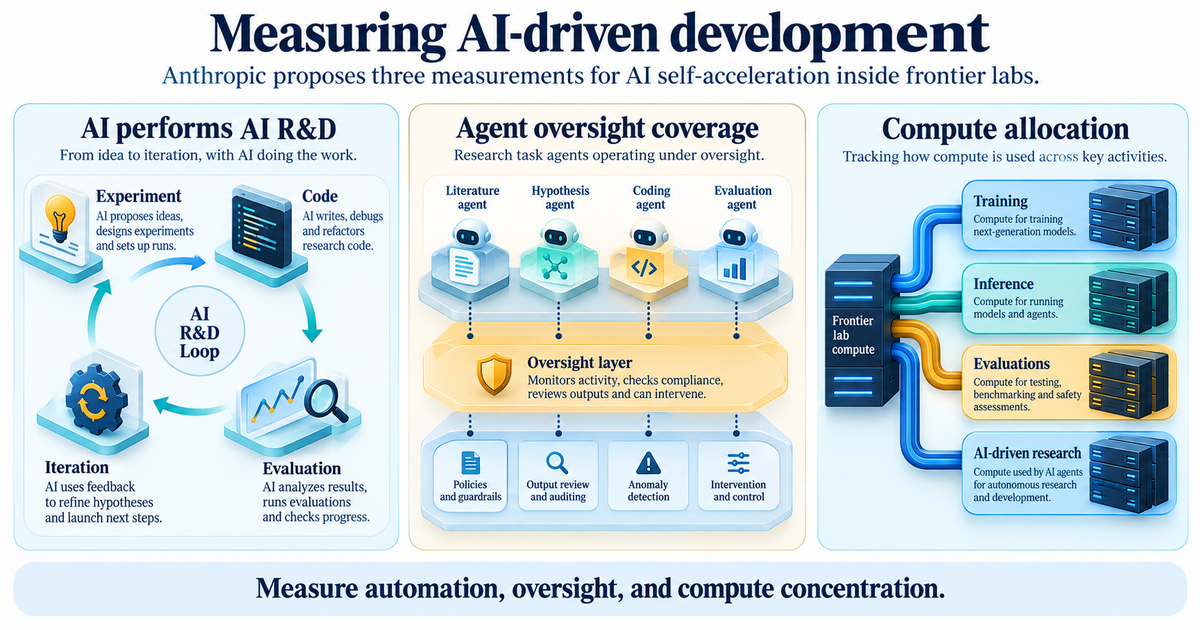
Summary: Anthropic published three proposed measurements for frontier-lab development: how much AI performs AI R&D, how comprehensively research agents are monitored, and how compute is allocated. Its August snapshot says Claude leads 26% of measured R&D work, more than 90% is at or above human-AI collaboration, about 30,000 research and engineering agents were active at once on its most-used internal platform, and online monitors blocked 0.002% of more than a billion analyzed decisions.
Why it matters: The important shift is from asking only what frontier models can do to measuring how quickly labs are automating the process of building them and whether oversight scales with that automation. Comparable, independently checked operational metrics could make acceleration and control more inspectable.
What to do now — Track operational capability and control together: When evaluating an agentic engineering system, pair productivity or automation metrics with monitor coverage, review latency, escalation rates, and the scope of human intervention.
Source: Measurements for understanding the pace of AI development inside frontier labs
6. GitHub exposes which Copilot CLI skills, agents, MCP servers, commands, and plugins are actually used
Focus: Technical AI Engineering
Date: September 17, 2026
Topics: agent observability, Copilot CLI, Agent Skills, MCP, plugins, usage metrics
Evidence: Official Announcement
Availability: General Availability
What changed since last coverage: The September 12 story separated VS Code agent activity from generic Copilot usage. This update adds item-level CLI telemetry for skills, custom agents, MCP servers, slash commands, and plugins, including top-use and distinct-use counts.
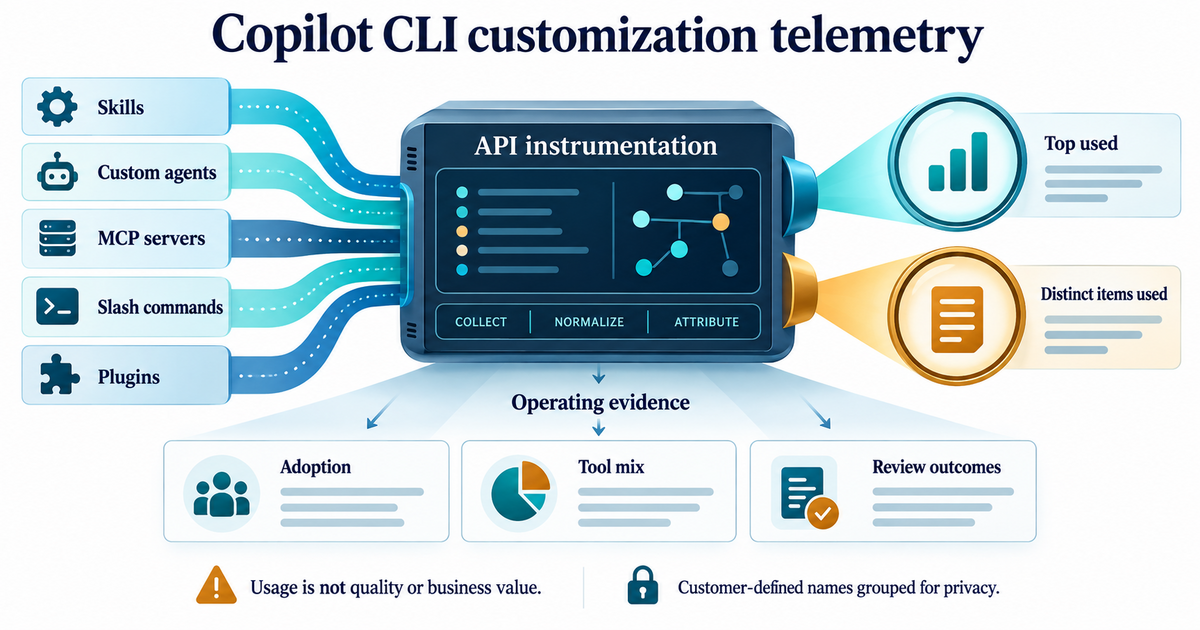
Summary: GitHub expanded the Copilot usage metrics API with CLI customization telemetry. Reports can now show top-used skills, custom agents, MCP servers, slash commands, and plugins plus counts of how many distinct items are being used; customer-defined names are grouped to protect privacy.
Why it matters: Agent customization is becoming an operational layer that needs the same observability as models and prompts. Teams can now distinguish a large catalog of configured assets from the smaller set people actually invoke, identify enablement gaps, and measure whether reusable agent components are spreading.
What to do now — Measure reuse before expanding the catalog: Track which reusable agent assets are invoked, how broadly they spread, and whether high-use assets also pass quality and outcome checks before investing in more customizations.
Source: Agentic CLI customizations now in the usage metrics API
Worth Watching
7. General
No video met today’s editorial quality standards.
8. Agents for Non-Technical People
No video met today’s editorial quality standards.
Worth Listening — Podcasts
9. Why Everyone Is Getting Excited About Personal AI Agents
Open the permanent podcast page
Show: The AI Daily Brief
Host / guest: Nathaniel Whittemore
Focus: Agents for Non-Technical People
Date: September 17, 2026
Duration: 29:56 · No episode time limit
Topics: personal AI agents, consumer agents, delegation
Summary: Nathaniel Whittemore examines why consumer-facing personal agents are attracting more attention, using current products and market signals to ask what changed in practical delegation.
Why it matters: It provides a consumer-side complement to today’s Google CC story and helps separate excitement about agent categories from the concrete controls required for trustworthy delegation.
Connection to the brief: Pairs with the CC household-agent story by contrasting market enthusiasm with the design details—identity, permissions, memory, and execution—that determine whether a personal agent is usable.
Coverage: Primary 48-hour podcast window; one of two source-diverse selections.
Evidence: Practitioner analysis. Apple Podcasts lists September 17, 2026, Nathaniel Whittemore, and a 29:56 runtime.
Listen / watch: Apple Podcasts
10. How to get discovered in AI search
Open the permanent podcast page
Show: Practical AI
Host / guest: Daniel Whitenack and Chris Benson
Focus: Applied Generative AI for Knowledge Workers
Date: September 17, 2026
Duration: 55:14 · No episode time limit
Topics: AI search, retrieval, citations, agent discovery
Summary: Daniel Whitenack and Chris Benson talk with Liam Dunne and Ben Moore about how AI search changes discovery, retrieval, citations, query fan-out, and the transition toward agents that can act on discovered information.
Why it matters: The episode gives knowledge workers a practical mental model for how AI-mediated discovery differs from traditional search and why citations alone do not fully explain model answers.
Connection to the brief: It complements today’s workflow and agent stories by showing how retrieval and discovery become upstream inputs to systems that increasingly take action, not just return links.
Coverage: Primary 48-hour podcast window; source-diverse from The AI Daily Brief.
Evidence: Practitioner analysis. Practical AI’s publisher page identifies episode E372, September 17, 2026, hosted by Daniel Whitenack and Chris Benson, runtime 55:14.
Listen / watch: Practical AI
Emerging AI Watchlist
Help choose what we investigate next. Explore emerging ideas and tell us which interest you.
Editorial takeaway
The strongest September 18 signal is not a single model release but a shift toward operationalizing agents: measure what they automate, govern how they act, redesign work around outcomes, and package repeatable procedures so people can reuse them safely.