Daily Generative AI Brief — October 9, 2026
Published: October 9, 2026
Coverage period: October 6–8, 2026
IN THIS EDITION · 6 ARTICLES / 2 VIDEOS / 2 PODCASTS
Choose what matters to your work
- Gemini agent uses modular skills to repeat governed business proceduresArticle · about 12 min source read
- Claude builds live data dashboards from plain-language questionsArticle · about 6 min source read
- Microsoft brings CRM records and approval-bound agents into everyday workArticle · about 6 min source read
- Intelligent UI turns an AI answer into a working interactive surfaceArticle · about 7 min source read
- AQuA watches live agent failures without becoming another tool in the agentArticle · about 11 min source read
- Copilot local sandboxing makes agent tool permissions an OS-level boundaryArticle · about 2 min source read
- Introducing the Decisions APIVideo · 5:34
- Build custom site annotations with ChatGPTVideo · 2:35
- Switching Models Shouldn't Mean Starting Over | Walrus Protocol's Kimberly LoganPodcast · 38:00
- The Best Way to Test New AI ModelsPodcast · 49:49
1. Gemini agent uses modular skills to repeat governed business procedures
Focus: Agents for Everyone
Date: October 8, 2026
Topics: Agent Skills, skills registry, cross-app tools, procedural context
Evidence: Publisher Authored
Availability: Available
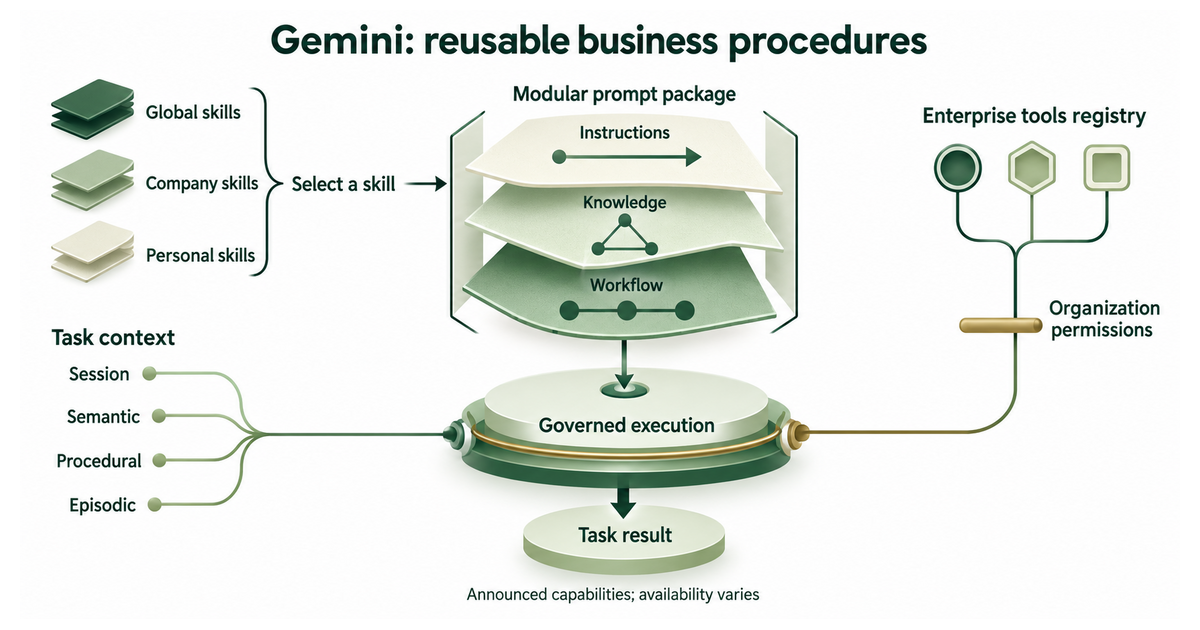
Summary: At Gemini at Work 2026, Google Cloud described a unified enterprise agent that brings tools, organizational context and reusable skills into one work environment. Here 'skill' has a concrete meaning: modular instructions, knowledge or a multi-step workflow stored as a prompt package that can be used again instead of rewritten for each request. Teams can publish shared procedures to a skills registry; individuals can maintain personal skills; a broader library supplies reusable starting points. A tools registry then connects an approved procedure to enterprise applications and data, while context mechanisms include task-session, semantic, procedural and episodic memory. The source also describes identity, authorization, policy management, sandboxing and network gateways. These are product announcements and design claims: they do not prove that every connector or capability is generally available to all customers. The durable mechanism is a governed skill-selection-and-execution pipeline, with organizational permissions constraining which systems a procedure can touch.
Why it matters: A nontechnical team can begin with one repeatable operating procedure, such as collecting weekly status from approved systems, explaining an anomaly and drafting a reviewable update. Specify inputs, tool permissions, acceptable evidence, human approval and output format inside the skill. Evaluate it on repeated tasks, not a single successful demo; version it when business rules change.
Source: Welcome to Gemini at Work 2026: Introducing the Gemini agent
2. Claude builds live data dashboards from plain-language questions
Focus: Agents for Everyone
Date: October 8, 2026
Topics: live dashboards, data source provenance, business questions, refresh controls
Evidence: Publisher Authored
Availability: Available
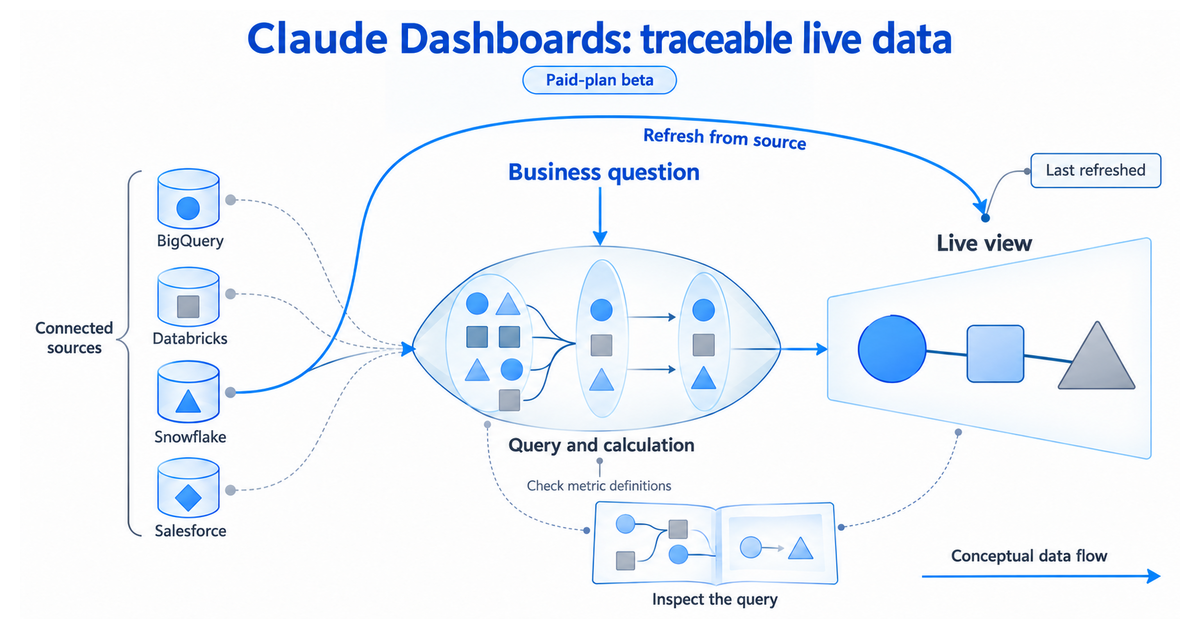
Summary: Anthropic introduced Claude Dashboards in paid-plan beta as a way to turn an ordinary business question into a dashboard connected to the underlying data. Supported examples include data warehouses such as BigQuery, Databricks and Snowflake and customer systems such as Salesforce. The displayed result is intended to remain current as the source updates, so an analysis can be revisited rather than frozen as a screenshot. The strongest reader value lies in the visible path from question to chosen data, query or calculation, chart, and latest refresh. The announcement also introduces Claude Motion, a separate beta capability for animated explainers, and makes Docs, Slides and Design available beyond beta. Those features have different eligibility; Motion is specifically Team and Enterprise beta. A live dashboard still needs the ordinary protections of any business-intelligence system: source ownership, calculation checks, access control, freshness indicators and an opportunity to challenge the chart.
Why it matters: A good first use is a low-risk recurring metric review. Ask for one live dashboard over a trusted dataset, inspect the metric definition and filters, then make one known data change and confirm the refresh behaves correctly. The product may simplify dashboard creation; it cannot replace the judgment needed to decide whether the underlying metric is meaningful.
Source: Build live dashboards and animate explainers with Claude
3. Microsoft brings CRM records and approval-bound agents into everyday work
Focus: Applied Generative AI for Knowledge Workers
Date: October 8, 2026
Topics: CRM context, sales and service, agent handoff, human approval
Evidence: Publisher Authored
Availability: Available
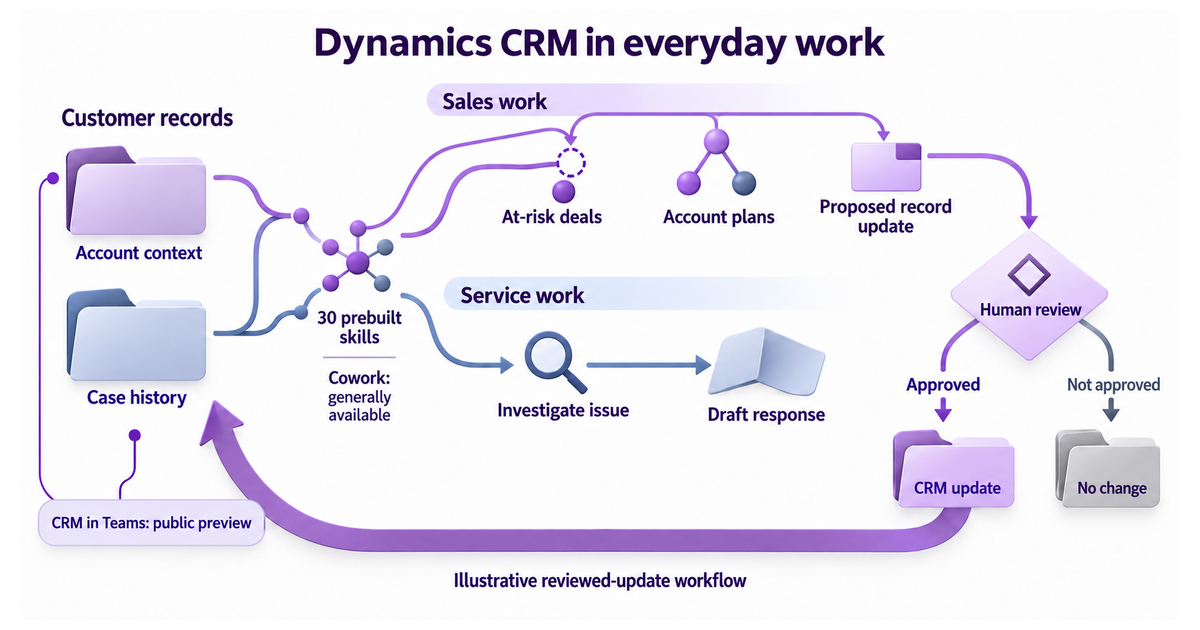
Summary: Microsoft's October 8 announcement moves customer relationship management data and work from a separate destination into Copilot and Teams. Thirty prebuilt Dynamics 365 skills let a seller surface at-risk opportunities, assemble account plans and propose CRM updates, while service colleagues can retrieve case history, investigate an issue and prepare a response without losing customer context. The source makes important availability distinctions: the skills are generally available in Cowork; Autopilot remains a private preview; Code is part of the Frontier Program; the connected Dynamics CRM-in-Teams experience is a public preview. At the process level, a Service Agent can carry selected work across business functions but escalate when judgment or approval is necessary. A Sales Development Agent can research and contact prospects and hand qualified opportunities to sellers; Microsoft lists it as a public preview, not broad general release. The effective design is a governed data-to-action path, not a generic conversational bot detached from its source of truth.
Why it matters: For a sales or service team, the most useful pilot may be narrow: retrieve one account’s trustworthy data, draft a suggested action, obtain human sign-off and record what changed in CRM. Measure avoided handoffs alongside data provenance, permissions and mistaken updates. Do not infer that preview features are already enabled for a particular tenant.
Source: Bringing CRM into the flow of work and agents into business process for sales and service teams
4. Intelligent UI turns an AI answer into a working interactive surface
Focus: Applied Generative AI for Knowledge Workers
Date: October 7, 2026
Topics: interactive responses, structured controls, visual reasoning, work surfaces
Evidence: Publisher Authored
Availability: Available
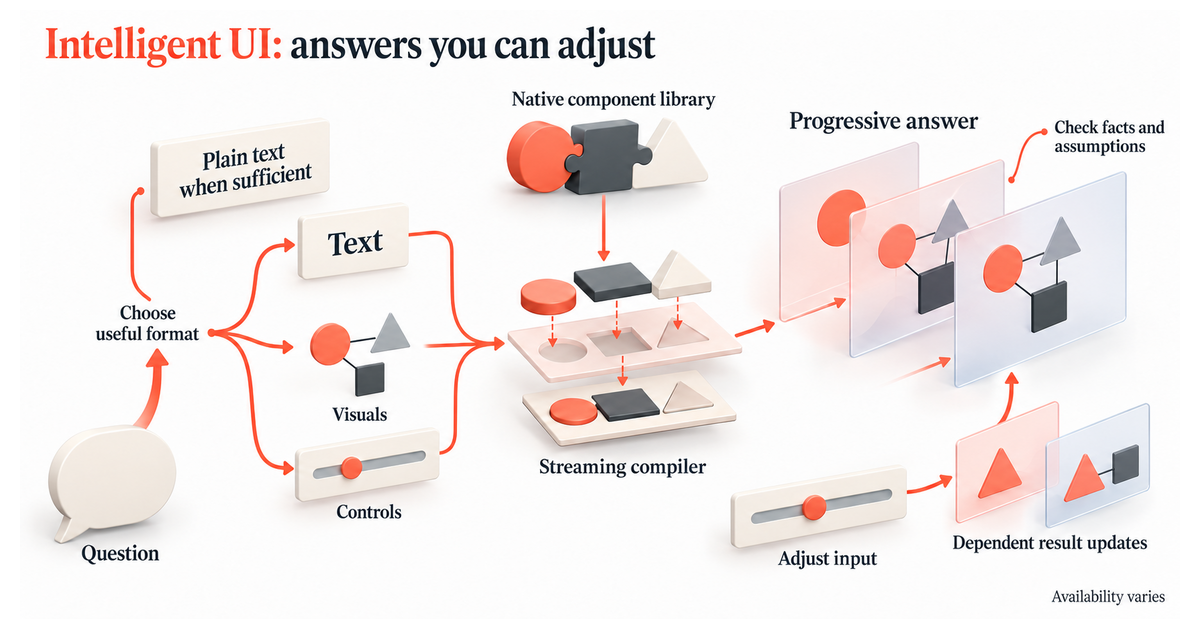
Summary: OpenAI introduced Intelligent UI with GPT-6 as an answer format that can combine written explanation with diagrams, structured comparisons and functioning controls. Instead of merely explaining how to configure a calculator or compare options, the assistant can present an interface tailored to the question, then let the reader manipulate the relevant inputs in place. The announcement emphasizes responsiveness: useful material can appear quickly while richer interactive elements are assembled. The important change is the boundary between model synthesis and user choice. An interface can make assumptions visible and support direct exploration, but the user still needs to inspect source facts, parameters and computed outputs. Some responses remain better as plain prose; visual interaction is not itself a quality guarantee. Rollout and feature availability can vary by plan and release stage, so the example should not imply every account gets identical controls immediately.
Why it matters: Knowledge workers often lose time copying AI recommendations into spreadsheets, comparison sheets or little calculation tools. Ask for a compact decision surface that exposes the actual inputs, then vary a key assumption and confirm that dependent outputs update coherently. Save the underlying methodology, not only the attractive presentation. The test is whether interaction makes a decision more auditable and faster.
Source: GPT-6 and Intelligent UI for everyone
5. AQuA watches live agent failures without becoming another tool in the agent
Focus: Technical AI Engineering
Date: October 8, 2026
Topics: agent observability, failure clustering, production diagnosis, trace evidence
Evidence: Publisher Authored
Availability: Available
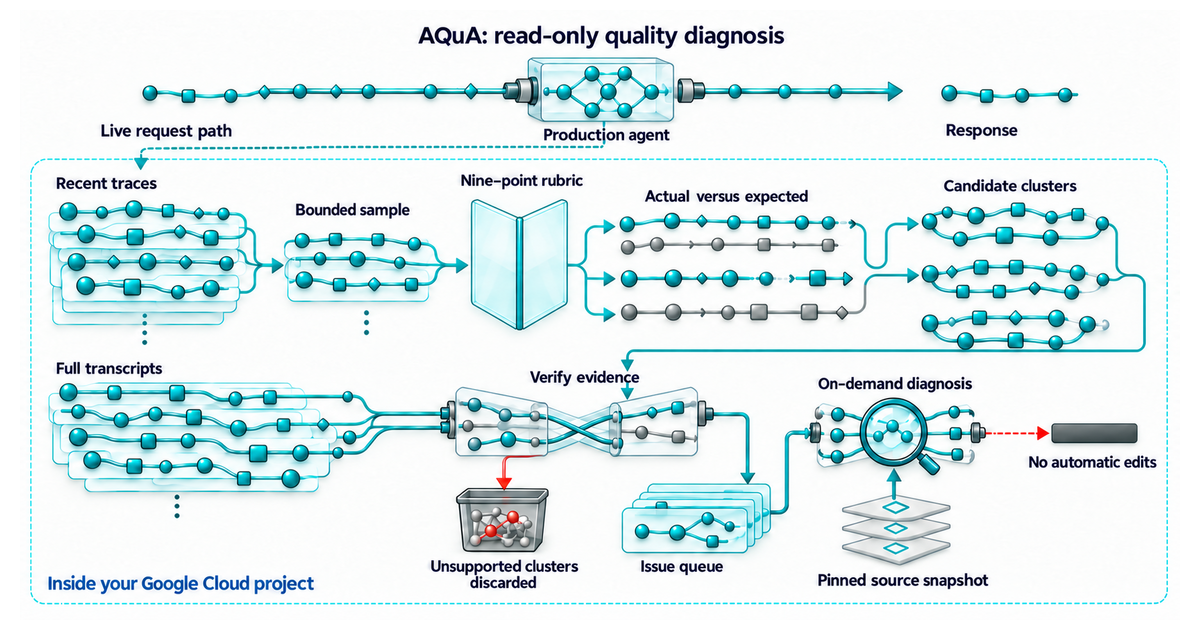
Summary: Google Developers describes AQuA, an ambient quality agent positioned outside an application agent’s live request path. Instead of asking the production agent to grade itself, AQuA takes a bounded sample of recent execution trajectories from Cloud Trace, Cloud Logging, or BigQuery, checks them against a nine-point quality rubric, groups the suspicious behaviors into recurring patterns, and verifies representative transcripts before reporting actionable issues. A targeted diagnosis can then compare a confirmed pattern with the deployed source snapshot. The architecture is deliberately read-only: underlying customer traces and source code stay within the organization’s Google Cloud project, and the observer does not change the running agent. In its reported scripted test, 32 replayed sessions yielded 27 failures, 42 initial findings, nine candidate clusters, and six remaining issues after three were rejected on inspection. Those figures describe the authors’ bounded example, not a universal accuracy benchmark. AQuA is best understood as an external quality-investigation pattern that produces human-reviewable evidence, not a guarantee that silent failures are eliminated.
Why it matters: An agent can return an apparently helpful answer while losing a requirement, taking a wrong tool path, or repeating a costly mistake. Separating the diagnostic loop from production prevents the evaluator from silently changing the system it measures. For a pilot, choose a small representative trace sample, define quality criteria, require reviewed examples for each error class, and track whether a confirmed issue recurs after a release.
Source: The Outer Loop, Insights First: An Ambient Quality Agent That Diagnoses Your Production Agent
6. Copilot local sandboxing makes agent tool permissions an OS-level boundary
Focus: Technical AI Engineering
Date: October 7, 2026
Topics: agent security, sandbox policy, tool execution, filesystem and network permissions
Evidence: Publisher Authored
Availability: Available
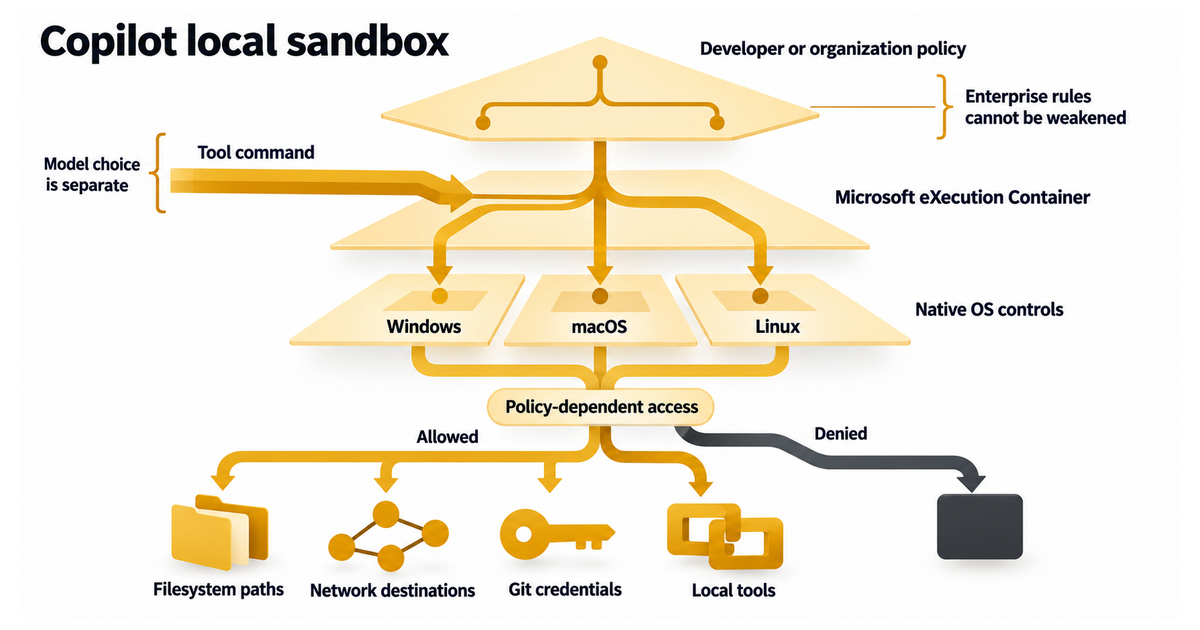
Summary: GitHub says local sandboxing is now generally available in Copilot CLI, the GitHub Copilot application, and VS Code Agent Host sessions. The mechanism places a developer- or administrator-defined access policy between agent-generated tool commands and the resources those commands would touch. Filesystem paths, internet and local-network destinations, Git credentials, and selected tools can be allowed or denied. Microsoft eXecution Container translates the shared policy into native operating-system enforcement on Windows, macOS, and Linux. Enterprise-managed settings can require sandboxing and prevent an individual developer from weakening the rules. The key architectural distinction is that restricting tool execution is independent of which language model produces the tool call: a capable model still runs inside the same boundary. A sandbox does not mean every output is correct, and policy quality still matters. This is a local execution protection, not evidence that every remote cloud-agent or third-party integration is automatically covered.
Why it matters: As coding assistants execute real commands, a prompt instruction alone is not a credible access-control boundary. Teams can start by enumerating writable project folders, credential access, allowed network destinations and MCP tools, then test deliberate denied operations. Pair this containment with read-only execution auditing and quality review rather than treating sandbox enforcement as a complete safety system.
Source: Local sandboxing for GitHub Copilot now generally available
Worth Watching
7. General
Introducing the Decisions API
Open the permanent video page
Channel: OpenAI
Date: October 6, 2026
Duration: 5:34
Format: Video
Summary: OpenAI's 5:34 official demo shows text and image inputs being classified into a deliberately bounded set of actions. It includes lead-routing, real-time visual choices and live-interaction examples; application logic acts on the selected decision rather than asking a general chatbot to invent unrestricted commands.
Why it matters: A useful companion to the sandbox story: the model selects within a small defined action space while other controls determine what execution is actually permitted. This is a demonstration, not independent production-latency benchmarking.
Source: Watch on YouTube
8. Agents for Everyone
Build custom site annotations with ChatGPT
Open the permanent video page
Channel: OpenAI
Date: October 7, 2026
Duration: 2:35
Format: Video
Summary: A 2:35 OpenAI how-to on adding custom site annotation controls and suggested questions to a website. It shows the practical shift from a generic chat bubble toward a contextual reader interface with task-relevant prompts and interaction.
Why it matters: Connects Intelligent UI to a small, concrete application: specify which actions a reader needs, expose them where the context lives, and evaluate whether the controls reduce friction. A short demonstration does not establish broad production suitability.
Source: Watch on YouTube
Worth Listening — Podcasts
9. Switching Models Shouldn't Mean Starting Over | Walrus Protocol's Kimberly Logan
Open the permanent podcast page
Show: Chain of Thought
Host / guest: Not listed
Focus: Agents for Everyone
Date: October 7, 2026
Duration: 38:00
Topics:
Summary: Episode 77, with host Conor Bronsdon and Walrus Foundation product lead Kimberly Logan, examines why portable agent memory remains difficult even with large context windows. The conversation separates a point-in-time export from maintaining memory across models and agent harnesses, and examines storage provenance, verifiability, and the trade-offs of decentralized memory. Walrus sponsors the episode; product claims are presented as guest claims, not independently validated outcomes.
Why it matters: Context portability is an architectural concern whenever a personal or enterprise assistant is expected to outlive a model switch. Readers should distinguish exported chat logs from durable, structured, permissioned and testable memory before committing a workflow to one vendor.
Connection to the brief: Context portability is an architectural concern whenever a personal or enterprise assistant is expected to outlive a model switch. Readers should distinguish exported chat logs from durable, structured, permissioned and testable memory before committing a workflow to one vendor.
Coverage: Selected for this edition.
Listen / watch: Chain of Thought
10. The Best Way to Test New AI Models
Open the permanent podcast page
Show: The AI Daily Brief
Host / guest: Not listed
Focus: Agents for Everyone
Date: October 7, 2026
Duration: 49:49
Topics:
Summary: Nathaniel Whittemore and guest Nufar Gaspar offer a practical operator's approach to choosing among the many new models: define four to six representative work tasks, include a wish-list challenge, compare models or agent harnesses blindly in fresh sessions, score outputs, and decide whether to switch, split work across tools or stay put. The discussion covers speed, cost, quality bias, repeatability and the problem of evaluating a rendered visual result from source code alone. Sponsor material and subjective model rankings are not treated as independent evidence of model superiority.
Why it matters: A professional can learn more by testing a candidate against their own failure-sensitive tasks than by adopting each benchmark winner. The repeatable procedure gives a concrete way to compare agents with consistent inputs and reveal trade-offs in cost, latency, judgment and quality.
Connection to the brief: A professional can learn more by testing a candidate against their own failure-sensitive tasks than by adopting each benchmark winner. The repeatable procedure gives a concrete way to compare agents with consistent inputs and reveal trade-offs in cost, latency, judgment and quality.
Coverage: Selected for this edition.
Listen / watch: The AI Daily Brief
Emerging AI Watchlist
2 new today · 3 updated · 20 carried forward. 2 archived / dropped recently.
New today:
- Ambient agent quality investigation
- Question-to-live-dashboard work surfaces
Updated today:
- Agent safeguards tailored to the task
- Reusable agent skills become observable
- Interactive answer surfaces
Carried forward: 20
Archived / dropped recently:
- Agentic workloads move toward measured edge inference — The new Decisions API video offers an interesting demonstration, but the available evidence does not supply an independent cross-system latency benchmark worthy of a separate watch item.
- Review-before-action in professional AI — The pattern is now integrated into the broader agent-governance topic instead of duplicated as a separate monitoring card.
Help choose what we investigate next. Explore emerging ideas and tell us which interest you.
Editorial takeaway
An agent can return an apparently helpful answer while losing a requirement, taking a wrong tool path, or repeating a costly mistake. Separating the diagnostic loop from production prevents the evaluator from silently changing the system it measures. For a pilot, choose a small representative trace sample, define quality criteria, require reviewed examples for each error class, and track whether a confirmed issue recurs after a release.