Intelligent UI turns an AI answer into a working interactive surface
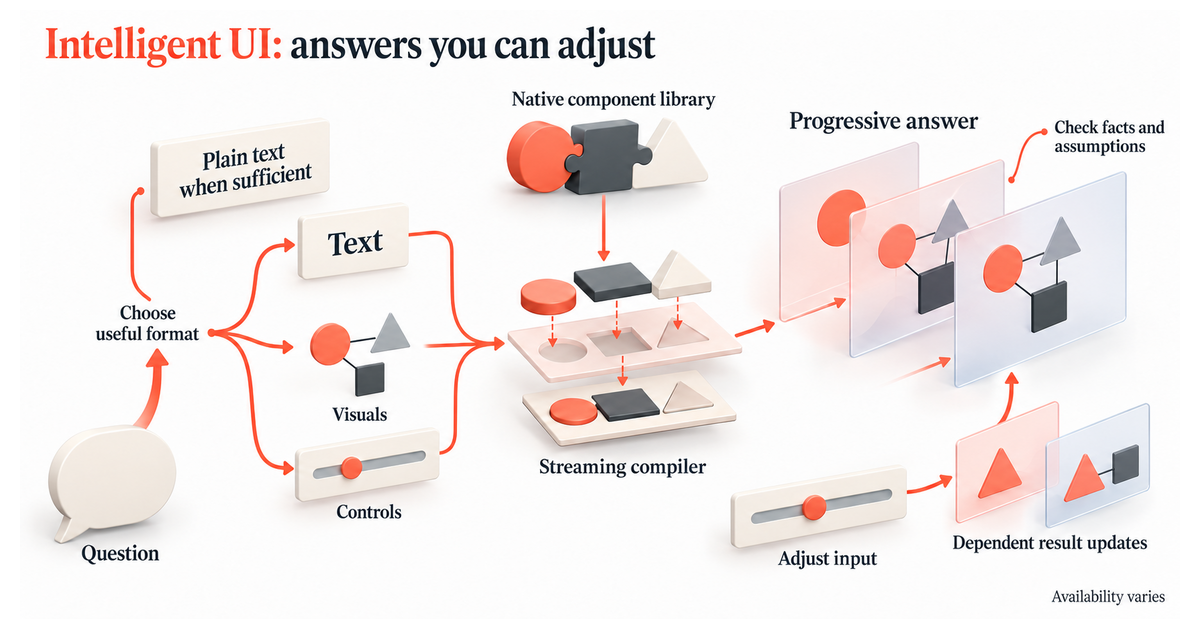
OpenAI introduced Intelligent UI with GPT-6 as an answer format that can combine written explanation with diagrams, structured comparisons and functioning controls. Instead of merely explaining how to configure a calculator or compare options, the assistant can present an interface tailored to the question, then let the reader manipulate the relevant inputs in place. The announcement emphasizes responsiveness: useful material can appear quickly while richer interactive elements are assembled. The important change is the boundary between model synthesis and user choice. An interface can make assumptions visible and support direct exploration, but the user still needs to inspect source facts, parameters and computed outputs. Some responses remain better as plain prose; visual interaction is not itself a quality guarantee. Rollout and feature availability can vary by plan and release stage, so the example should not imply every account gets identical controls immediately.
Intelligent UI turns an AI answer into a working interactive surface
Focus: Applied Generative AI for Knowledge Workers Date: October 7, 2026 Topics: interactive responses, structured controls, visual reasoning, work surfaces Evidence: Publisher Authored Availability: Available
Summary: OpenAI introduced Intelligent UI with GPT-6 as an answer format that can combine written explanation with diagrams, structured comparisons and functioning controls. Instead of merely explaining how to configure a calculator or compare options, the assistant can present an interface tailored to the question, then let the reader manipulate the relevant inputs in place. The announcement emphasizes responsiveness: useful material can appear quickly while richer interactive elements are assembled. The important change is the boundary between model synthesis and user choice. An interface can make assumptions visible and support direct exploration, but the user still needs to inspect source facts, parameters and computed outputs. Some responses remain better as plain prose; visual interaction is not itself a quality guarantee. Rollout and feature availability can vary by plan and release stage, so the example should not imply every account gets identical controls immediately.
Why it matters: Knowledge workers often lose time copying AI recommendations into spreadsheets, comparison sheets or little calculation tools. Ask for a compact decision surface that exposes the actual inputs, then vary a key assumption and confirm that dependent outputs update coherently. Save the underlying methodology, not only the attractive presentation. The test is whether interaction makes a decision more auditable and faster.