Daily Generative AI Brief — October 16, 2026
Published: October 16, 2026
Coverage period: October 7–15, 2026
IN THIS EDITION · 6 ARTICLES / 2 VIDEOS / 2 PODCASTS
Choose what matters to your work
- Build an Agent Skill that tests autonomy boundaries before deploymentArticle · about 6 min source read
- Five production lessons turn agent enthusiasm into measurable decisionsArticle · about 5 min source read
- Gemini can query federated enterprise catalogs without moving the dataArticle · about 7 min source read
- A curriculum-grounded assistant was shaped through teacher-led pilotsArticle · about 8 min source read
- GitHub's AI Scan adds advisory vulnerability findings to pull requestsArticle · about 1 min source read
- Agentic autofix couples security repairs with a fresh CodeQL checkArticle · about 2 min source read
- Navigating AI automation in Looker: Essential developer tools for agentsVideo · 5:55
- Production Monitoring with Codex: Grafana, Kubernetes, & SecurityVideo · 7:59
- Can Open Models Keep Up With the AI Frontier? | Nathan LambertPodcast · 1:00:00
- The AGORÀ Briefing — Wednesday, October 14, 2026Podcast · 8:00
1. Build an Agent Skill that tests autonomy boundaries before deployment
Focus: Agents for Everyone
Date: October 15, 2026
Topics: Agent Skills, Autonomy boundaries, Human escalation
Evidence: Publisher Authored
Availability: Available
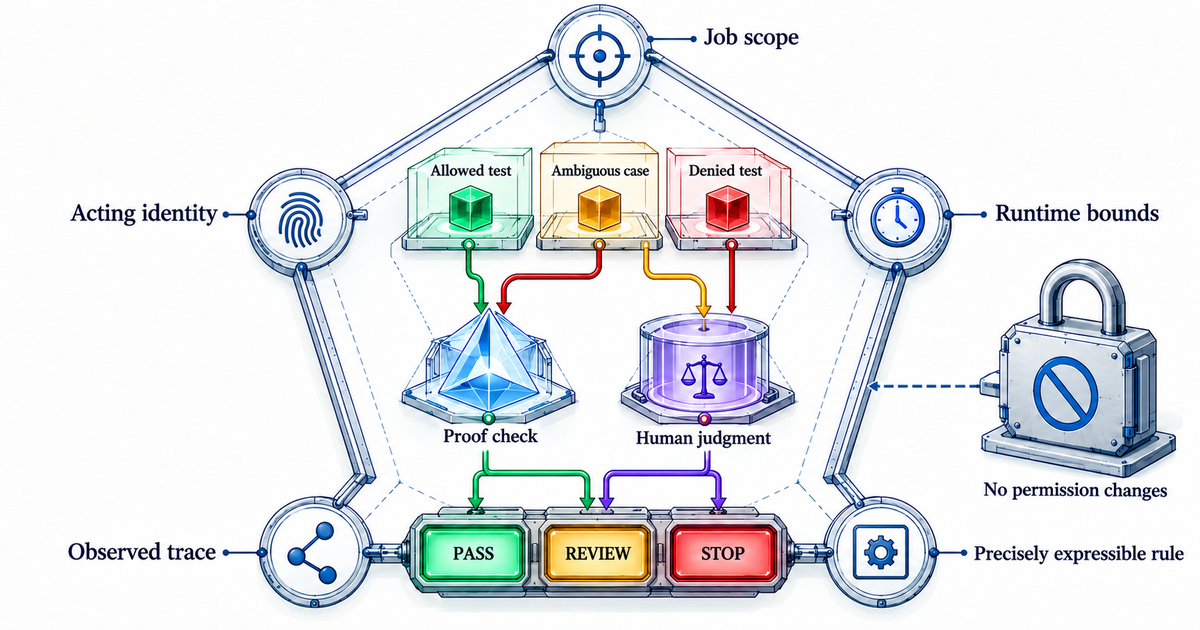
Summary: AWS proposes five layers for trustworthy agents: scope the job, know the acting identity, bound runtime actions, observe completed work and prove precisely expressible rules. Those layers support a reusable predeployment Agent Skill. The Skill should inventory tools and data, convert boundaries into test cases, identify ambiguous decisions, and produce a human-reviewed autonomy recommendation without changing permissions.
Why it matters: Run the Skill on one low-risk workflow before granting broader access. Verify an allowed action, a denied action and an ambiguous case requiring escalation. Preserve the evidence and assumptions; formal checks cannot prove subjective rules or incomplete system descriptions.
Source: Trust in Depth: Giving agents more autonomy without losing control
2. Five production lessons turn agent enthusiasm into measurable decisions
Focus: Agents for Everyone
Date: October 15, 2026
Topics: Production readiness, Agent evaluation, Phased rollout
Evidence: Publisher Authored
Availability: Available
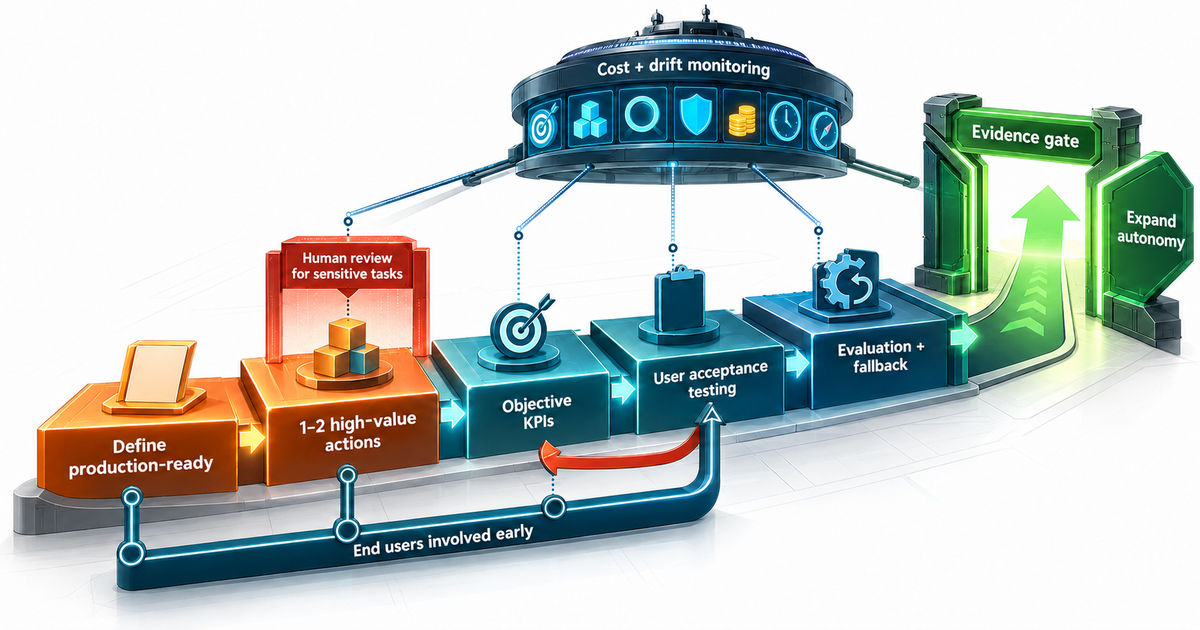
Summary: Google Cloud Consulting recommends defining production readiness before coding, restricting initial agents to one or two valuable actions, and replacing vague helpfulness goals with measurable task, error and latency criteria. The guidance also budgets time for user acceptance testing, involves employees early, phases sensitive actions behind review, and monitors cost, drift, infrastructure health and fallback behavior.
Why it matters: A small team can translate these lessons into a launch scorecard: named users, bounded actions, target completion and error rates, a test calendar, escalation owners and a cost ceiling. Expand autonomy only after observed results meet the agreed thresholds.
Source: Five lessons from Google Cloud Consulting for moving agents into production
3. Gemini can query federated enterprise catalogs without moving the data
Focus: Applied Generative AI for Knowledge Workers
Date: October 15, 2026
Topics: Federated analytics, Natural language queries, Data access controls
Evidence: Publisher Authored
Availability: Available
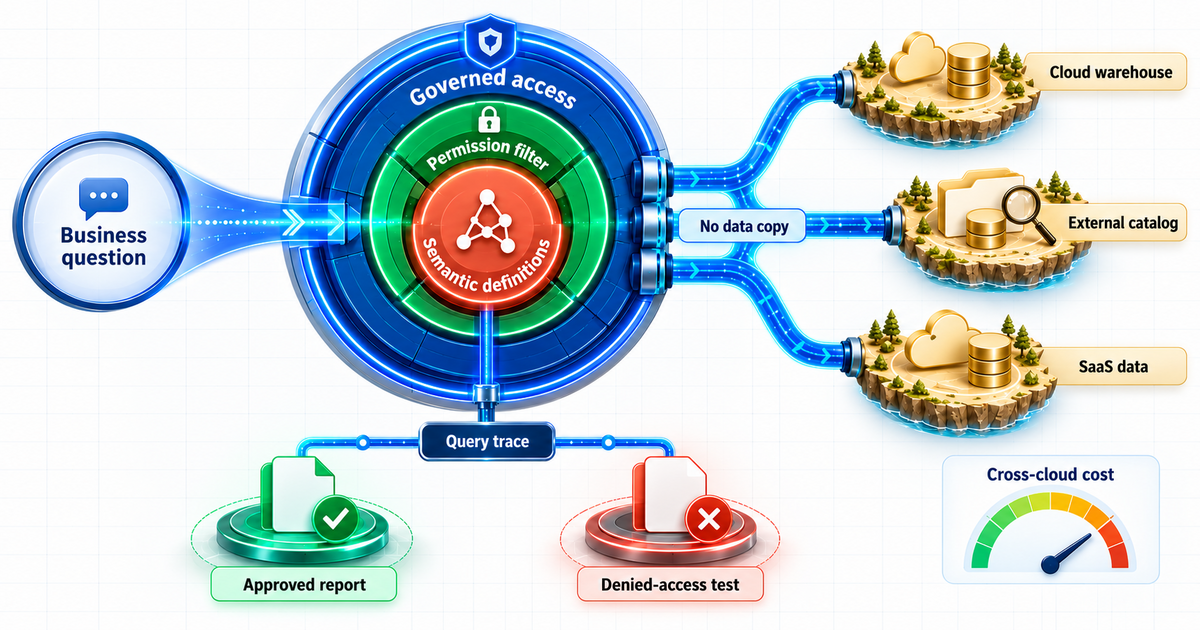
Summary: Google Cloud previewed direct Gemini access to its borderless Lakehouse, including catalog federation with Databricks Unity Catalog and Snowflake Horizon. Business users can ask natural-language questions across configured data sources without first copying records into one store. The architecture expands reach, but permissions, semantic consistency, cross-cloud costs and answer validation still determine whether a report is trustworthy.
Why it matters: Begin with one governed question whose correct result is already known. Limit catalogs and columns, record the generated query, compare totals with an approved report, and test denied access. Federation reduces copying; it does not resolve meaning or authorization automatically.
Source: Bringing the borderless Lakehouse into the agentic era with innovations for Gemini
4. A curriculum-grounded assistant was shaped through teacher-led pilots
Focus: Applied Generative AI for Knowledge Workers
Date: October 15, 2026
Topics: Curriculum grounding, Teacher co-design, Editable lesson materials
Evidence: Publisher Authored
Availability: Available
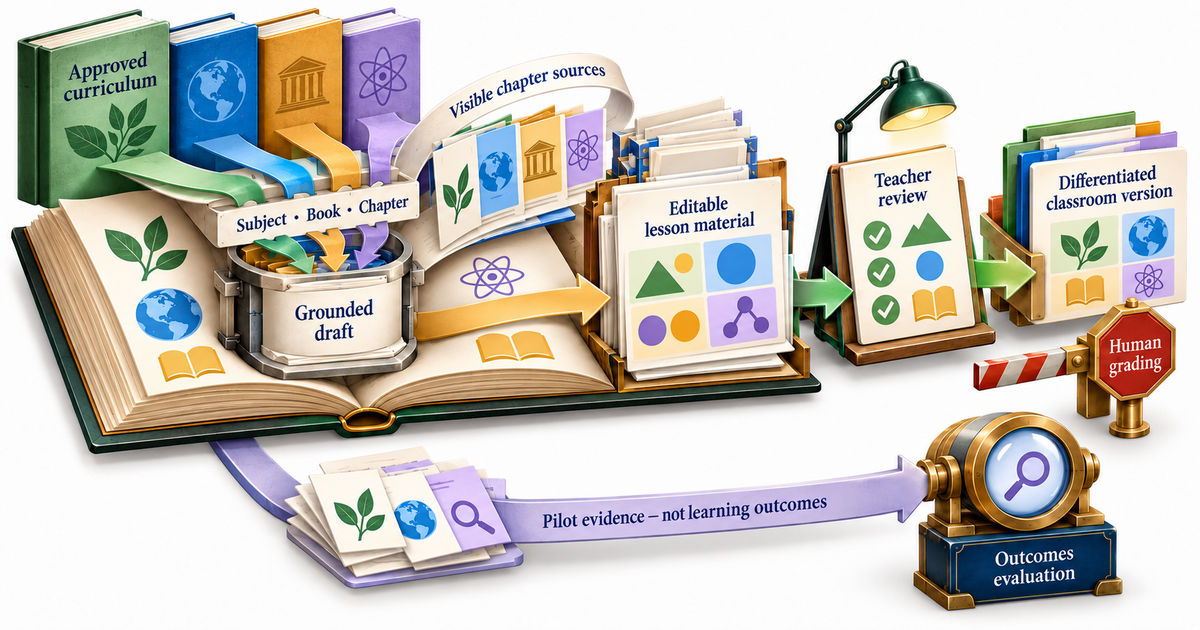
Summary: AWS describes Sanoma Learning's Sanna assistant, which grounds lesson plans, exercises and tests in selected textbooks and exposes source chapters for checking. Sanoma involved teachers through interviews, diary studies and a 1,500-person classroom pilot across seven countries. Reported adoption and quality figures come from the vendor-customer case study, not an independent learning-outcomes evaluation.
Why it matters: Knowledge teams can borrow the pattern: ground drafts in approved materials, expose citations, make outputs editable and involve users before rollout. Evaluate factual quality and downstream outcomes separately from satisfaction, while keeping consequential judgments with qualified professionals.
Source: Built with teachers, powered by AWS: How Sanoma Learning created Sanna, its AI teacher assistant
5. GitHub's AI Scan adds advisory vulnerability findings to pull requests
Focus: Technical AI Engineering
Date: October 15, 2026
Topics: Advisory security scans, Pull request review, CodeQL coverage
Evidence: Publisher Authored
Availability: Available
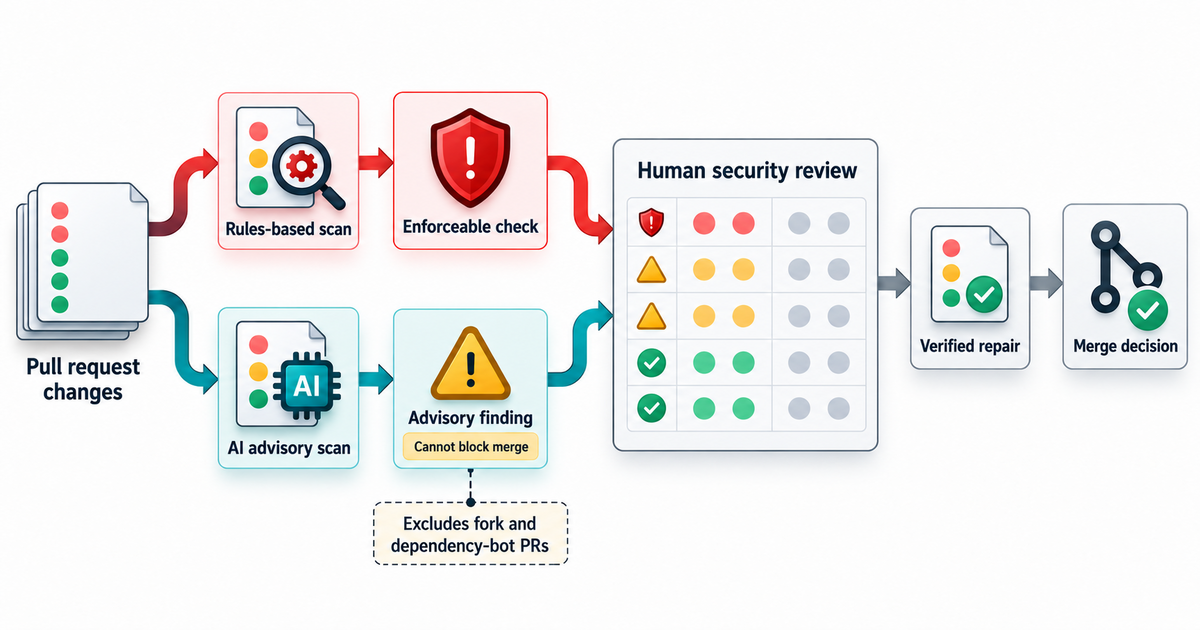
Summary: GitHub made AI Scan generally available for pull requests, adding model-generated security findings beside CodeQL results for languages and frameworks outside current CodeQL coverage. Findings can explain risk and suggest a repair, but they remain advisory: they cannot fail the check, block merges, inspect forked contributions, or scan Dependabot pull requests.
Why it matters: Security teams should measure precision, missed defects and reviewer workload before treating AI Scan as a control. Keep enforceable CodeQL and ruleset gates, label AI findings clearly, and require human verification of every suggested fix before merging.
Source: AI Scan for pull requests generally available
6. Agentic autofix couples security repairs with a fresh CodeQL check
Focus: Technical AI Engineering
Date: October 15, 2026
Topics: Security repair loops, CodeQL validation, Draft pull requests
Evidence: Publisher Authored
Availability: Available
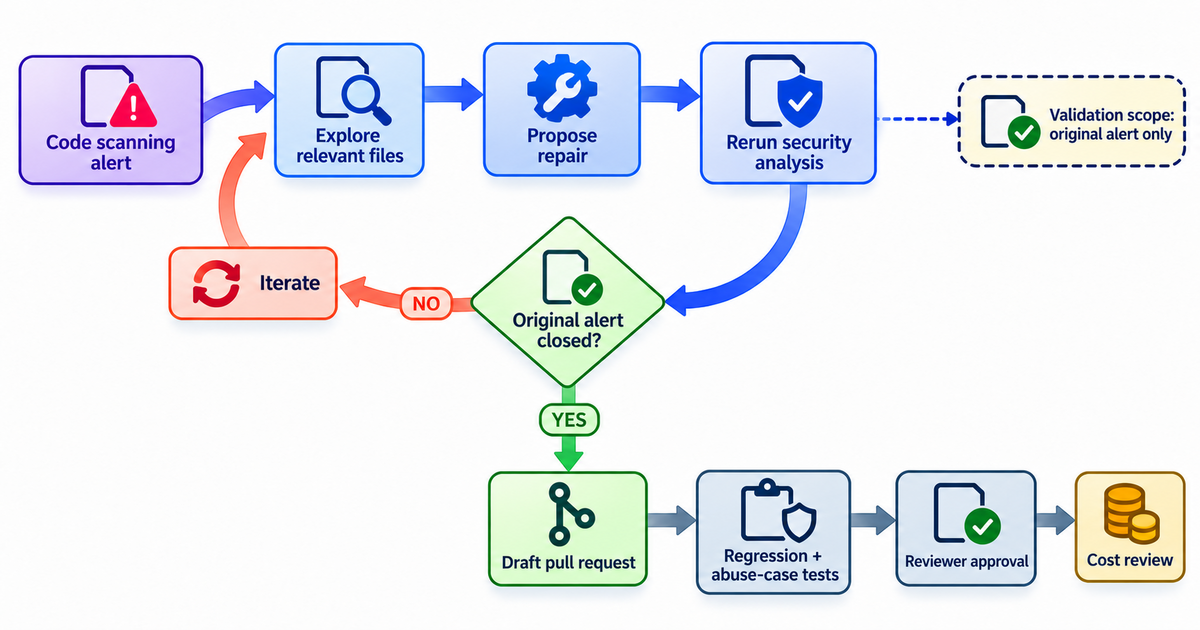
Summary: GitHub's agentic autofix now explores relevant repository files, proposes a repair, reruns CodeQL, and iterates before opening a draft pull request. Teams may assign one alert or batch up to twenty-five default-branch alerts. The validation confirms that CodeQL closes the original alert, not that the patch preserves every behavior or removes unrelated risks.
Why it matters: Treat the generated pull request as evidence to review, not a finished remediation. Run regression and abuse-case tests, inspect permission and dependency changes, confirm the alert's root cause, and track AI-credit and Actions-minute costs before scaling.
Source: Agentic autofix for code scanning alerts general availability
Worth Watching
7. General
Navigating AI automation in Looker: Essential developer tools for agents
Open the permanent video page
Channel: Google Cloud Tech official video
Date: October 8, 2026
Duration: 5:55
Format: Video
Summary: Google Cloud developer advocate Chrissie Goodrich distinguishes five pieces of an agent-ready Looker developer stack: Looker Skills, command-line access, a managed MCP server, a database MCP toolbox and the VS Code extension. The video outlines how metadata-driven instructions can limit context load while service-account permissions govern tool access. Its practical lesson is to separate reusable analytic procedures from actual data authorization and independently verify calculations in LookML. The synopsis uses published caption-derived analysis, not playback.
Why it matters: Use narrow service accounts, explicit schemas and validation when adding Looker business intelligence tools to AI agents.
Source: Watch on YouTube
8. Agents for Everyone
Production Monitoring with Codex: Grafana, Kubernetes, & Security
Open the permanent video page
Channel: OpenAI official YouTube video
Date: October 7, 2026
Duration: 7:59
Format: Video
Summary: OpenAI presenters walk through three bounded production-response scenarios: a checkout failure correlated with Grafana and recent changes, a Kubernetes rollout with out-of-memory restarts, and shared-worker exhaustion treated as an availability issue. The segment emphasizes reconstructing evidence before proposing patches, human review before high-impact changes, and replay-based validation after remediation. These are demonstrations, not independent incident-resolution benchmarks; summary derives from a complete indexed original-language transcript, not watched playback.
Why it matters: Use telemetry and change history as controlled context, then review and regression-test each suggested operational patch.
Source: Watch on YouTube
Worth Listening — Podcasts
9. Can Open Models Keep Up With the AI Frontier? | Nathan Lambert
Open the permanent podcast page
Show: The a16z Show / Andreessen Horowitz
Host / guest: Not listed
Focus: Agents for Everyone
Date: October 14, 2026
Duration: 1:00:00
Topics:
Summary: In a discussion hosted by a16z partner Lisha Li, researcher Nathan Lambert contrasts closed frontier labs' infrastructure and capital advantages with open-model builders' ability to adapt techniques. They examine compute constraints, distillation, reinforcement-learning environments and the changing economics of post-training. Lambert also explains Trillium's ambition to make training environments and evaluations more accessible, while acknowledging uncertainty about self-improvement. The episode helps practitioners assess customization costs rather than treating open-weight availability as equivalent to frontier reliability; audio was not played.
Why it matters: Frame model choices around compute, maintainability, adaptation budgets and independent task-specific evaluation, not benchmark rankings alone.
Connection to the brief: Frame model choices around compute, maintainability, adaptation budgets and independent task-specific evaluation, not benchmark rankings alone.
Coverage: Selected for this edition.
Listen / watch: The a16z Show / Andreessen Horowitz
10. The AGORÀ Briefing — Wednesday, October 14, 2026
Open the permanent podcast page
Show: AGORÀ Intelligence — The Briefing
Host / guest: Not listed
Focus: Agents for Everyone
Date: October 14, 2026
Duration: 8:00
Topics:
Summary: AGORÀ Intelligence's October 14 briefing assembles five reported developments spanning economic conditions for AI investment, a customer-service bot designed as an agent, workplace trust questions, AI gateway access weaknesses and Asia-Pacific enterprise partnership announcements. Its publisher notes list these as individual topics without establishing the underlying claims as independently verified here. For knowledge workers the useful exercise is to separate announcements, operational risks and macroeconomic forecasts, then follow each primary source before adopting a workflow. No listening claimed.
Why it matters: Scan varied AI business risks rapidly, but verify each individual reported incident or commercial claim at its original source.
Connection to the brief: Scan varied AI business risks rapidly, but verify each individual reported incident or commercial claim at its original source.
Coverage: Selected for this edition.
Listen / watch: AGORÀ Intelligence — The Briefing
Emerging AI Watchlist
3 new today · 2 updated · 23 carried forward. 2 archived / dropped recently.
New today:
- Advisory AI pull-request security scanning
- Code scanning agent repair loops
- Curriculum-grounded professional assistants
Updated today:
- Audited long-form business reasoning
- Consumer agent task permissions
Carried forward: 23
Archived / dropped recently:
- Reproducible agent workflow dependencies — No separate October 15 lockfile development was verified, so the October 14 preview moves to monitored history.
- Document extraction instruction feedback — No new October 15 implementation evidence was found, while today's edition prioritizes newly documented controls and deployments.
Help choose what we investigate next. Explore emerging ideas and tell us which interest you.
Editorial takeaway
Security teams should measure precision, missed defects and reviewer workload before treating AI Scan as a control. Keep enforceable CodeQL and ruleset gates, label AI findings clearly, and require human verification of every suggested fix before merging.