← Daily Brief for October 26, 2026
OpenAI explains how Habitat rebalanced storage for more than one billion users
Focus: Technical AI Engineering
Date: October 23, 2026
Topics: Storage scaling, Tenant isolation, Regional latency
Evidence: Publisher Authored
Availability: Available
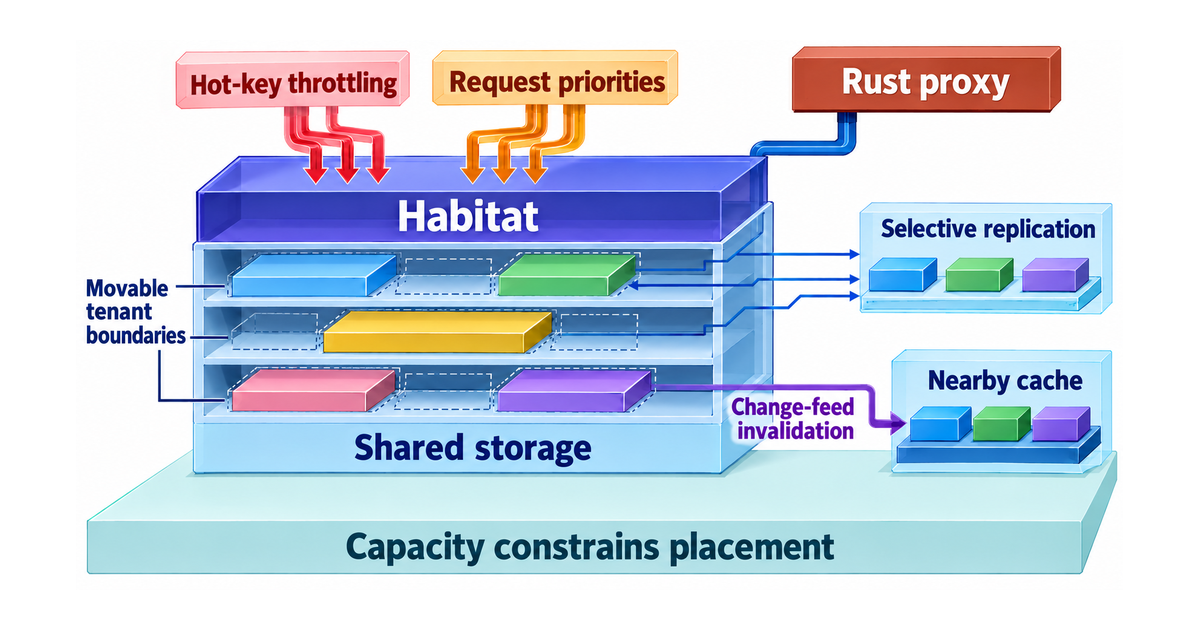
Summary: OpenAI describes evolving Habitat, its application-storage platform, to serve more than one billion users across 40 regions on Azure Cosmos DB. The team moved from fixed tenant placement toward multi-tenancy with data movement, hot-key controls, quality-of-service policies, selective replication, integrated caching and a Rust proxy, while documenting tradeoffs rather than a universal blueprint.
Why it matters: You will learn a staged response to uneven AI-product growth: measure noisy neighbors, preserve movable tenant boundaries, place latency-sensitive data selectively and reduce proxy overhead only after workload evidence. The architecture offers decisions to test, not a copy-ready configuration.
Source: Rapidly scaling online storage to serve over 1 billion ChatGPT users (Part II)