Build a reusable Agent Skill with a guarded, testable procedure
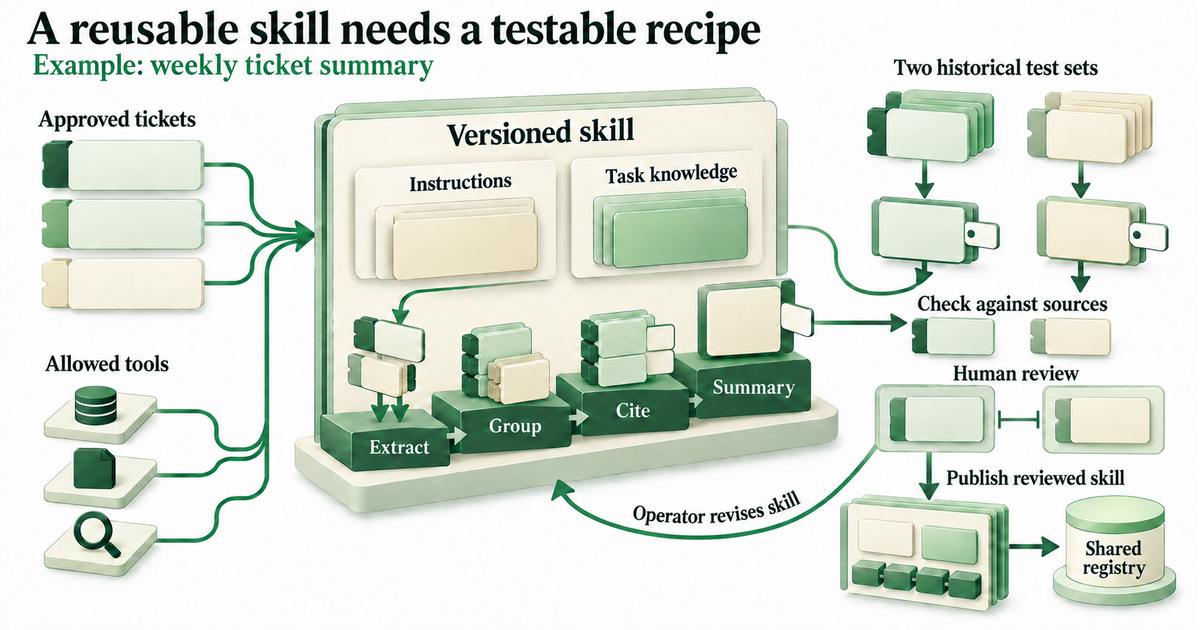
Google's October 8 Gemini at Work announcement gives a concrete mechanism for turning an ad-hoc AI request into a reusable Agent Skill. A skill is a modular prompt containing instructions, task knowledge and a multi-step procedure; the platform describes personal, shared-company and global skill libraries along with a governed tool registry. That means a recurring task should specify more than a clever sentence. For example, a weekly customer-issue summary skill can define an eligible input folder, allowed support-data fields, the sequence for grouping recurring issues, a rule to cite exact ticket references, a fixed output template and a final human approval point. The agent can retrieve appropriate authorized tools and repeat the procedure while session, semantic, procedural and episodic memory support different forms of continuity. A sensible operator would first run the skill against two historical ticket sets, compare its grouped findings with source records, remove unauthorized actions and only then publish a versioned shared skill. This is a practical how-to follow-on to the prior Brief's announcement coverage—not a second claim that Gemini Skills were launched again on October 10. Google describes these capabilities, but availability, permissions and reliability vary by organization.
Build a reusable Agent Skill with a guarded, testable procedure
Focus: Agents for Everyone Date: October 8, 2026 Topics: agent skills, reusable workflow prompts, tool permissions, procedural memory, human approval Evidence: Publisher Authored Availability: Available
Summary: Google's October 8 Gemini at Work announcement gives a concrete mechanism for turning an ad-hoc AI request into a reusable Agent Skill. A skill is a modular prompt containing instructions, task knowledge and a multi-step procedure; the platform describes personal, shared-company and global skill libraries along with a governed tool registry. That means a recurring task should specify more than a clever sentence. For example, a weekly customer-issue summary skill can define an eligible input folder, allowed support-data fields, the sequence for grouping recurring issues, a rule to cite exact ticket references, a fixed output template and a final human approval point. The agent can retrieve appropriate authorized tools and repeat the procedure while session, semantic, procedural and episodic memory support different forms of continuity. A sensible operator would first run the skill against two historical ticket sets, compare its grouped findings with source records, remove unauthorized actions and only then publish a versioned shared skill. This is a practical how-to follow-on to the prior Brief's announcement coverage—not a second claim that Gemini Skills were launched again on October 10. Google describes these capabilities, but availability, permissions and reliability vary by organization.
Why it matters: Readers can create a minimal reusable skill specification today: name and trigger; intended users; required and prohibited data; ordered steps; tool allowlist; source-citation rule; output schema; escalation condition; review owner; and version. Test it against realistic successes and edge cases before putting it in a team registry. The transferable idea is controlled procedural reuse, independent of whether the particular Google agent is enabled in one's organization.