Anthropic's OSS Scanner puts human triage behind AI-found flaws
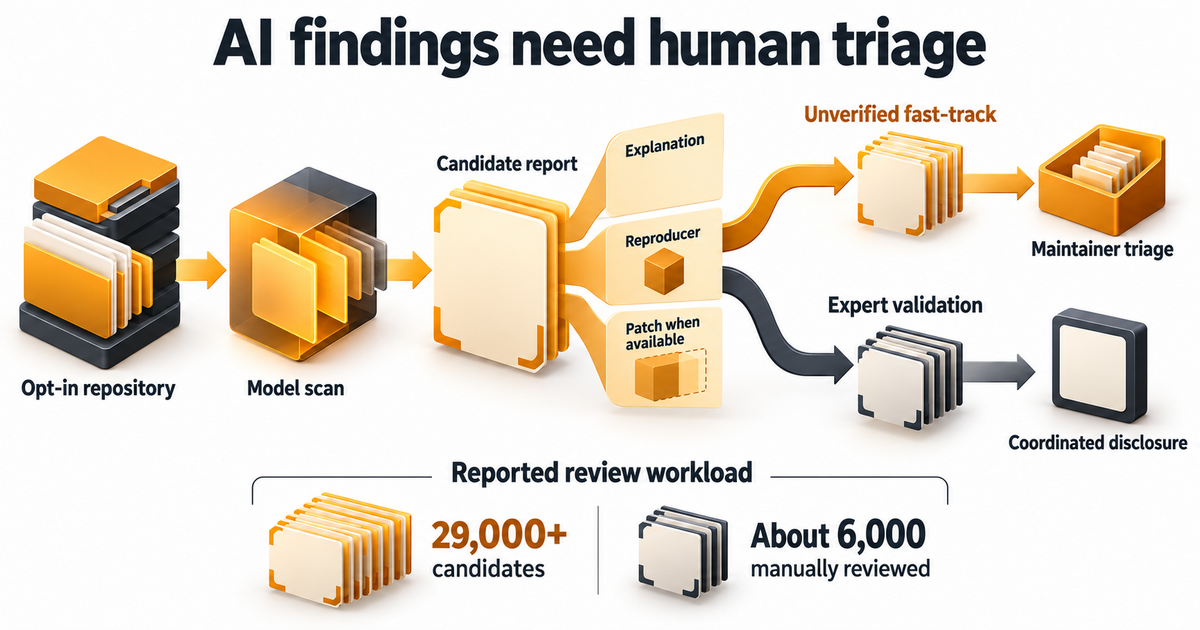
Anthropic's Frontier Red Team introduced OSS Scanner as a free, opt-in vulnerability-finding service for qualifying open-source maintainers. Its models can inspect code and produce candidate weaknesses, supporting detail and proposed patches, but candidate generation and trusted security disclosure are not the same thing. Anthropic reports identifying more than 29,000 candidate vulnerabilities during earlier scanning and manually reviewing roughly 6,000; those totals describe an enormous triage workload, not 29,000 confirmed exploitable flaws or a measured precision rate. The service offers maintainers a choice: request unverified candidate reports sooner and do their own triage, or use the established coordinated disclosure route for human-verified findings. The announcement notes that nearly 5,000 unvalidated reports had already been sent to maintainers who explicitly asked for the bulk findings. The key architecture is an evidence and responsibility boundary. An LLM can expand coverage and suggest reproductions; maintainers still have to reproduce, judge severity, decide whether a patch is safe and coordinate disclosure. This is not a warrant for publishing exploits or accepting an automated patch unreviewed.
Anthropic's OSS Scanner puts human triage behind AI-found flaws
Focus: Technical AI Engineering Date: October 8, 2026 Topics: AI-assisted security, open source, human validation, coordinated disclosure, workflow triage Evidence: Publisher Authored Availability: Available
Summary: Anthropic's Frontier Red Team introduced OSS Scanner as a free, opt-in vulnerability-finding service for qualifying open-source maintainers. Its models can inspect code and produce candidate weaknesses, supporting detail and proposed patches, but candidate generation and trusted security disclosure are not the same thing. Anthropic reports identifying more than 29,000 candidate vulnerabilities during earlier scanning and manually reviewing roughly 6,000; those totals describe an enormous triage workload, not 29,000 confirmed exploitable flaws or a measured precision rate. The service offers maintainers a choice: request unverified candidate reports sooner and do their own triage, or use the established coordinated disclosure route for human-verified findings. The announcement notes that nearly 5,000 unvalidated reports had already been sent to maintainers who explicitly asked for the bulk findings. The key architecture is an evidence and responsibility boundary. An LLM can expand coverage and suggest reproductions; maintainers still have to reproduce, judge severity, decide whether a patch is safe and coordinate disclosure. This is not a warrant for publishing exploits or accepting an automated patch unreviewed.
Why it matters: Open-source teams need a receipt-and-queue process before turning on automated security discovery. Require opt-in scope, confidentiality, reproducible evidence, issue deduplication, human validation and disclosure ownership. Track how often findings become confirmed remediations and how much reviewer effort they consume, rather than treating number of generated reports as success. Projects with limited triage capacity may benefit more from the slower verified route.