Oracle turns specialist knowledge into repeatable AI-assisted work
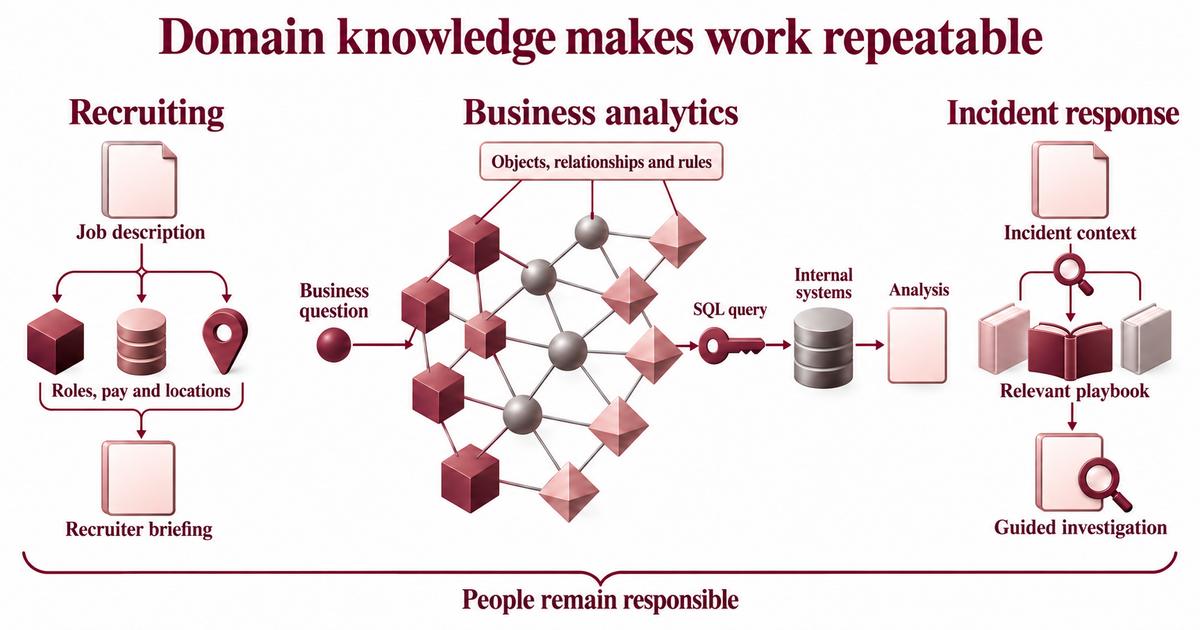
OpenAI's Oracle customer study describes how domain knowledge, tools and human review are combined into repeatable workplace procedures. In recruiting, a job description feeds a talent-market-intelligence workflow that compares roles, looks at compensation and assesses talent pools by geography. Oracle's hiring lead says preparation that previously took two to four days can now be done in about 15 to 20 minutes; that is a customer-reported case, not an independent controlled trial. The Oracle Applications Lab team also describes an ontology of company entities, relationships and rules that lets business users ask questions in plain language and have Codex translate their intent into appropriate SQL and reports. In operations, institutional playbooks and specialist expertise form context for incident investigation instead of requiring an employee to know where everything is stored. The connecting thread is not a new chat interface: inputs are typed by business purpose, data lives in an authoritative system, output formats are predictable, and employees remain responsible for use of sensitive data and decisions. The case illustrates several possible patterns without proving that every organization will achieve the same speed-up.
Oracle turns specialist knowledge into repeatable AI-assisted work
Focus: Applied Generative AI for Knowledge Workers Date: October 8, 2026 Topics: knowledge work, recruiting workflows, business ontology, text-to-SQL, enterprise context Evidence: Publisher Authored Availability: Available
Summary: OpenAI's Oracle customer study describes how domain knowledge, tools and human review are combined into repeatable workplace procedures. In recruiting, a job description feeds a talent-market-intelligence workflow that compares roles, looks at compensation and assesses talent pools by geography. Oracle's hiring lead says preparation that previously took two to four days can now be done in about 15 to 20 minutes; that is a customer-reported case, not an independent controlled trial. The Oracle Applications Lab team also describes an ontology of company entities, relationships and rules that lets business users ask questions in plain language and have Codex translate their intent into appropriate SQL and reports. In operations, institutional playbooks and specialist expertise form context for incident investigation instead of requiring an employee to know where everything is stored. The connecting thread is not a new chat interface: inputs are typed by business purpose, data lives in an authoritative system, output formats are predictable, and employees remain responsible for use of sensitive data and decisions. The case illustrates several possible patterns without proving that every organization will achieve the same speed-up.
Why it matters: Teams evaluating enterprise AI should identify a specific expensive preparatory task, inventory authoritative data and policy, and define what evidence a reviewer needs to trust the result. For recruiting, preserve market sources and date ranges; for analytics, validate the generated query against approved metrics; for incidents, check the retrieved playbook version before acting. Measure preparation time and error corrections together, not simply adoption.