Asana's browser-agent tests show why stable context can slash costs
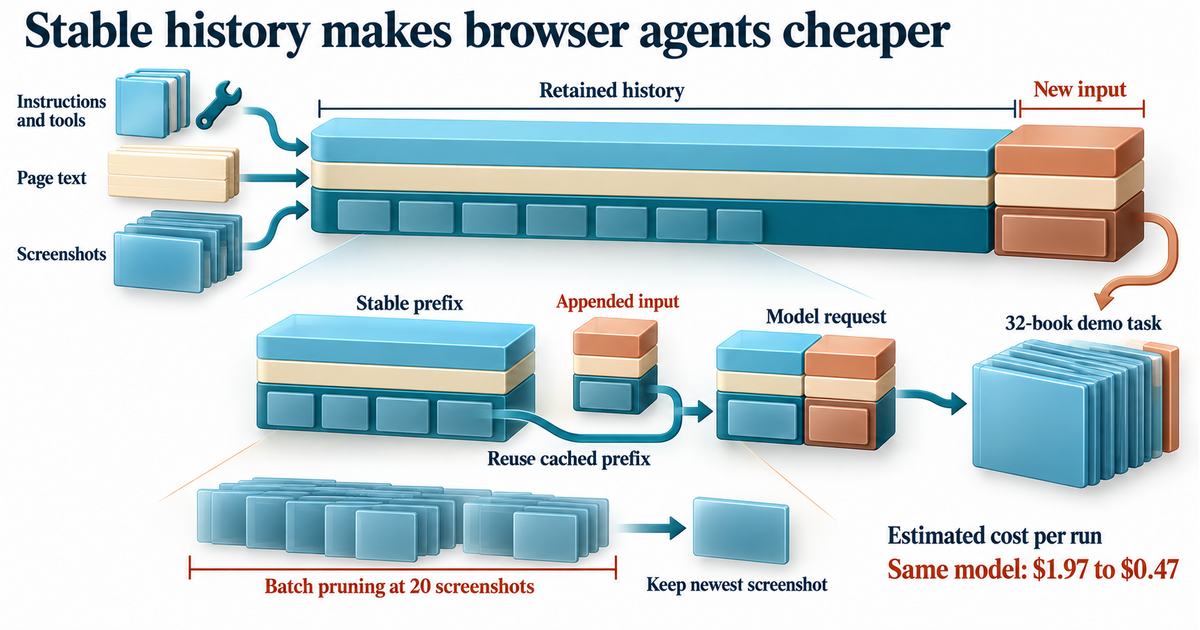
Asana's StackAI browser agent repeatedly builds requests from a growing trail of pages, screenshots and tool results. Its existing cache covered fixed instructions but not that changing history, so an expensive part of each step was sent again. In a 144-run experiment across four models, the team compared two history budgets with six caching and screenshot-handling policies. Holding more page history and pruning screenshots in batches—rather than continually rewriting the whole context—preserved stable input prefixes that could be reused by a prompt cache. The chosen policy retained as many as 20 screenshots before trimming to the newest image. On GPT-6.1 Sol, the larger-history configuration with that policy reduced estimated model cost from $1.97 to $0.47 per run. Versus the previous production setup on a different model, the optimized Sol workflow was reported as 76 times cheaper and approximately five times faster, taking roughly four minutes. The test collected six fields from each of 32 demonstration-catalog books, not arbitrary internet work. Its baseline included capped or unfinished runs, and the cost figures reflect a particular workload and providers' pricing—not a universal agent-performance ranking.
Asana's browser-agent tests show why stable context can slash costs
Focus: Technical AI Engineering Date: October 9, 2026 Topics: browser agents, prompt caching, context retention, evaluation design, model operating cost Evidence: Publisher Authored Availability: Available
Summary: Asana's StackAI browser agent repeatedly builds requests from a growing trail of pages, screenshots and tool results. Its existing cache covered fixed instructions but not that changing history, so an expensive part of each step was sent again. In a 144-run experiment across four models, the team compared two history budgets with six caching and screenshot-handling policies. Holding more page history and pruning screenshots in batches—rather than continually rewriting the whole context—preserved stable input prefixes that could be reused by a prompt cache. The chosen policy retained as many as 20 screenshots before trimming to the newest image. On GPT-6.1 Sol, the larger-history configuration with that policy reduced estimated model cost from $1.97 to $0.47 per run. Versus the previous production setup on a different model, the optimized Sol workflow was reported as 76 times cheaper and approximately five times faster, taking roughly four minutes. The test collected six fields from each of 32 demonstration-catalog books, not arbitrary internet work. Its baseline included capped or unfinished runs, and the cost figures reflect a particular workload and providers' pricing—not a universal agent-performance ranking.
Why it matters: The design lesson is that context management is part of systems engineering, not merely prompt style. Measure which parts of the history change, cache stable prefixes, change trimming only at intentional boundaries and keep enough evidence to avoid repeat browsing. Compare cost, elapsed time and task completion together; a superficially cheaper configuration that loses needed context can increase retries and error rates. Treat the reported 76-fold figure as a case result, not a forecast for another application.