For small teams, the useful agent pattern is a bounded role with measurable work
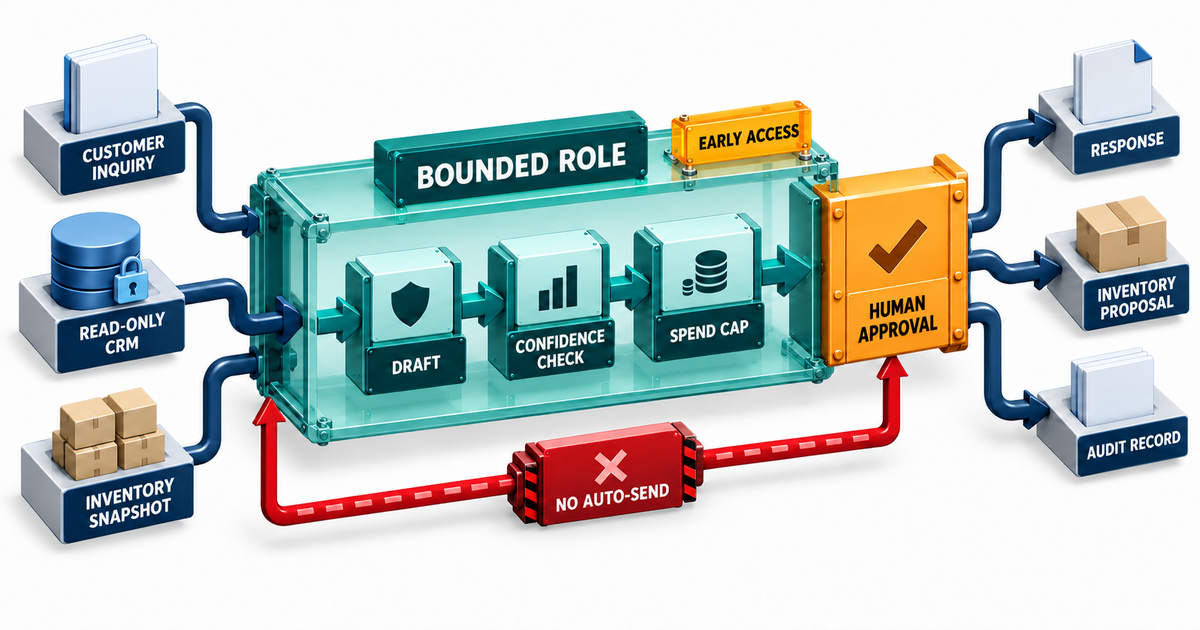
Google Cloud's October 8 SMB guide reframes the agent as a narrowly assigned team role rather than a universal replacement for staff. For a small business it suggests practical roles—bookkeeping assistant, inventory coordinator, marketing consultant or project manager—and emphasizes connections to the systems the team already uses. Google lists tools such as Shopify, Slack, Salesforce, Notion and Box alongside document and collaboration applications. The claimed advantages come from continuity of context, selecting models appropriate to task complexity and billing controls that cap project-level spend. Real customer examples span automating technical support, formatting learning materials against approved templates, indexing internal knowledge and processing logistics documents. The article also points readers toward training paths for Workspace, data transformation and custom agents. Importantly, Google said the new universal Gemini agent was in early access for SMB customers at publication time, with broader availability to follow; a reader should not assume immediate access on every plan. Customer time or error reductions are illustrative, vendor-reported case studies, not independently audited causal outcomes. The broadly reusable idea is a job design: one agent owns a bounded information flow, operates on approved systems and returns evidence the business can inspect.
For small teams, the useful agent pattern is a bounded role with measurable work
Focus: Agents for Everyone Date: October 8, 2026 Topics: small business, agent delegation, workflow design, spend controls, human-in-loop Evidence: Publisher Authored Availability: Available
Summary: Google Cloud's October 8 SMB guide reframes the agent as a narrowly assigned team role rather than a universal replacement for staff. For a small business it suggests practical roles—bookkeeping assistant, inventory coordinator, marketing consultant or project manager—and emphasizes connections to the systems the team already uses. Google lists tools such as Shopify, Slack, Salesforce, Notion and Box alongside document and collaboration applications. The claimed advantages come from continuity of context, selecting models appropriate to task complexity and billing controls that cap project-level spend. Real customer examples span automating technical support, formatting learning materials against approved templates, indexing internal knowledge and processing logistics documents. The article also points readers toward training paths for Workspace, data transformation and custom agents. Importantly, Google said the new universal Gemini agent was in early access for SMB customers at publication time, with broader availability to follow; a reader should not assume immediate access on every plan. Customer time or error reductions are illustrative, vendor-reported case studies, not independently audited causal outcomes. The broadly reusable idea is a job design: one agent owns a bounded information flow, operates on approved systems and returns evidence the business can inspect.
Why it matters: A small team can pilot an agent without automating purchases or customer commitments. Choose a recurrent task such as turning a customer request into a draft response and a proposed inventory check. Allow the agent to read only the approved mailbox and inventory export, prohibit outbound sending or stock adjustments, and have an owner approve the final action. Measure first-pass accuracy, time saved after review, mistakes caught, cost per completed item and how often access permissions must change. Expand autonomy only when these observations justify it.