SAP's Joule shows how enterprise agents need process graphs and deterministic controls
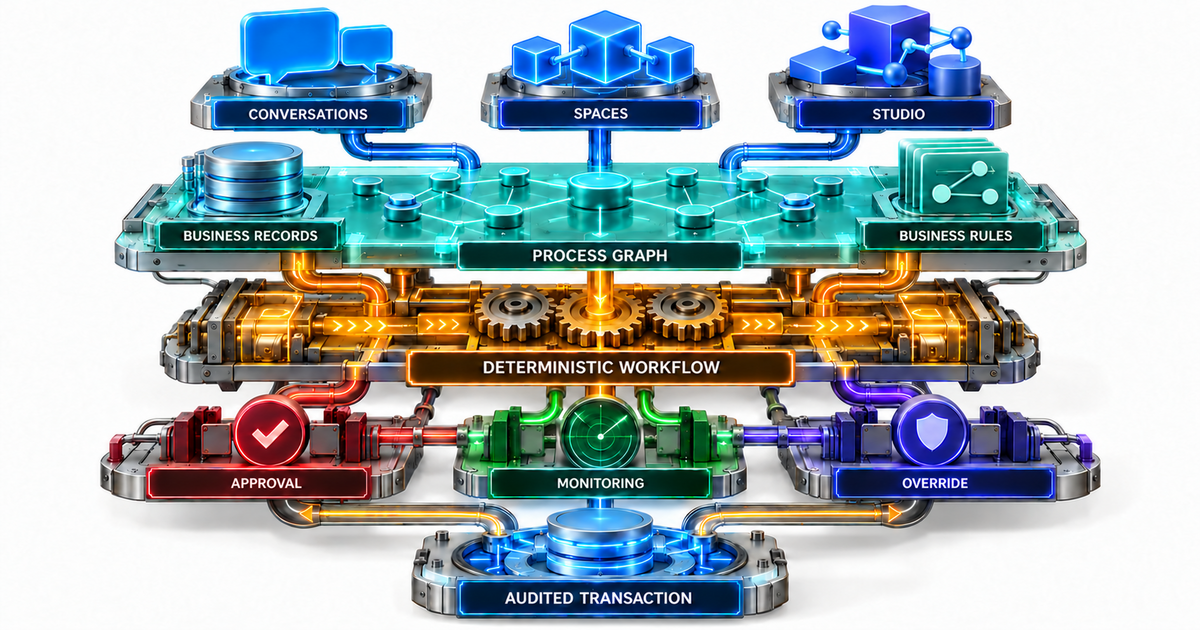
SAP's October 7 account of SAP Connect separates the conversational interface from the enterprise systems that make an AI action legitimate. Joule Work is presented through three pillars: conversations for questions and delegation, shared spaces that show business context and work, and Joule Studio for customizing agent behavior. Underneath, SAP positions its Business AI Platform and Knowledge Graph as the source of process relationships, data definitions, application APIs and business rules. The keynote's central distinction is between probabilistic model outputs and operational actions carried out through deterministic application workflows. A procurement or finance agent should not simply infer what an approval means from a chat response; it should use the correct application context, role permissions, established rules and auditable workflow execution. SAP also describes an Autonomous Suite spanning finance, procurement, supply chain, HR and customer experience, with customers choosing different levels of autonomy by process risk. Chief Security Officer Marielle Ehrmann outlined three distinct human controls: approval before consequential actions, monitoring during permitted operation and override authority when operators need to regain control. Several counts of agents and productivity improvements are SAP-reported and should not be read as independent verification of deployment success.
SAP's Joule shows how enterprise agents need process graphs and deterministic controls
Focus: Applied Generative AI for Knowledge Workers Date: October 7, 2026 Topics: enterprise process automation, knowledge graphs, governance, ERP AI, human oversight Evidence: Publisher Authored Availability: Available
Summary: SAP's October 7 account of SAP Connect separates the conversational interface from the enterprise systems that make an AI action legitimate. Joule Work is presented through three pillars: conversations for questions and delegation, shared spaces that show business context and work, and Joule Studio for customizing agent behavior. Underneath, SAP positions its Business AI Platform and Knowledge Graph as the source of process relationships, data definitions, application APIs and business rules. The keynote's central distinction is between probabilistic model outputs and operational actions carried out through deterministic application workflows. A procurement or finance agent should not simply infer what an approval means from a chat response; it should use the correct application context, role permissions, established rules and auditable workflow execution. SAP also describes an Autonomous Suite spanning finance, procurement, supply chain, HR and customer experience, with customers choosing different levels of autonomy by process risk. Chief Security Officer Marielle Ehrmann outlined three distinct human controls: approval before consequential actions, monitoring during permitted operation and override authority when operators need to regain control. Several counts of agents and productivity improvements are SAP-reported and should not be read as independent verification of deployment success.
Why it matters: A knowledge worker implementing AI inside ERP, HR or finance should map the process and business data before selecting a model. Build a simple approval matrix identifying who owns an agent, which records it can see, which transaction thresholds it may handle and how its decisions are logged. Separate read-only explanation from action execution and test exceptions—missing supplier data, nonstandard terms and failed approvals. The strongest design keeps the model flexible in interpretation while the system of record retains authoritative control over transactions.