Google's Gemini agent turns cross-app context, skills and governance into a work system
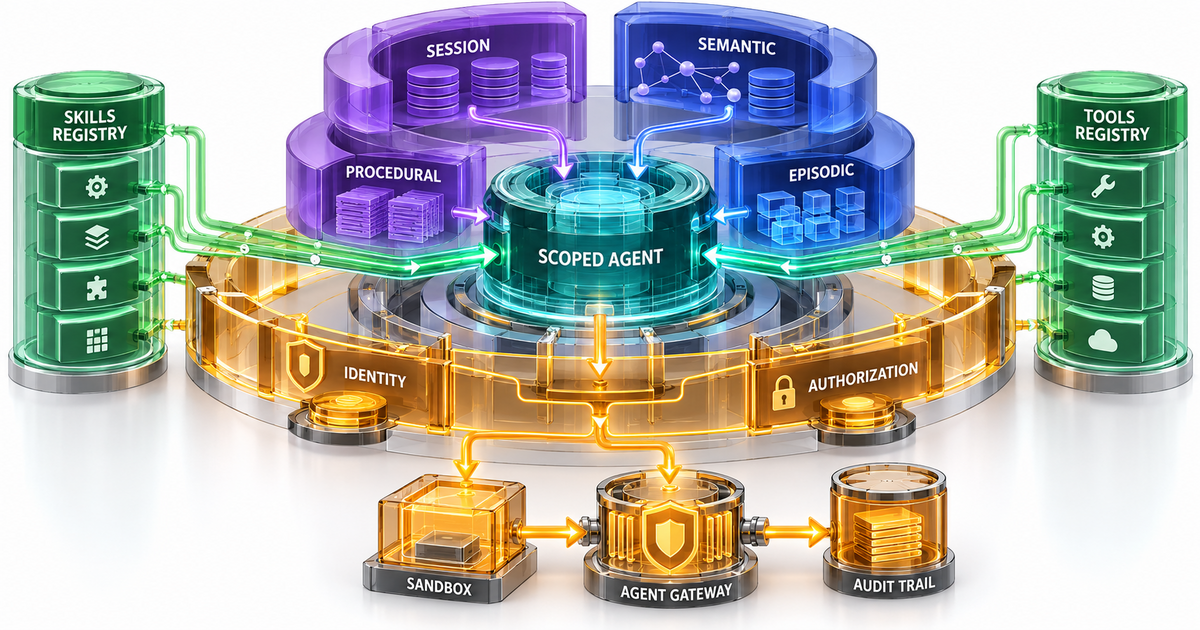
At Gemini at Work 2026, Google Cloud announced a universal Gemini agent intended to combine answering, drafting, data analysis, media generation and tool-using execution across documents, email, chat and connected business systems. Its architecture has four separate ingredients: persistent contextual memory, modular task skills, connector-backed tools and policies that govern the agent's authority. The keynote describes background task execution, on-demand subagents with task-specific identities, and longer-lived coworker agents whose context and permissions are supplied by a team. It also describes session, semantic, procedural and episodic memory, rather than treating every interaction as a fresh prompt. Within Workspace, examples include extracting a meeting's participants from a chat space, finding calendar openings, or responding to a project-update request by assembling a sheet and presentation. The broader enterprise design adds a skills registry, tool registry, data-catalog grounding, industry-specific packages and model routing. Google says agent actions are attributed to identities in audit logs and controlled by role-based permissions, a sandbox and a policy-enforcing network gateway. A number of large customer adoption or productivity figures appear in the keynote and should be treated as Google-reported outcomes, not independently verified causal estimates. The announcement describes capabilities and direction; enterprises must check their own edition, geography and rollout availability.
Google's Gemini agent turns cross-app context, skills and governance into a work system
Focus: Applied Generative AI for Knowledge Workers Date: October 8, 2026 Topics: context engineering, enterprise agents, cross-app workflows, memory, agent identity Evidence: Publisher Authored Availability: Available
Summary: At Gemini at Work 2026, Google Cloud announced a universal Gemini agent intended to combine answering, drafting, data analysis, media generation and tool-using execution across documents, email, chat and connected business systems. Its architecture has four separate ingredients: persistent contextual memory, modular task skills, connector-backed tools and policies that govern the agent's authority. The keynote describes background task execution, on-demand subagents with task-specific identities, and longer-lived coworker agents whose context and permissions are supplied by a team. It also describes session, semantic, procedural and episodic memory, rather than treating every interaction as a fresh prompt. Within Workspace, examples include extracting a meeting's participants from a chat space, finding calendar openings, or responding to a project-update request by assembling a sheet and presentation. The broader enterprise design adds a skills registry, tool registry, data-catalog grounding, industry-specific packages and model routing. Google says agent actions are attributed to identities in audit logs and controlled by role-based permissions, a sandbox and a policy-enforcing network gateway. A number of large customer adoption or productivity figures appear in the keynote and should be treated as Google-reported outcomes, not independently verified causal estimates. The announcement describes capabilities and direction; enterprises must check their own edition, geography and rollout availability.
Why it matters: A productive cross-application assistant is a workflow architecture, not a more elaborate prompt. Knowledge workers should identify where authoritative context lives, what systems the agent may read, which actions it may take and which decisions require human confirmation. A practical pilot is a read-only project briefing spanning email, source documents and a status table. Verify every cited fact, inspect the exact access footprint, then selectively enable reversible write actions. Govern the memory and permissions that survive between jobs, rather than assuming the interface boundary limits data access.