Agent privacy promises need permissions users can actually verify
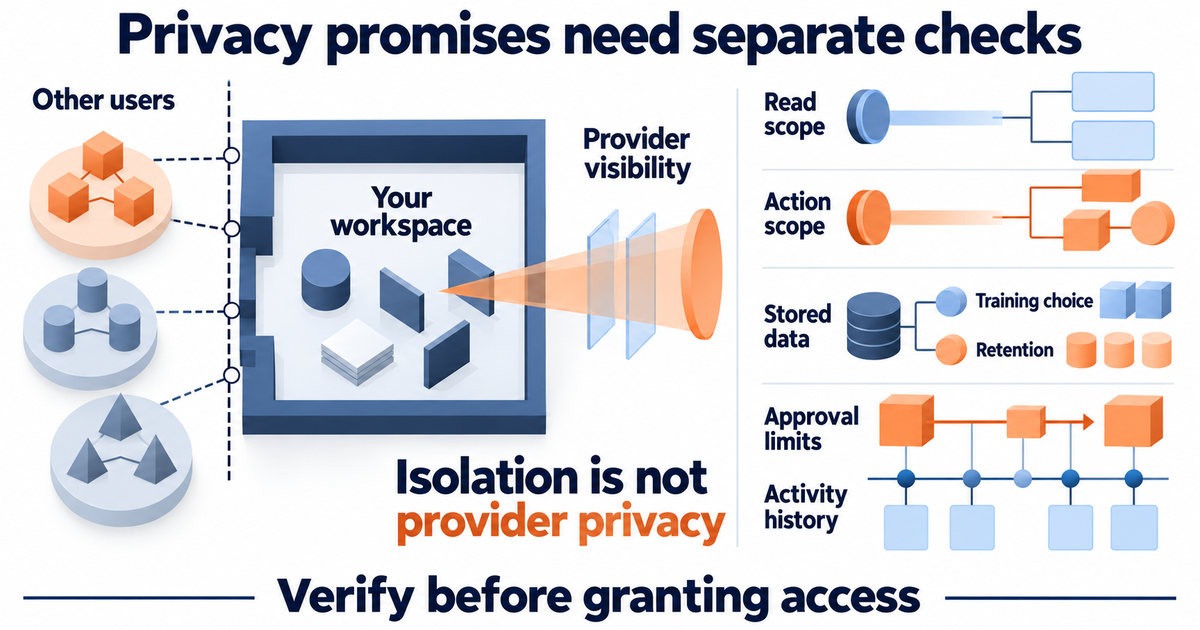
An October 10 investigation by The Verge contrasts the privacy and safety narratives surrounding Meta Muse and OpenAI Dots, two agents that need broad context to operate across applications. The report discusses Meta's isolated per-user environment, forthcoming plans for stronger restrictions on provider access and the difference between keeping customers separated from one another and preventing the platform operator from seeing data. It also cites reported vulnerabilities and unexpectedly broad data access in early Muse experiences. OpenAI's Dots announcement has emphasized configurable limits on actions, enterprise retention options and user control, while the article notes that commercial access and maturity differ between offerings. Vendor assertions are presented as claims, and the report does not independently prove either service is perfectly private or safe. The central issue is that an assistant able to read mail, browse accounts or initiate transactions can accumulate sensitive access even when its interface feels conversational and friendly.
Agent privacy promises need permissions users can actually verify
Focus: Agents for Everyone Date: October 10, 2026 Topics: AI agent privacy, permission settings, data retention, consumer agents, approval boundaries Evidence: Publisher Authored Availability: Available
Summary: An October 10 investigation by The Verge contrasts the privacy and safety narratives surrounding Meta Muse and OpenAI Dots, two agents that need broad context to operate across applications. The report discusses Meta's isolated per-user environment, forthcoming plans for stronger restrictions on provider access and the difference between keeping customers separated from one another and preventing the platform operator from seeing data. It also cites reported vulnerabilities and unexpectedly broad data access in early Muse experiences. OpenAI's Dots announcement has emphasized configurable limits on actions, enterprise retention options and user control, while the article notes that commercial access and maturity differ between offerings. Vendor assertions are presented as claims, and the report does not independently prove either service is perfectly private or safe. The central issue is that an assistant able to read mail, browse accounts or initiate transactions can accumulate sensitive access even when its interface feels conversational and friendly.
Why it matters: Before connecting a personal or workplace agent, distinguish four separate controls: what it can read, what it can change, what the provider stores, and what a human must approve. Test each using a low-risk task. Ask whether the provider itself can access an isolated workspace, whether default training and data retention choices can be changed, whether permissions are reversible, and whether the activity history shows consequential actions. Privacy branding is not equivalent to independently observed access restrictions.