Make one reusable Agent Skill that triggers reliably and stays in bounds
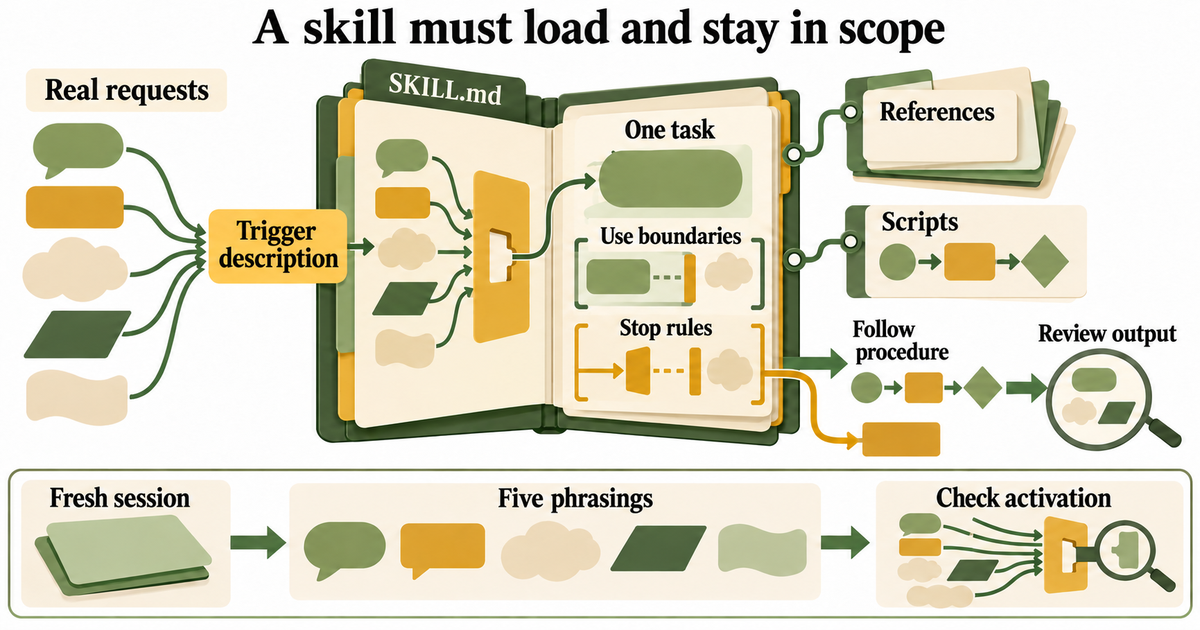
A practical Agent Skills guide published October 7 argues that reusable AI procedures succeed or fail on activation and scope, not on how impressively their instructions are written. An Agent Skill is a folder centered on SKILL.md: its metadata names the task and describes when the assistant should load it; its body supplies the procedure and any supporting references or scripts. The article recommends a description containing realistic request phrases, a single job per skill, predictable directory structure, separate reference material for details that need not always be loaded, and explicit exclusions preventing scope creep. The practical example is straightforward: create an invoice-review skill that takes a document list, extracts required fields, flags exceptions and produces a structured review table, without approving payments or changing records. Write a description triggered by requests such as 'check these invoices' and 'identify invoice mismatches'; provide five alternative phrasings and verify whether activation and output are appropriate in a fresh session. The guide includes broad GitHub popularity statistics; those numbers are not necessary to this practical recommendation and have not been independently audited here.
Make one reusable Agent Skill that triggers reliably and stays in bounds
Focus: Agents for Everyone Date: October 7, 2026 Topics: Agent Skills, SKILL.md, reusable workflows, progressive disclosure, trigger testing Evidence: Publisher Authored Availability: Available
Summary: A practical Agent Skills guide published October 7 argues that reusable AI procedures succeed or fail on activation and scope, not on how impressively their instructions are written. An Agent Skill is a folder centered on SKILL.md: its metadata names the task and describes when the assistant should load it; its body supplies the procedure and any supporting references or scripts. The article recommends a description containing realistic request phrases, a single job per skill, predictable directory structure, separate reference material for details that need not always be loaded, and explicit exclusions preventing scope creep. The practical example is straightforward: create an invoice-review skill that takes a document list, extracts required fields, flags exceptions and produces a structured review table, without approving payments or changing records. Write a description triggered by requests such as 'check these invoices' and 'identify invoice mismatches'; provide five alternative phrasings and verify whether activation and output are appropriate in a fresh session. The guide includes broad GitHub popularity statistics; those numbers are not necessary to this practical recommendation and have not been independently audited here.
Why it matters: A reusable skill should become a dependable operating procedure for non-developers, not an unexplained magic command. Restrict it to one bounded task, declare what it must never do, keep reference files separate and make its completion check visible to the user. The first evaluation should score both correct activation and correct refusal on near-miss requests. Treat any imported third-party skill as executable instructions and review it before granting file or tool access.