Oracle's production-AI interview makes outcomes and controls the first design step
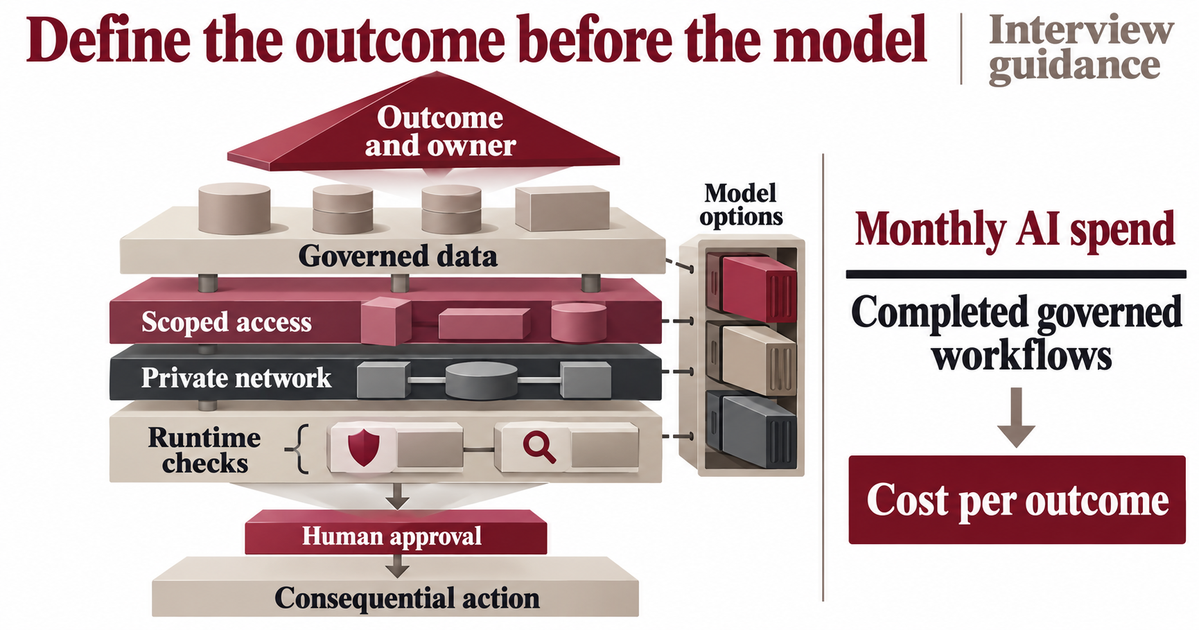
In an October 9 interview published by Express Computer, Oracle India's Vivek Gupta argues that production generative AI should begin with a defined business outcome rather than a model selection. The interview describes the shift from impressive pilots to workflows that consistently improve support, finance, supply chain or other operations. Gupta recommends keeping identity, network boundaries, observability and audit controls stable even when teams change their model. He also emphasizes locating AI execution near governed business data where possible, recognizing that latency, sector rules and data residency often determine the correct deployment. For an agent that can act, he outlines three related boundaries: identity-based access to approved sources and tools, private network routes, and runtime protections against prompt injection or exposure of personal data. A particularly useful metric is total cost per successfully completed governed workflow, including retrieval, integration, human review and monitoring, rather than inference price alone. These are expert/vendor perspectives expressed in an interview, not an independently verified enterprise performance benchmark.
Oracle's production-AI interview makes outcomes and controls the first design step
Focus: Applied Generative AI for Knowledge Workers Date: October 9, 2026 Topics: AI production governance, enterprise outcomes, cost per workflow, data sovereignty, least privilege Evidence: Publisher Authored Availability: Available
Summary: In an October 9 interview published by Express Computer, Oracle India's Vivek Gupta argues that production generative AI should begin with a defined business outcome rather than a model selection. The interview describes the shift from impressive pilots to workflows that consistently improve support, finance, supply chain or other operations. Gupta recommends keeping identity, network boundaries, observability and audit controls stable even when teams change their model. He also emphasizes locating AI execution near governed business data where possible, recognizing that latency, sector rules and data residency often determine the correct deployment. For an agent that can act, he outlines three related boundaries: identity-based access to approved sources and tools, private network routes, and runtime protections against prompt injection or exposure of personal data. A particularly useful metric is total cost per successfully completed governed workflow, including retrieval, integration, human review and monitoring, rather than inference price alone. These are expert/vendor perspectives expressed in an interview, not an independently verified enterprise performance benchmark.
Why it matters: A pilot-to-production decision should be auditable in business terms. Define the workflow outcome and accountable owner; then document data authority, permissions, review and rollback before choosing a model or cloud topology. For a small example, measure monthly expense divided by approved completed cases, while separately monitoring error rates and human corrections. This prevents an apparently inexpensive AI feature from quietly creating an expensive queue of unresolved exceptions.