Google Cloud and Alteryx show a governed path from invoice PDFs to decisions
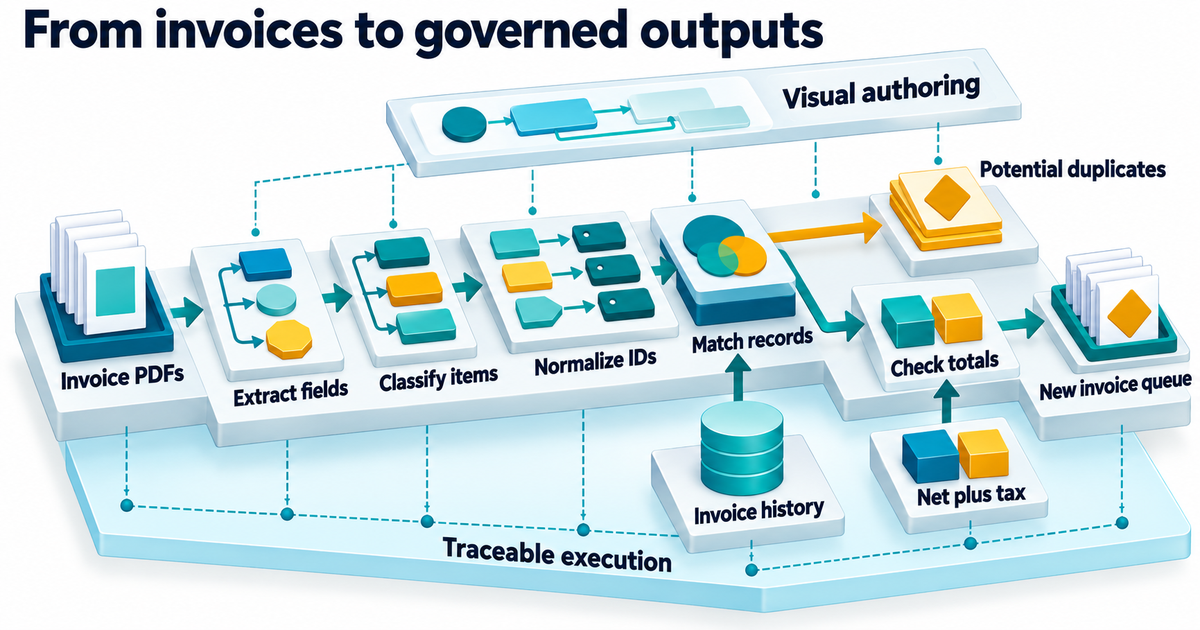
Google Cloud and Alteryx describe a finance-workflow pattern in which staff can design an invoice pipeline through a browser interface while data transformations and reconciliation operate close to governed BigQuery data. Invoice PDFs begin in Cloud Storage. An Alteryx Live Query document-extraction step uses a selected service, such as Gemini through BigQuery's AI.GENERATE or Document AI, to turn source PDFs into structured fields. The workflow can classify line items with AI.CLASSIFY, normalize vendor and invoice identifiers, compare those fields with historical records already in BigQuery, and flag duplicates or amounts that fail a reconciliation rule. The vendor walkthrough separates the user-facing workflow editor from the platform's transformation service and the customer's execution/data environment. Its SQL is explicitly illustrative, not evidence of an independently measured production throughput improvement. The article describes two operational output paths: potentially duplicated invoices and validated new invoices with exceptions routed for review. Governance is achieved through existing data policies and reducing unnecessary data movement, not by trusting extraction output blindly.
Google Cloud and Alteryx show a governed path from invoice PDFs to decisions
Focus: Applied Generative AI for Knowledge Workers Date: October 9, 2026 Topics: invoice processing, document AI, BigQuery, governed data, exception review Evidence: Publisher Authored Availability: Available
Summary: Google Cloud and Alteryx describe a finance-workflow pattern in which staff can design an invoice pipeline through a browser interface while data transformations and reconciliation operate close to governed BigQuery data. Invoice PDFs begin in Cloud Storage. An Alteryx Live Query document-extraction step uses a selected service, such as Gemini through BigQuery's AI.GENERATE or Document AI, to turn source PDFs into structured fields. The workflow can classify line items with AI.CLASSIFY, normalize vendor and invoice identifiers, compare those fields with historical records already in BigQuery, and flag duplicates or amounts that fail a reconciliation rule. The vendor walkthrough separates the user-facing workflow editor from the platform's transformation service and the customer's execution/data environment. Its SQL is explicitly illustrative, not evidence of an independently measured production throughput improvement. The article describes two operational output paths: potentially duplicated invoices and validated new invoices with exceptions routed for review. Governance is achieved through existing data policies and reducing unnecessary data movement, not by trusting extraction output blindly.
Why it matters: A knowledge worker can move from reviewing unstructured invoices to overseeing an auditable exception queue. The critical design move is to place deterministic matching and accounting rules after probabilistic extraction, rather than allowing an LLM to make payment decisions unaided. A useful pilot should test missing invoice fields, duplicate numbers, net-plus-tax mismatches, extraction confidence and human sign-off, recording false positives before any automatic posting.