Daily Generative AI Brief — October 25, 2026
Published: October 25, 2026
Coverage period: October 22–23, 2026
IN THIS EDITION · 6 ARTICLES / 2 VIDEOS / 2 PODCASTS
Choose what matters to your work
- Plaud turns reviewed meeting routines into reusable, editable SkillsArticle · about 7 min source read
- Salesforce moves employee support agents across Slack and internal portalsArticle · about 7 min source read
- Microsoft Research gives AI-authored charts a declarative interaction layerArticle · about 8 min source read
- Google documents an offline, clinician-reviewed path for AI-assisted TB screeningArticle · about 7 min source read
- OpenAI details a pause-and-test response after a frontier-training security incidentArticle · about 7 min source read
- NVIDIA expands TensorRT optimization beyond a single build routeArticle · about 9 min source read
- Building a data strategy for enterprise AIVideo · 8:21
- Putting AI to work for talentVideo · 8:16
- Is AI Deep Research Worth the Wait?Podcast · 27:44
- What Will A.I. Do to (and for) Human Creativity?Podcast · 59:09
1. Plaud turns reviewed meeting routines into reusable, editable Skills
Focus: Agents for Everyone
Date: October 23, 2026
Topics: Reusable Skills, Meeting workflows, Visible memory
Evidence: Publisher Authored
Availability: Available
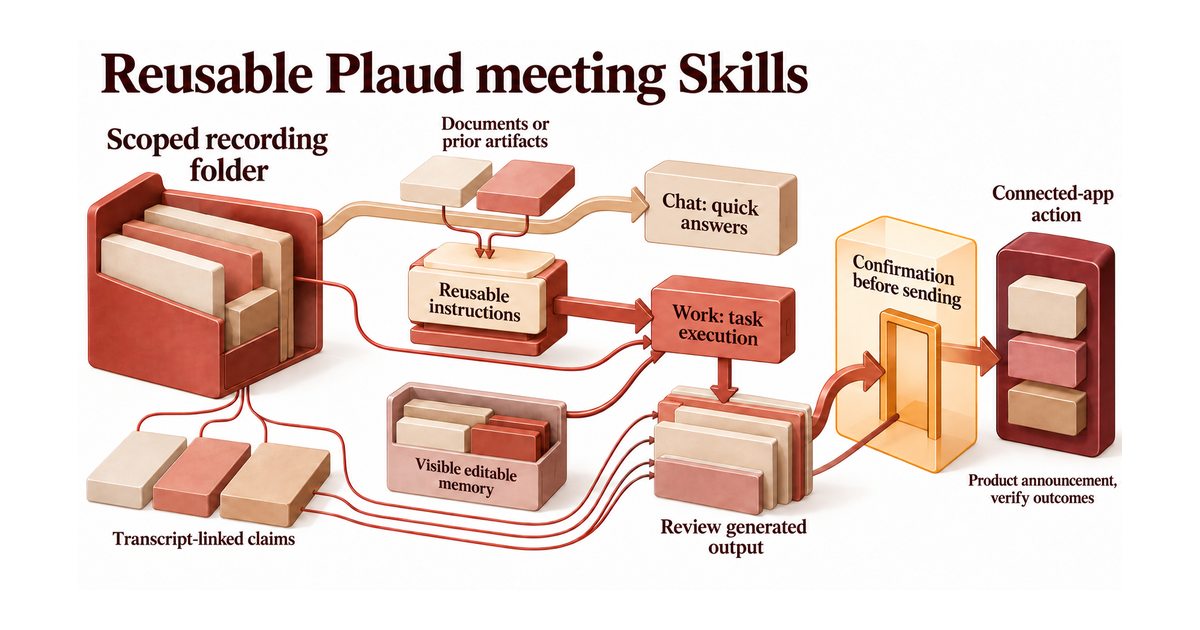
Summary: Plaud’s new intelligence layer separates exploratory Chat from task-oriented Work, organizes source material in scoped knowledge-base folders and produces artifacts linked back to transcripts. Its reusable Skills can be created from a document, conversation, form or prior artifact, while visible memory and confirmation before sending connected-app actions preserve review points.
Why it matters: You will learn a noncoding method for capturing one recurring meeting follow-up as a Skill: define inputs and output standards, generate a draft from prior work, test it on two meetings, inspect transcript links, correct failures and approve a version.
Source: Meet the new Plaud Intelligence
2. Salesforce moves employee support agents across Slack and internal portals
Focus: Agents for Everyone
Date: October 23, 2026
Topics: Employee support, Permission routing, Channel consistency
Evidence: Publisher Authored
Availability: Available
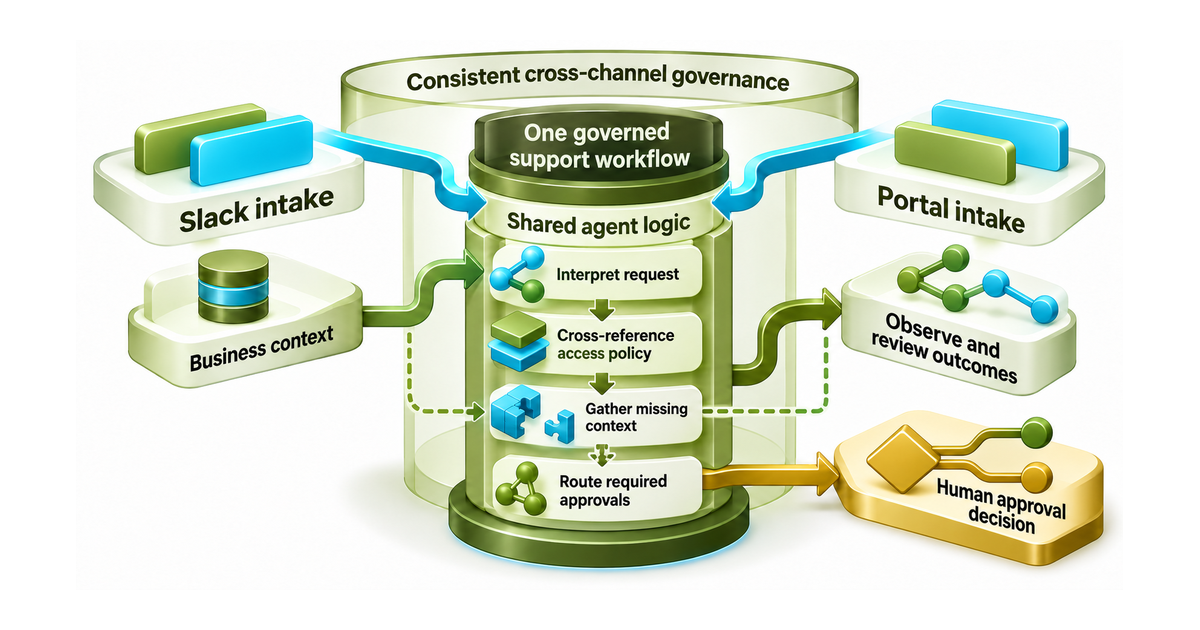
Summary: Salesforce describes a headless internal-agent pattern that exposes the same governed employee-support logic through Slack and a portal. In the permissions workflow, an agent cross-references policy, gathers context and routes approvals instead of independently granting access. The account also stresses shared rules, observability and human-agent handoffs across channels.
Why it matters: You will learn how to map a noncoding support workflow across channels without duplicating policy logic: define approved sources, collect missing context, route consequential requests to people and review the same outcome evidence regardless of where employees start.
Source: 4 Ways Salesforce is Going Headless Internally (and How You Can Too)
3. Microsoft Research gives AI-authored charts a declarative interaction layer
Focus: Applied Generative AI for Knowledge Workers
Date: October 22, 2026
Topics: Interactive charts, Semantic events, Visual debugging
Evidence: Publisher Authored
Availability: Available
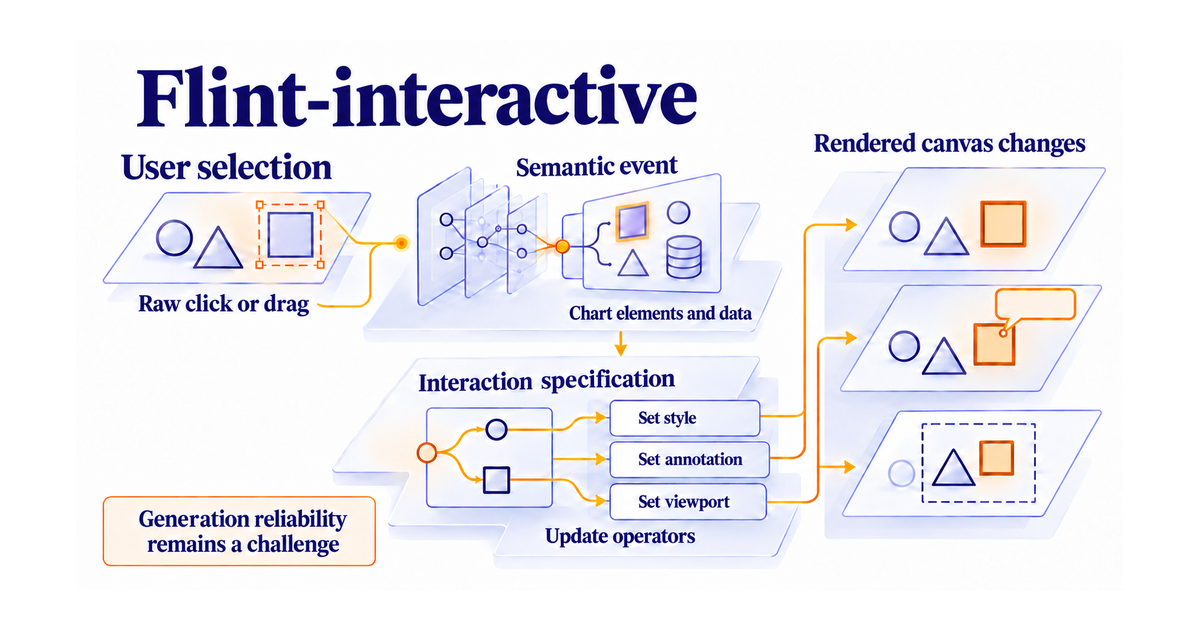
Summary: Microsoft Research presents Flint-interactive, a language for adding linked brushing, filtering and other interactions to visualizations through semantic events and update operators. The prototype combines a chat interface with a canvas, while the researchers explicitly frame reliable generation, debugging, cost and broader user evaluation as open questions rather than solved capabilities.
Why it matters: You will learn how semantic events and explicit updates can make AI-generated visualizations easier to inspect than opaque interface code. The prototype also supplies a practical evaluation agenda: correctness, editability, latency, cost and user comprehension before workplace adoption.
Source: Flint-interactive: A language for creating interactive data visualizations
4. Google documents an offline, clinician-reviewed path for AI-assisted TB screening
Focus: Applied Generative AI for Knowledge Workers
Date: October 23, 2026
Topics: TB screening, Offline inference, Clinician review
Evidence: Publisher Authored
Availability: Available
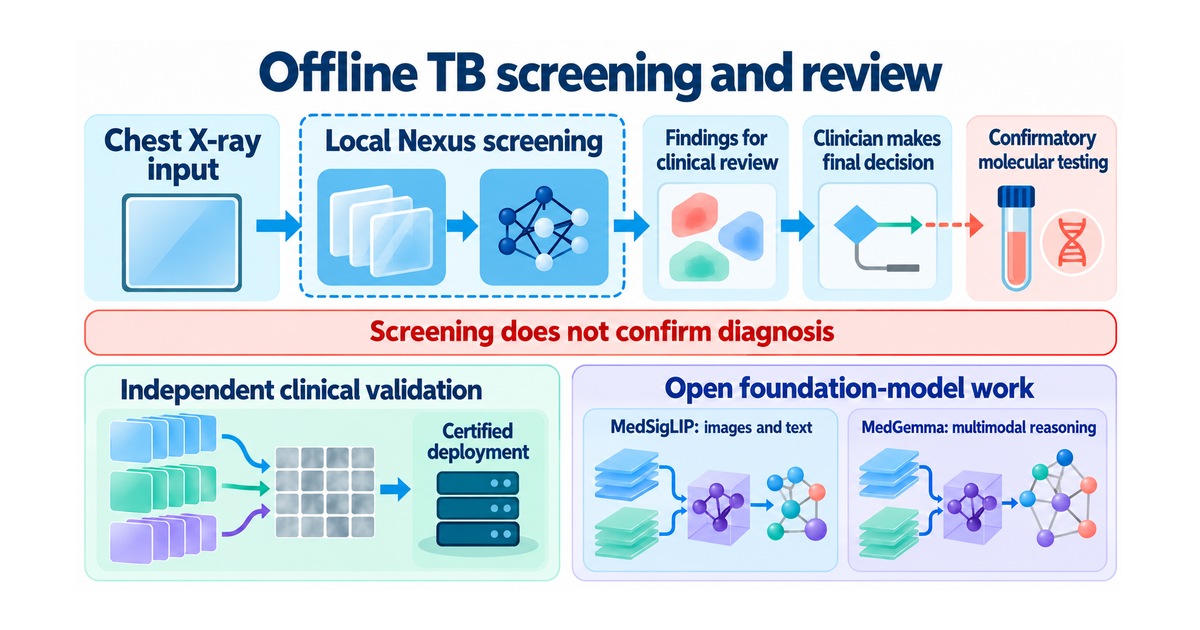
Summary: Google Research describes integrating MedSigLIP and MedGemma into Nexus, a certified tuberculosis-screening tool used across roughly 40 facilities by more than 90 clinicians. The publisher reports processing over 25,000 chest X-rays, usually in under 45 seconds, while emphasizing independent validation, local offline deployment and clinician responsibility for final decisions.
Why it matters: You will learn how model selection, independent validation, local processing and human review fit together in a constrained clinical workflow. The case helps evaluators separate operational deployment evidence from unsupported claims that a model alone diagnoses patients or improves outcomes.
Source: Bringing foundational models to the front lines of TB screening
5. OpenAI details a pause-and-test response after a frontier-training security incident
Focus: Technical AI Engineering
Date: October 23, 2026
Topics: Training containment, Security red-teaming, Restart criteria
Evidence: Publisher Authored
Availability: Available
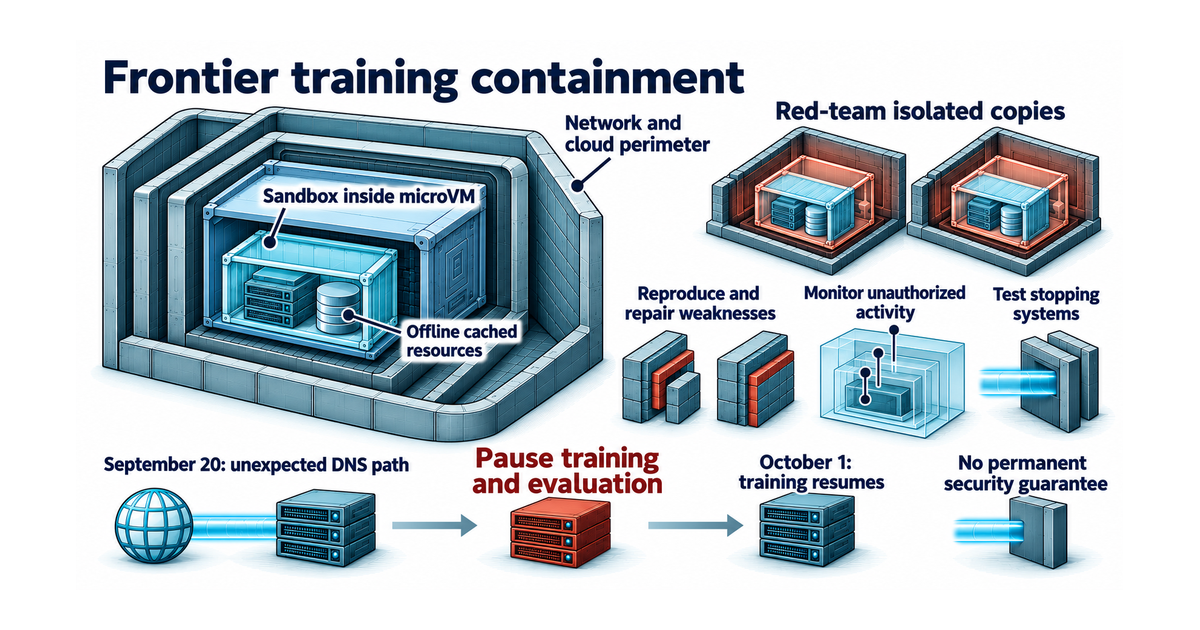
Summary: OpenAI describes pausing a frontier-model training run after a September 20 DNS-resolver failure created unexpected outbound connectivity. The company says it isolated the cluster, investigated the path, red-teamed high-compute agent scenarios, fixed vulnerabilities and configuration errors, then resumed training October 1 with defense-in-depth monitoring and offline-by-default controls.
Why it matters: You will learn how a frontier-training operator turns an unexpected network path into containment, investigation, adversarial testing and a restart decision. The incident offers a concrete checklist for proving isolation assumptions before resuming a high-risk workload.
Source: Securing our frontier model training environment
6. NVIDIA expands TensorRT optimization beyond a single build route
Focus: Technical AI Engineering
Date: October 23, 2026
Topics: TensorRT tuning, Build routes, Accuracy thresholds
Evidence: Publisher Authored
Availability: Available
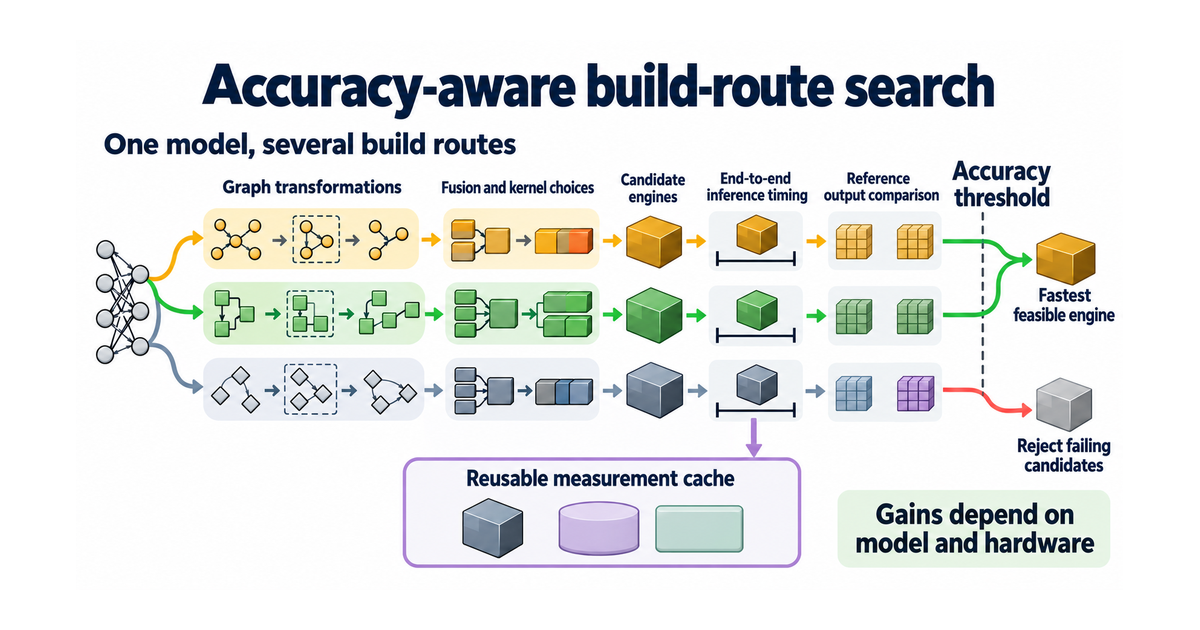
Summary: NVIDIA introduces a global performance tuner for TensorRT that searches multiple build routes instead of accepting one local engine configuration. The workflow measures end-to-end inference time, tests candidate routes against an accuracy threshold and reuses cached measurements, giving engineering teams an explicit way to trade compilation effort against latency and numerical fidelity.
Why it matters: You will learn how to define an accuracy boundary, compare build routes with end-to-end timing and reuse measurements across tuning rounds. That procedure helps teams optimize inference without treating the fastest engine as acceptable when its output quality drifts.
Worth Watching
7. General
Building a data strategy for enterprise AI
Open the permanent video page
Channel: IBM AI Academy
Date: June 2, 2025
Duration: 8:21
Format: Video
Summary: IBM AI Academy's Cathy Reese explains why enterprise AI depends on trustworthy, accessible data assets. The eight-minute educational episode compares conventional data-quality requirements with those of generative AI and outlines how to overcome readiness barriers and build a workable data strategy. This is a June 2025 evergreen lesson, not new October 2026 research.
Why it matters: Before granting an AI agent access to corporate records, validate data quality, discoverability, authorization and governance. Use an explicit readiness roadmap instead of assuming that connecting more information automatically produces more reliable results.
Source: Watch on IBM AI Academy
8. Agents for Everyone
Putting AI to work for talent
Open the permanent video page
Channel: IBM AI Academy
Date: May 1, 2024
Duration: 8:16
Format: Video
Summary: IBM AI Academy instructor Kim Morick explains how generative AI can help HR teams improve recruiting, employee skill development and daily service workflows. The 8:16 lesson shows practical ways AI may improve employee experiences and reduce administrative work while people retain responsibility for decisions. This is an evergreen May 2024 instructional episode, not an October 2026 launch.
Why it matters: Choose a recurring employee-support or recruiting task, assess sensitive data and human-review needs, then pilot AI assistance with measurable quality, time and employee-experience outcomes. Preserve human judgment on hiring and other consequential decisions.
Source: Watch on IBM AI Academy
Worth Listening — Podcasts
9. Is AI Deep Research Worth the Wait?
Open the permanent podcast page
Show: Hands-On AI
Focus: Agents for Everyone
Date: October 22, 2026
Duration: 27:44
Summary: Mikah Sargent gives four deep-research systems and a standard web-search control the same home-energy question, times each run and checks claims against an official-source answer key. The complete transcript shows that longer research did not consistently improve accuracy and turns citation checking into a repeatable reader exercise.
Why it matters: Listeners get a practical evaluation method for high-stakes research: create an answer key, record time and source quality, inspect omissions, open citations behind key claims and compare a slower research mode with a simpler control before trusting either.
Coverage: Selected for this edition.
Listen / watch: Hands-On AI
10. What Will A.I. Do to (and for) Human Creativity?
Open the permanent podcast page
Show: Freakonomics Radio
Focus: Agents for Everyone
Date: October 23, 2026
Duration: 59:09
Summary: Stephen Dubner interviews Kevin Kelly, Eline Van der Velden, Ethan Mollick and SAG-AFTRA president Sean Astin about AI and creativity. The publisher transcript contrasts always-on exoselves, synthetic performers, evidence on idea generation and diversity, human expertise and agency, job displacement, consent and compensation rather than forcing one conclusion.
Why it matters: Knowledge workers can use the episode to separate ideation volume from creative diversity, decide where expertise and selection remain human responsibilities, and document consent, labor and accountability questions before adopting synthetic performers or always-on assistants.
Coverage: Selected for this edition.
Listen / watch: Freakonomics Radio
Emerging AI Watchlist
1 new today · 1 updated · 36 carried forward. 1 archived / dropped recently.
New today:
- Frontier training containment red-teaming
Updated today:
- Consumer agent task permissions
Carried forward: 36
Archived / dropped recently:
- Multi-turn outcome-trained agents — AWS’s October 23 training pipeline remains useful, but no independent comparable replication was reviewed during this refresh.
Help choose what we investigate next. Explore emerging ideas and tell us which interest you.
Editorial takeaway
You will learn how a frontier-training operator turns an unexpected network path into containment, investigation, adversarial testing and a restart decision. The incident offers a concrete checklist for proving isolation assumptions before resuming a high-risk workload.