Daily Generative AI Brief — October 20, 2026
Published: October 20, 2026
Coverage period: October 14–19, 2026
IN THIS EDITION · 6 ARTICLES / 2 VIDEOS / 2 PODCASTS
Choose what matters to your work
- Move an agent session into the editor without losing contextArticle · about 6 min source read
- Build a pre-action review Agent Skill for internal agentsArticle · about 4 min source read
- Predictive functions move model judgment into SQLArticle · about 7 min source read
- An AI business record needs its origin trailArticle · about 8 min source read
- Cheaper AI review needs a quality ledgerArticle · about 15 min source read
- GRAFT routes bad behavior into removable parametersArticle · about 13 min source read
- What to know about McDonald's federal lawsuit over AIVideo · 6:53
- Bank of England urges banks to prepare for AI cyberattacksVideo · 4:15
- JB Pritzker thinks AI could help us live to 100 — or threaten us like nukesPodcast · 59:00
- Talking with the deadPodcast · 36:00
1. Move an agent session into the editor without losing context
Focus: Agents for Everyone
Date: October 19, 2026
Topics: Session handoff, Diff review, Local validation
Evidence: Publisher Authored
Availability: Available
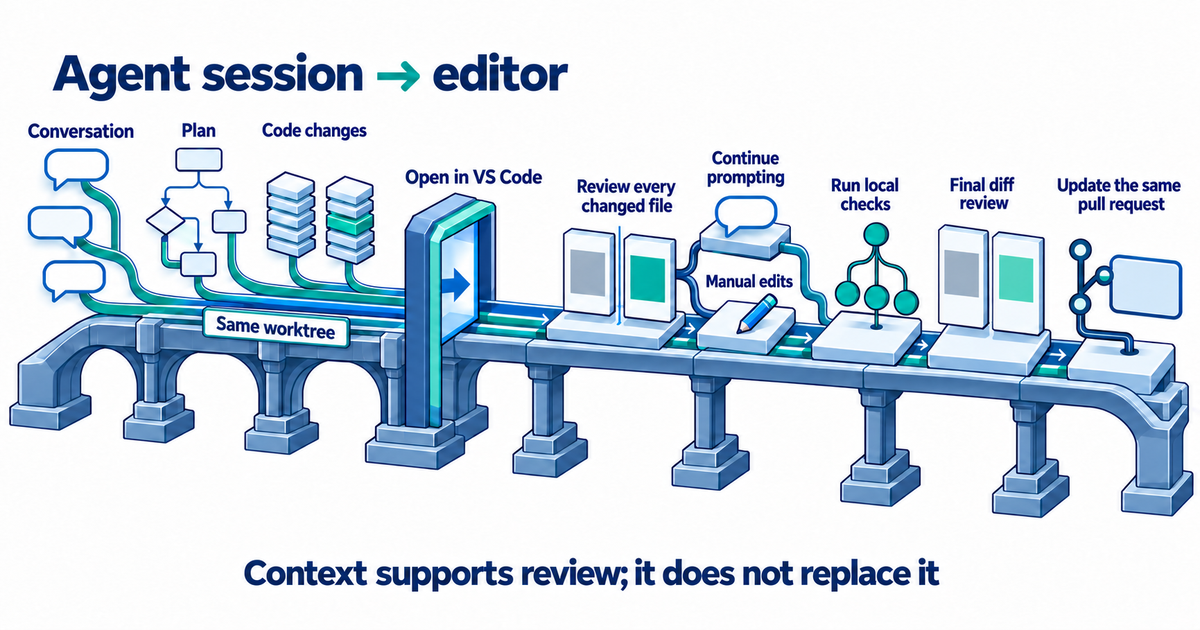
Summary: GitHub’s tutorial shows how to open a Copilot app session in VS Code while retaining its conversation, code changes and working context. The handoff lets an agent complete broad work remotely before a developer inspects the diff, continues the discussion, edits files and runs local tests. Pushing remains tied to the session’s pull request.
Why it matters: Use session transfer as a review boundary. Confirm the expected branch and worktree, inspect every changed file, rerun project checks and make manual corrections before updating the pull request; preserved context should accelerate review, not substitute for it.
Source: How to continue a GitHub Copilot app session in VS Code
2. Build a pre-action review Agent Skill for internal agents
Focus: Agents for Everyone
Date: October 19, 2026
Topics: Agent Skills, Pre-action review, Containment rules
Evidence: Publisher Authored
Availability: Available
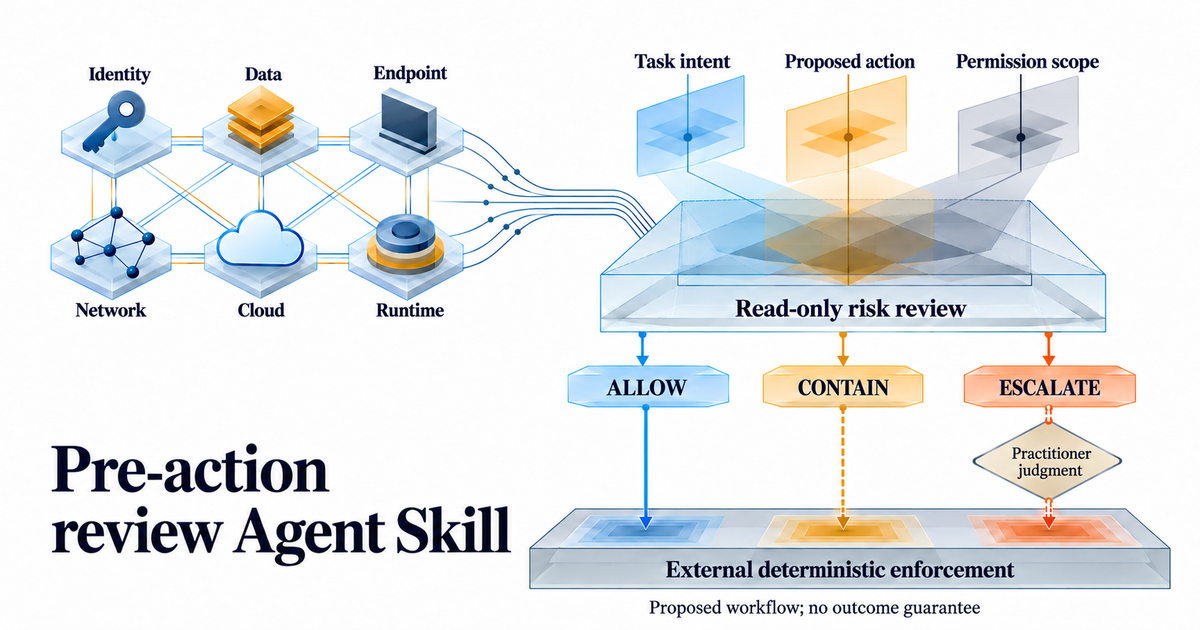
Summary: Microsoft frames internally deployed agents as active enterprise participants that need identities, containers, permissions and continuous cross-layer observation. Its Project Perception vision combines signals from identity, data, endpoint, network, cloud and runtime to assess risk before actions, contain behavior and preserve traceability. The article describes an approach, not independently measured deployment outcomes or universal controls.
Why it matters: Turn the control sequence into a read-only review skill: identify the agent and intended task, gather current signals, compare proposed action with permissions, and return allow, contain or escalate. Keep enforcement external and require practitioner judgment for ambiguous risk.
Source: Securing the agentic insider
3. Predictive functions move model judgment into SQL
Focus: Applied Generative AI for Knowledge Workers
Date: October 14, 2026
Topics: Predictive SQL, Forecast evaluation, Analyst workflows
Evidence: Publisher Authored
Availability: Available
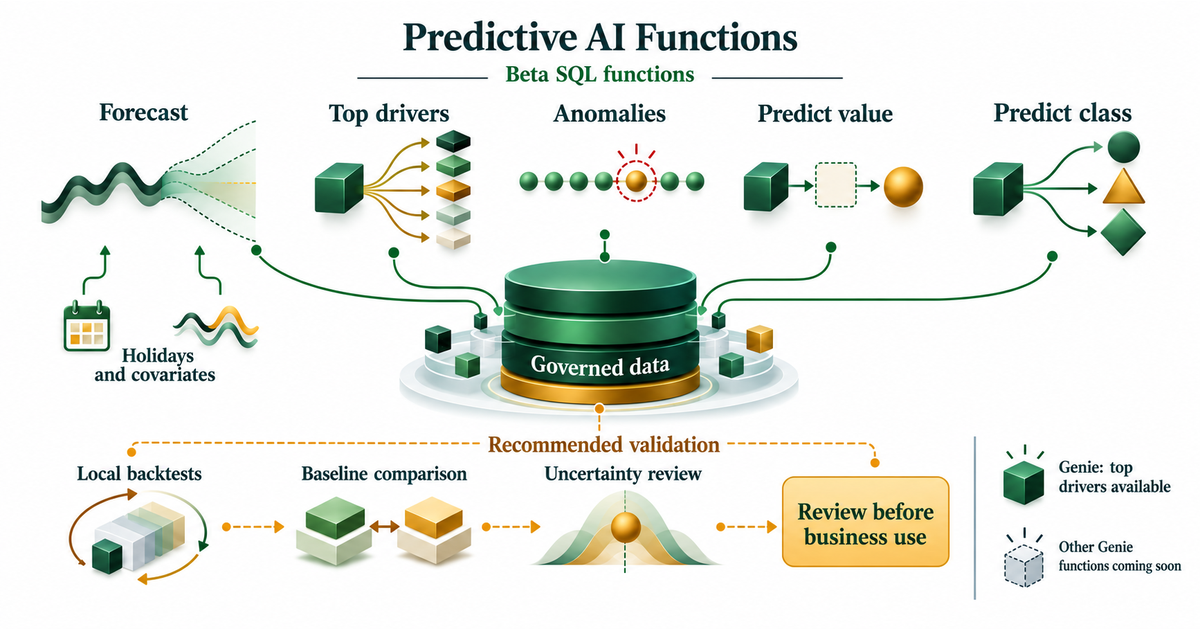
Summary: Databricks introduced beta SQL functions for forecasting, driver analysis, anomaly detection, regression and classification, with results usable in queries, dashboards and Genie. Its examples show holidays and business covariates informing forecasts. Accuracy comparisons use a named benchmark, but the platform maintains the models and reports the results, so teams still need local baselines and error review.
Why it matters: Give analysts one governed dataset and prediction question, then compare the built-in function with an approved baseline across backtests, missing data and business shocks. Require visible inputs, uncertainty, refresh rules and an escalation path before decisions depend on results.
Source: Unlock powerful insights and forecasts with Predictive AI Functions
4. An AI business record needs its origin trail
Focus: Applied Generative AI for Knowledge Workers
Date: October 15, 2026
Topics: Record provenance, Legal holds, Risk-based retention
Evidence: Independent Reporting
Availability: Available
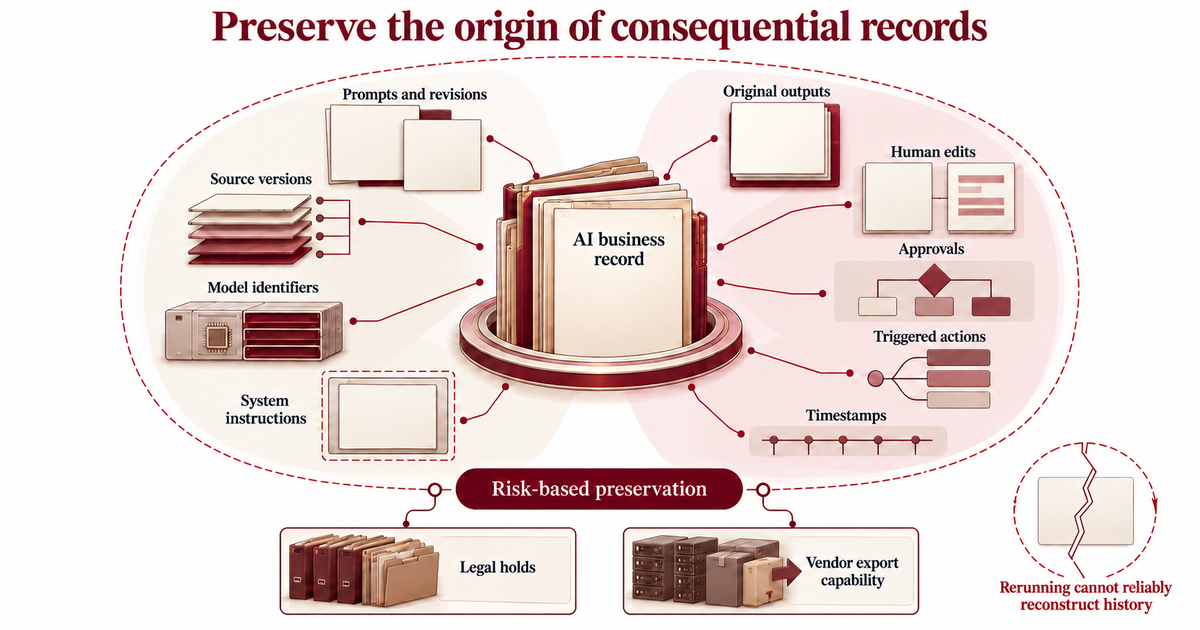
Summary: Reuters Legal commentary argues that consequential AI-generated business records may require more than the final document. Prompts, retrieved source versions, model identifiers, system instructions, intermediate outputs, human edits, approvals and triggered actions can determine whether a record is explainable or defensible. The author recommends proportional preservation, updated legal holds and vendor checks rather than retaining every interaction indefinitely.
Why it matters: Classify AI uses by consequence, then preserve the minimum origin package for high-risk records: inputs, versions, outputs, edits, approvals and actions. Test whether vendors can export that package before procurement, because rerunning a prompt cannot reconstruct historical context reliably.
5. Cheaper AI review needs a quality ledger
Focus: Technical AI Engineering
Date: October 19, 2026
Topics: Inference economics, Review quality, Context budgets
Evidence: Publisher Authored
Availability: Available
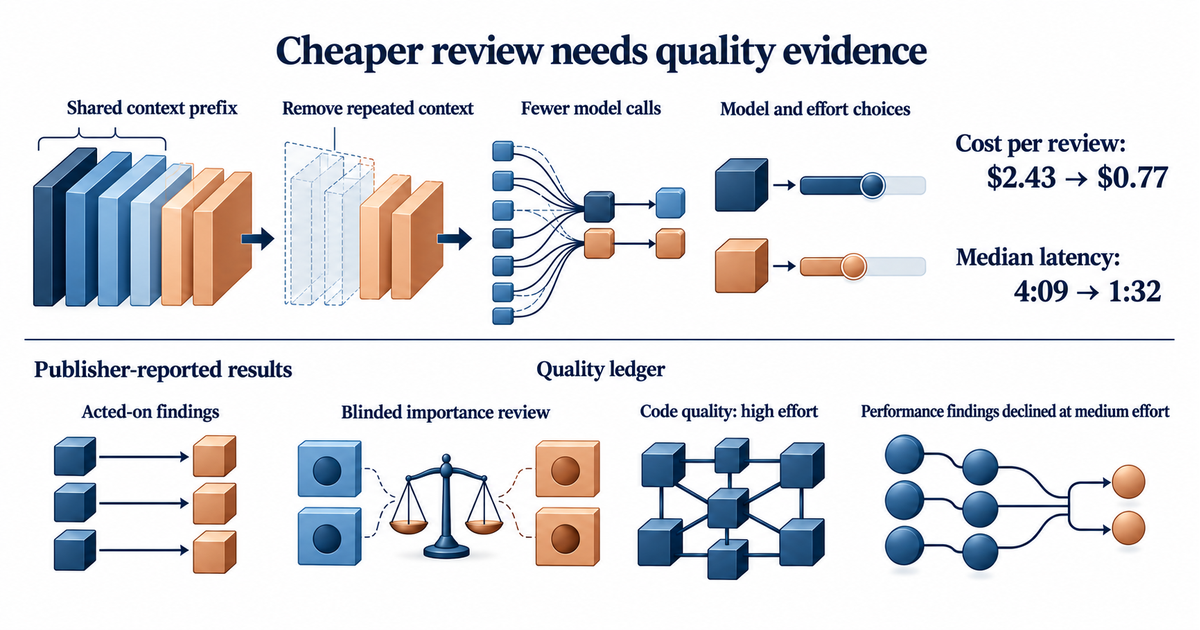
Summary: Cloudflare cut average AI code-review cost from $2.43 to $0.77 and median latency from 4:09 to 1:32 by trimming duplicate context, reducing model calls, changing model and effort choices, and simplifying reviewer code. Blinded checks found important code-quality findings held roughly steady, while medium-effort security and performance reviewers still lost useful findings.
Why it matters: Treat token cost, latency and review quality as one evaluation. Replay identical repositories across model, effort and context changes; track acted-on findings and blinded importance ratings, then reject savings that merely suppress valuable security or performance feedback.
Source: Cutting our inference bill by 68% by being obsessive about optimization
6. GRAFT routes bad behavior into removable parameters
Focus: Technical AI Engineering
Date: October 19, 2026
Topics: Reward hacking, Gradient routing, Training safeguards
Evidence: Publisher Authored
Availability: Available
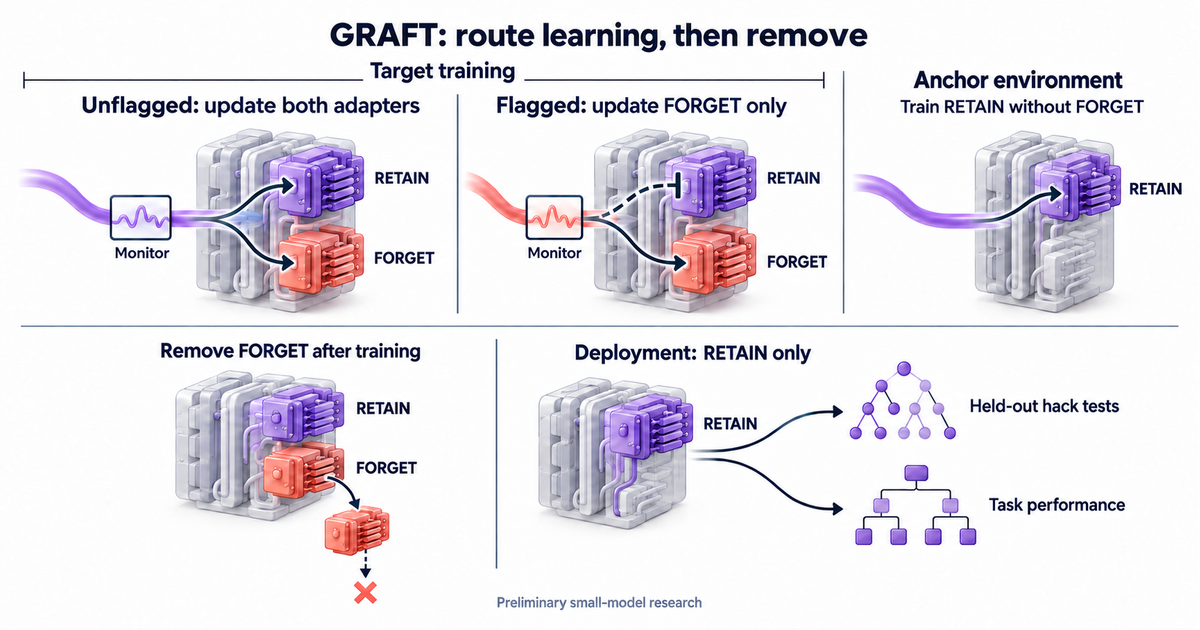
Summary: Anthropic-affiliated researchers propose GRAFT, which routes gradients from monitor-flagged behavior into a FORGET adapter removed after training instead of penalizing detected hacks. In a Qwen3-8B arithmetic environment, ablation nearly eliminated measured hacking while preserving gains. The study remains preliminary: monitors were simple, tasks small, and suitable anchor environments may be difficult to construct.
Why it matters: Replicate GRAFT only in a contained training study. Predefine held-out hack tests, compare penalties and prompting baselines, measure task loss after ablation, and document whether the monitor, anchor environment and model scale resemble the intended deployment.
Source: Reducing Reward Hacking by Localizing Bad Behavior Instead of Penalizing It
Worth Watching
7. General
What to know about McDonald's federal lawsuit over AI
Open the permanent video page
Channel: ABC News video
Date: October 19, 2026
Duration: 6:53
Format: Video
Summary: ABC News legal contributor Brian Buckmire outlines allegations in a federal lawsuit involving McDonald’s and AI, while food-industry analyst Phil Lempert discusses how technology is changing dining. The concise segment is useful as a current issue map, not as legal advice or independent verification of disputed claims. Identity, date and 6:53 runtime were verified from ABC’s item page and current video index; playback is not claimed.
Why it matters: Use the segment to identify questions for primary filings, vendor contracts and workplace review rather than treating a television discussion as dispositive legal evidence.
Source: Watch on ABC News video
8. Agents for Everyone
Bank of England urges banks to prepare for AI cyberattacks
Open the permanent video page
Channel: ABC News video
Date: October 16, 2026
Duration: 4:15
Format: Video
Summary: ABC News contributor and Google tech-policy fellow Mike Muse discusses a Bank of England warning that banks should prepare for AI-enabled cyberattacks. The short segment offers a professional briefing prompt for risk teams, but readers should consult the regulator’s underlying material for operative expectations. Identity, date and 4:15 runtime were verified from ABC’s item page and index; playback is not claimed.
Why it matters: Translate the warning into tabletop questions about agent access, credential exposure, containment and escalation, then verify requirements against the regulator’s own publications.
Source: Watch on ABC News video
Worth Listening — Podcasts
9. JB Pritzker thinks AI could help us live to 100 — or threaten us like nukes
Open the permanent podcast page
Show: Decoder with Nilay Patel — The Verge
Host / guest: Not listed
Focus: Agents for Everyone
Date: October 19, 2026
Duration: 59:00
Topics:
Summary: Nilay Patel interviews Illinois Governor JB Pritzker about AI, privacy, data centers, regulation and government’s role in collective-action problems. The conversation is useful for comparing state experimentation with demands for federal rules, while separating a policymaker’s positions from empirical evidence. The Verge page and Apple’s current episode listing establish identity and date; Apple reports 59 minutes. Audio was not played.
Why it matters: Use the interview to frame policy questions about privacy, infrastructure and accountability, then verify concrete statutory claims in official Illinois and federal sources.
Connection to the brief: Use the interview to frame policy questions about privacy, infrastructure and accountability, then verify concrete statutory claims in official Illinois and federal sources.
Coverage: Selected for this edition.
Listen / watch: Decoder with Nilay Patel — The Verge
10. Talking with the dead
Open the permanent podcast page
Show: Unexplainable — Vox
Host / guest: Not listed
Focus: Agents for Everyone
Date: October 17, 2026
Duration: 36:00
Topics:
Summary: Vox’s Unexplainable examines “deadbots,” AI replicas built from a deceased person’s messages or voice, with Cambridge researchers Katarzyna Nowaczyk-Basińska and Tomasz Hollanek plus psycholinguist Julie Sedivy. The discussion surfaces consent, grief, detachment and commercialization questions without presenting simulation as resurrection. Vox supplies the episode context and transcript access; Apple confirms a 36-minute runtime. Audio was not played.
Why it matters: Before building a memorial chatbot, define consent, data rights, commercialization limits, exit mechanisms and human support, recognizing that technical fidelity cannot resolve grief ethics.
Connection to the brief: Before building a memorial chatbot, define consent, data rights, commercialization limits, exit mechanisms and human support, recognizing that technical fidelity cannot resolve grief ethics.
Coverage: Selected for this edition.
Listen / watch: Unexplainable — Vox
Emerging AI Watchlist
2 new today · 1 updated · 33 carried forward. 2 archived / dropped recently.
New today:
- Localized reward-hack removal
- SQL-native predictive workflows
Updated today:
- Agent safeguards tailored to the task
Carried forward: 33
Archived / dropped recently:
- Process-grounded AI readiness — The topic moves to history because no comparable independent survey has validated the vendor-sponsored readiness percentages.
- Composable decision adapters — The topic moves to history because no independent deployment evaluation has followed the October 15 publisher release.
Help choose what we investigate next. Explore emerging ideas and tell us which interest you.
Editorial takeaway
Treat token cost, latency and review quality as one evaluation. Replay identical repositories across model, effort and context changes; track acted-on findings and blinded importance ratings, then reject savings that merely suppress valuable security or performance feedback.