Daily Generative AI Brief — October 19, 2026
Published: October 19, 2026
Coverage period: October 13–17, 2026
IN THIS EDITION · 6 ARTICLES / 2 VIDEOS / 2 PODCASTS
Choose what matters to your work
- Deep Agents keeps long-run context recoverable and inspectableArticle · about 11 min source read
- Build a permission-bounded release-note Agent SkillArticle · about 10 min source read
- A governed context layer is more than a vector databaseArticle · about 13 min source read
- Independent AI assurance needs visible constraintsArticle · about 15 min source read
- Safe model failover starts with replay boundariesArticle · about 22 min source read
- Granite Switch composes chat, decisions and speech in one modelArticle · about 9 min source read
- Put your dot on callVideo · 2:38
- How To Actually Automate Your Company w Claude (Seriously)Video · 6:54
- Le Chonk! Also: Espionage at OpenAIPodcast · 30:00
- Predicted: How AI Is Restructuring Social Life with Mona SloanePodcast · 40:46
1. Deep Agents keeps long-run context recoverable and inspectable
Focus: Agents for Everyone
Date: October 14, 2026
Topics: Context rot, Recoverable memory, Subagent isolation
Evidence: Publisher Authored
Availability: Available
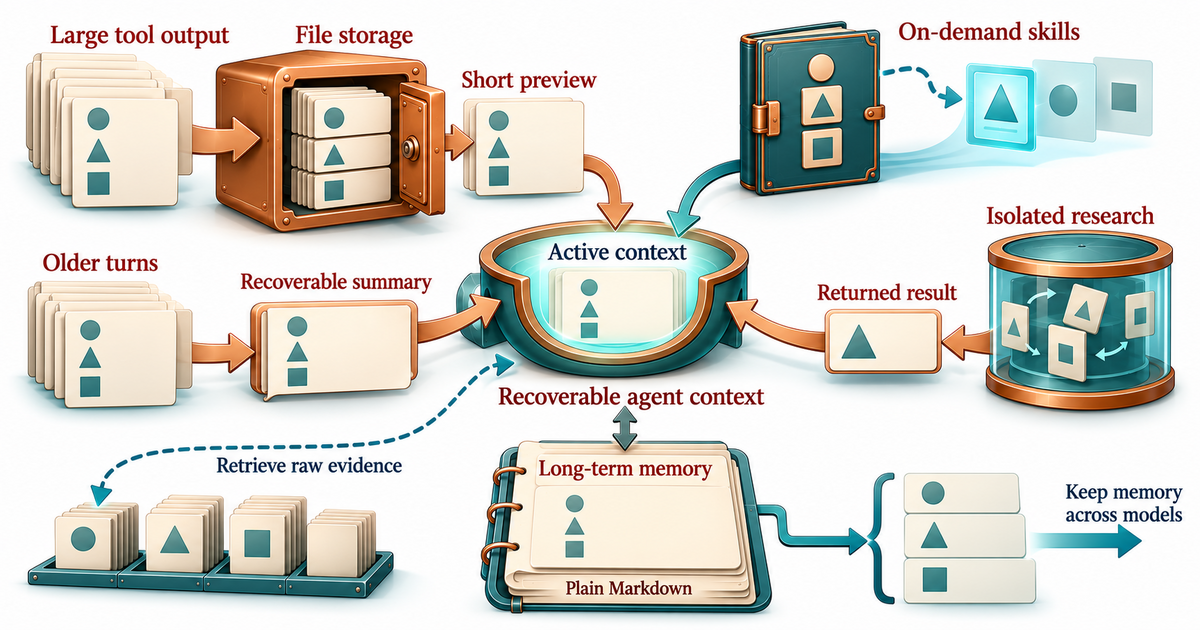
Summary: LangChain describes five Deep Agents mechanisms for limiting context rot: offload large inputs to files, summarize older turns, load skills only when relevant, isolate noisy work in subagents and persist selected knowledge as plain Markdown. Summaries remain recoverable, and user-controlled storage lets memory survive a model or provider change instead of remaining trapped in one service.
Why it matters: Keep active context small without deleting evidence. Store raw outputs behind previews, preserve summarized history for retrieval, separate exploratory work and review persistent memory edits. This makes long-running agents easier to audit, migrate and correct when their retained assumptions become stale.
Source: Context Engineering: How Deep Agents Remember
2. Build a permission-bounded release-note Agent Skill
Focus: Agents for Everyone
Date: October 17, 2026
Topics: Agent Skills, Release notes, Permission boundaries
Evidence: Publisher Authored
Availability: Available
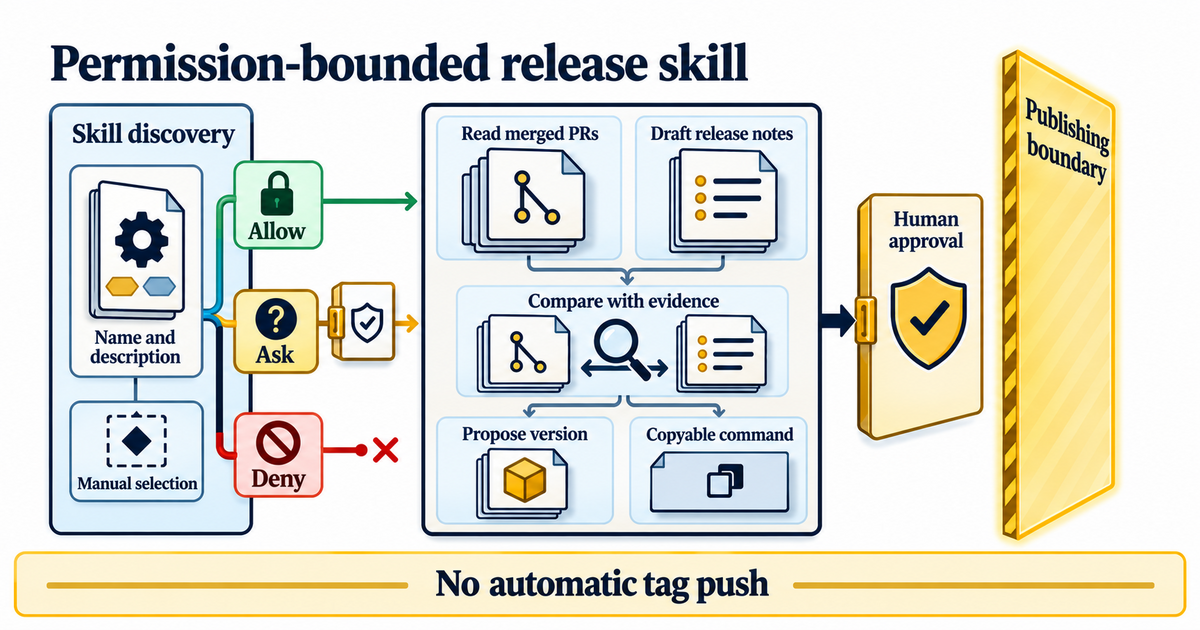
Summary: OpenCode documents portable SKILL.md discovery across project, global, Claude-compatible and agent-compatible paths. Its git-release example pairs strict frontmatter with bounded instructions for drafting release notes, proposing a version bump and returning a copyable command. Pattern permissions can allow, deny or require approval, while manual-only metadata prevents accidental automatic selection.
Why it matters: Create a read-only release skill, test its name and discovery, deny unrelated internal skills and require approval before any publishing command. Compare generated notes with merged pull requests, keep version choice human-owned and never let the procedure push tags automatically.
Source: Agent Skills
3. A governed context layer is more than a vector database
Focus: Applied Generative AI for Knowledge Workers
Date: October 15, 2026
Topics: Knowledge governance, Context pipelines, Build versus buy
Evidence: Publisher Authored
Availability: Available
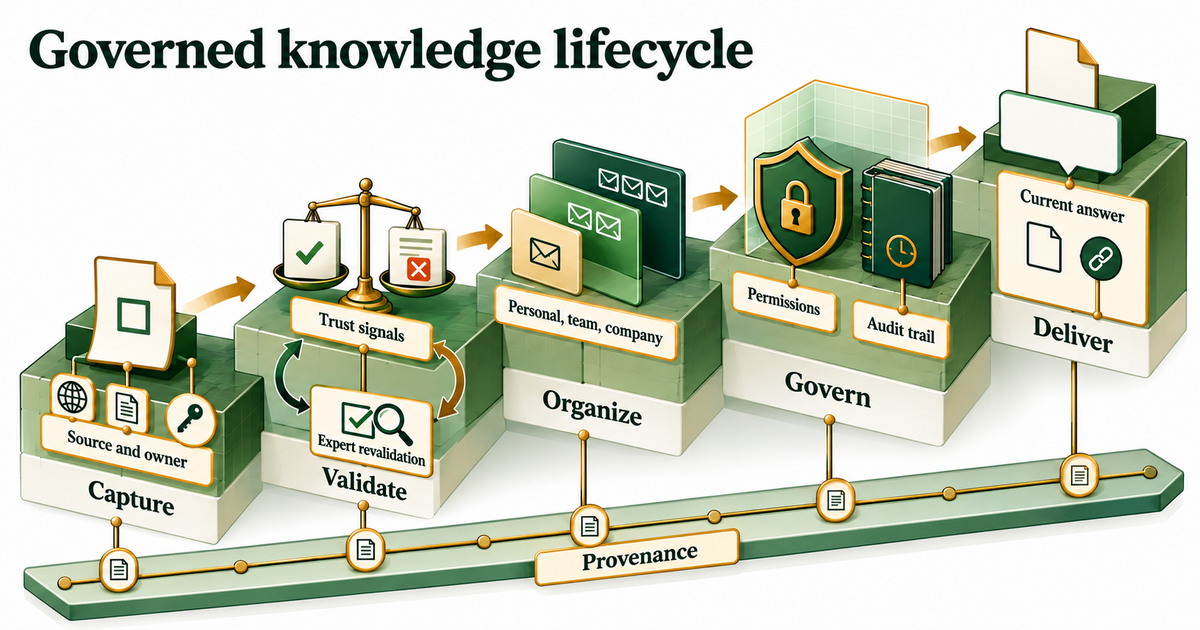
Summary: Stack Overflow divides an enterprise AI context layer into capture, validation, organization, governance and delivery. Its argument is that connectors and retrieval are only the beginning: teams must preserve provenance, ownership, permissions, audit history and changing trust. The article promotes Stack Internal, so its build-versus-buy conclusion should be tested against internal costs and alternatives.
Why it matters: Inventory one knowledge workflow across all five stages before funding a platform. Measure connector upkeep, stale-answer handling, expert review, permission enforcement and audit needs; then compare those recurring costs with vendor lock-in, migration effort and evidence portability.
Source: Why your platform team shouldn’t build an AI context layer (even though they probably could)
4. Independent AI assurance needs visible constraints
Focus: Applied Generative AI for Knowledge Workers
Date: October 14, 2026
Topics: Independent assurance, Evidence limits, Process transparency
Evidence: Publisher Authored
Availability: Available
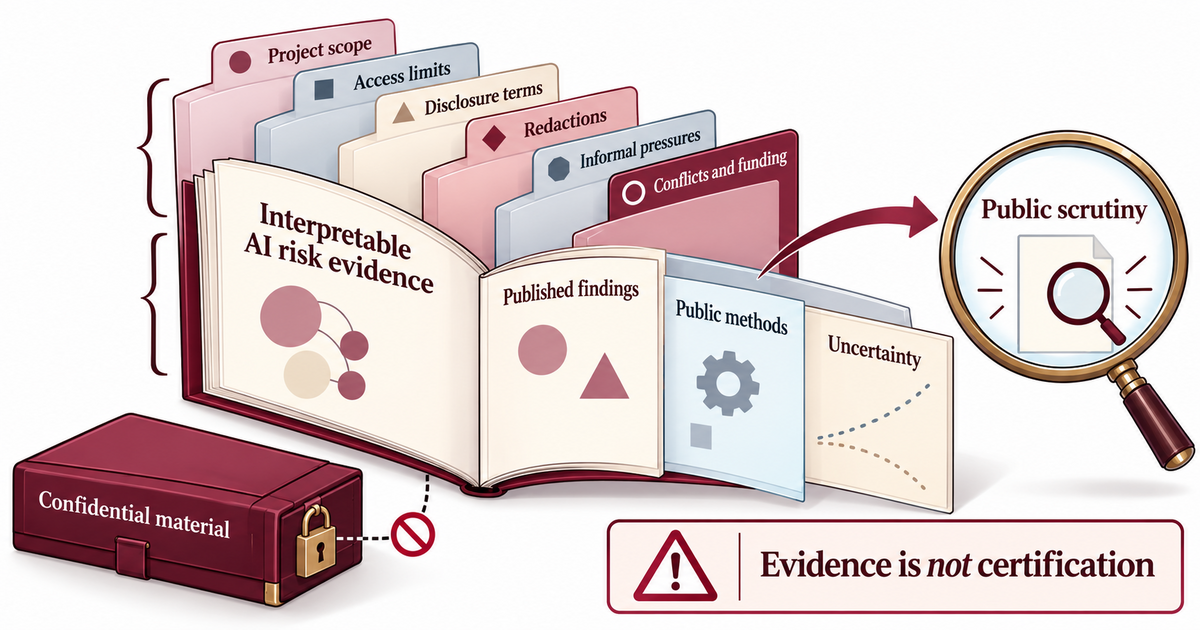
Summary: METR explains how external AI-risk work can inform the public without pretending to certify deployment decisions. It commits to disclose project scope, access limits, redactions, constraints and conflicts, while protecting confidential material. The organization also aims to publish evidence and methods for outside analysis, acknowledge scientific uncertainty and issue iterative findings rather than closed-door assurance.
Why it matters: When reading an AI safety assessment, check who paid, what evaluators could access, which evidence was removed, how methods can be challenged and whether conclusions exceed the scope. These disclosures help leaders distinguish independent evidence from a broad safety endorsement.
Source: Our approach to working with AI companies
5. Safe model failover starts with replay boundaries
Focus: Technical AI Engineering
Date: October 14, 2026
Topics: Provider failover, Retry safety, Recovery ownership
Evidence: Publisher Authored
Availability: Available
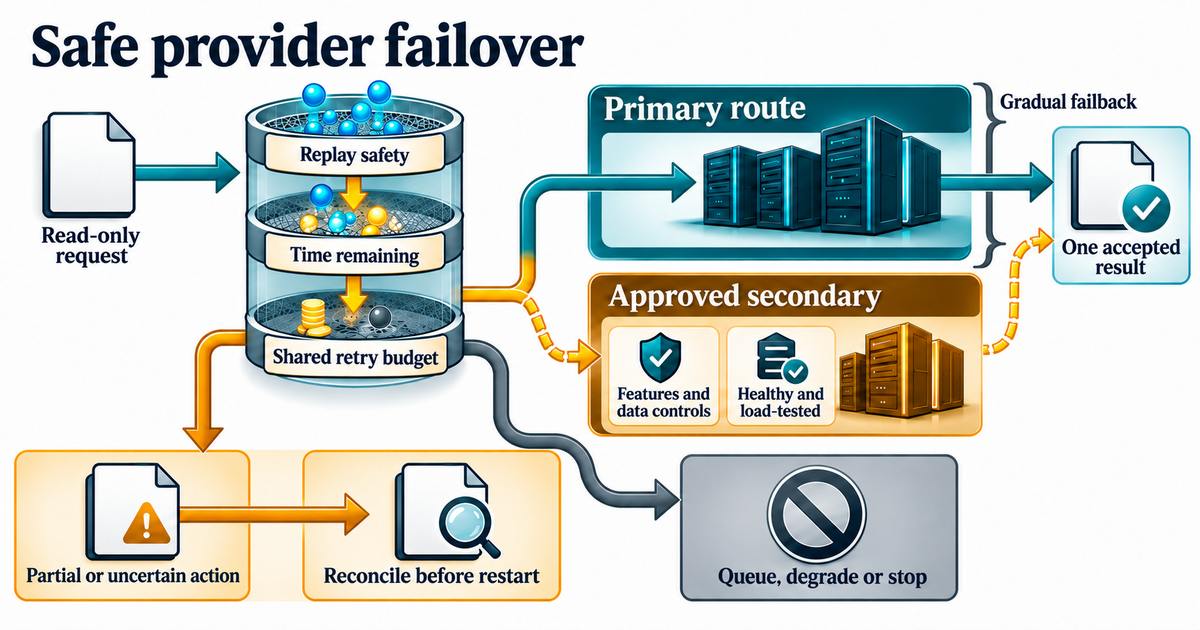
Summary: OpenAI’s production-routing guide separates multi-provider availability from safe workflow recovery. Using a read-only fraud assessment, it permits failover only when retries are repeatable, deadlines remain, the secondary is approved and healthy, and features plus data controls match. Stateful sessions, partial outputs, unknown errors and uncertain actions require reconciliation or a safe stop.
Why it matters: Start with one read-only inference step. Centralize retry budgets, test both routes under load, block ambiguous replays and define queue, degraded or manual paths so an outage does not become duplicate work, policy drift or an uncontrolled provider switch.
Source: Designing failover across OpenAI model providers
6. Granite Switch composes chat, decisions and speech in one model
Focus: Technical AI Engineering
Date: October 15, 2026
Topics: Activated LoRAs, Shared KV cache, Modular inference
Evidence: Publisher Authored
Availability: Available
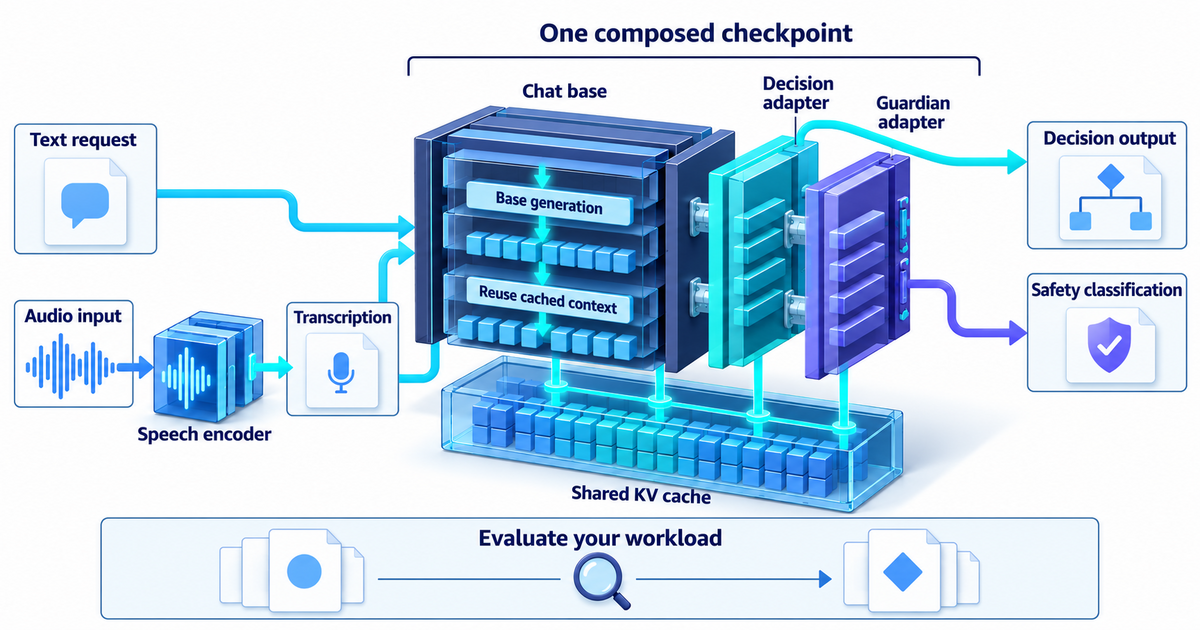
Summary: IBM Granite’s 8B and 30B Switch 4.1 checkpoints combine a general decision adapter, a guardian adapter and a speech encoder with the base chat model. Activated LoRAs reuse the base model’s KV cache, while the project supports vLLM and llama.cpp. Reported speed and benchmark claims remain publisher-produced and need workload-specific replication.
Why it matters: Evaluate the composed checkpoint as a system: verify adapter routing, classification quality, speech accuracy, cache behavior, memory use and latency on your own traffic. Treat publisher comparisons as hypotheses until identical fixtures reproduce them under the intended runtime.
Source: Granite Switch 4.1: Chat, Decisions, and Speech from One Endpoint
Worth Watching
7. General
Put your dot on call
Open the permanent video page
Channel: OpenAI official YouTube video
Date: October 16, 2026
Duration: 2:38
Format: Video
Summary: An OpenAI engineer demonstrates a bounded incident-response handoff: a persistent dot watches an on-call channel, investigates a 3 a.m. alert, starts a Codex thread and lets the engineer steer from a phone. The short product demonstration is useful for identifying the coordination pattern, but it is not an independent reliability benchmark. This synopsis relies on creator metadata and indexed scene descriptions, not playback.
Why it matters: Separate alert detection, evidence gathering and code changes, then keep incident ownership and high-impact approvals with the on-call engineer.
Source: Watch on YouTube
8. Agents for Everyone
How To Actually Automate Your Company w Claude (Seriously)
Open the permanent video page
Channel: Nick Saraev official YouTube video
Date: October 13, 2026
Duration: 6:54
Format: Video
Summary: Nick Saraev presents a repeatable automation triage: observe real work, inventory tasks, run each candidate ten times, score the outputs, improve weak procedures, package only passing workflows as skills and schedule only low-risk work. His revenue and automation figures are self-reported, and screen capture can expose secrets. The synopsis uses the creator listing plus a chaptered independent summary, not playback.
Why it matters: Measure repeatability before scheduling automation, protect captured work data and preserve human review for client-facing or high-impact deliverables.
Source: Watch on YouTube
Worth Listening — Podcasts
9. Le Chonk! Also: Espionage at OpenAI
Open the permanent podcast page
Show: AI Agents Hour by Mastra
Host / guest: Not listed
Focus: Agents for Everyone
Date: October 16, 2026
Duration: 30:00
Topics:
Summary: Mastra cofounders Shane Thomas and Abhi Aiyer survey new models, decision systems, Anthropic’s source-control work, a reported agent disclosure of personal finances and open agent protocols. The publisher page and independent index provide detailed chapters through 28:44. Treat the program as practitioner commentary: use its map to locate primary evidence before relying on release, funding or incident claims. Audio was not played.
Why it matters: Use the chapter map to prioritize primary-source checks on agent security, decision models and protocol changes instead of treating a news discussion as verification.
Connection to the brief: Use the chapter map to prioritize primary-source checks on agent security, decision models and protocol changes instead of treating a news discussion as verification.
Coverage: Selected for this edition.
Listen / watch: AI Agents Hour by Mastra
10. Predicted: How AI Is Restructuring Social Life with Mona Sloane
Open the permanent podcast page
Show: New Books Network — New Books in Sociology
Host / guest: Not listed
Focus: Agents for Everyone
Date: October 16, 2026
Duration: 40:46
Topics:
Summary: Host Pete Kunze interviews sociologist Mona Sloane about treating AI as social infrastructure rather than a detached technological force. They discuss prediction, classification, institutional authority, technological determinism and public agency. A complete indexed transcript grounds the synopsis, while the publisher listing and independent catalog establish identity, date and runtime. The conversation helps leaders examine who defines predictive categories and who can challenge them; audio was not played.
Why it matters: Ask which institutional assumptions an AI workflow encodes, whose authority it changes and what meaningful route exists for affected people to contest predictions.
Connection to the brief: Ask which institutional assumptions an AI workflow encodes, whose authority it changes and what meaningful route exists for affected people to contest predictions.
Coverage: Selected for this edition.
Listen / watch: New Books Network — New Books in Sociology
Emerging AI Watchlist
2 new today · 1 updated · 32 carried forward. 2 archived / dropped recently.
New today:
- Provider-aware AI failover
- Composable decision adapters
Updated today:
- Reusable agent skills become observable
Carried forward: 32
Archived / dropped recently:
- Governed public-service process agents — The topic moves to history because its current support remains a vendor experience-center demonstration without independent operational outcomes.
- Process-grounded AI readiness — The topic moves to history because no comparable independent survey has validated the vendor-sponsored readiness percentages.
Help choose what we investigate next. Explore emerging ideas and tell us which interest you.
Editorial takeaway
Start with one read-only inference step. Centralize retry budgets, test both routes under load, block ambiguous replays and define queue, degraded or manual paths so an outage does not become duplicate work, policy drift or an uncontrolled provider switch.