Daily Generative AI Brief — October 17, 2026
Published: October 17, 2026
Coverage period: October 7–16, 2026
IN THIS EDITION · 6 ARTICLES / 2 VIDEOS / 2 PODCASTS
Choose what matters to your work
- Package one repository quality procedure as a reviewable Agent SkillArticle · about 5 min source read
- A narrow scorecard turns an agent pilot into a production decisionArticle · about 5 min source read
- Public-service AI works best when accountability spans the full processArticle · about 4 min source read
- Ericsson separates proven quote digitization from exploratory agent assistanceArticle · about 5 min source read
- A live laboratory digital twin gives scientific agents physical guardrailsArticle · about 9 min source read
- GitHub makes license policy a pre-merge constraint coding agents can queryArticle · about 3 min source read
- Navigating AI automation in Looker: Essential developer tools for agentsVideo · 5:55
- Reimagine business productivity with AI agents and assistantsVideo · 7:58
- Can Open Models Keep Up With the AI Frontier? | Nathan LambertPodcast · 1:00:00
- The AGORÀ Briefing — Wednesday, October 14, 2026Podcast · 8:00
1. Package one repository quality procedure as a reviewable Agent Skill
Focus: Agents for Everyone
Date: October 12, 2026
Topics: Agent Skills, Quality checks, Repository instructions
Evidence: Publisher Authored
Availability: Available
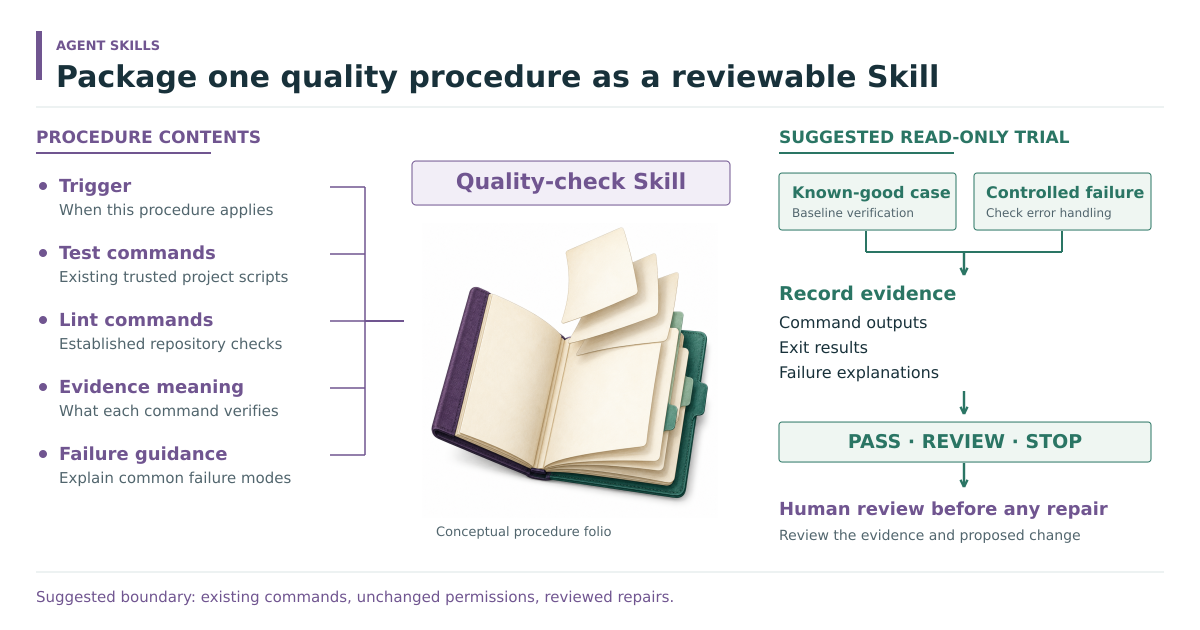
Summary: GitHub explains four repository-level customization layers for Copilot: broad custom instructions, task-specific Agent Skills, specialized custom agents and MCP connections. Its quality-check example stores a SKILL.md with triggers, test and lint commands, what each script verifies and failure guidance. That pattern makes one recurring engineering procedure discoverable without granting new permissions.
Why it matters: Start with a read-only quality procedure that already has trusted commands. Review every instruction and script, test correct and failing cases, record outputs and require a person to approve any suggested fix. The Skill should explain checks, not expand access.
Source: GitHub Copilot app for Beginners: How to teach Copilot about your codebase
2. A narrow scorecard turns an agent pilot into a production decision
Focus: Agents for Everyone
Date: October 15, 2026
Topics: Production readiness, Agent scorecards, Phased rollout
Evidence: Publisher Authored
Availability: Available
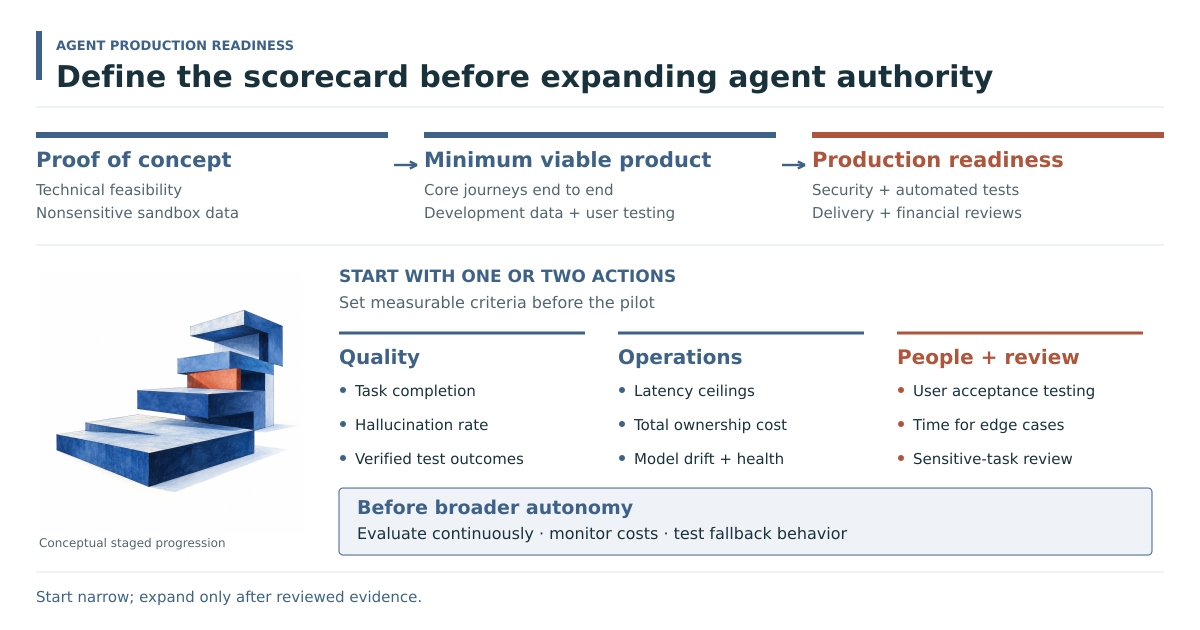
Summary: Google Cloud Consulting recommends defining production stages before coding, limiting initial agents to one or two high-value actions and replacing vague helpfulness goals with measurable task completion, error and latency thresholds. The guidance also allocates time for user acceptance testing, phases sensitive actions behind review and monitors cost, drift, infrastructure health and fallback behavior.
Why it matters: Write the production scorecard before the pilot. Include task success, hallucination, latency, cost, escalation and rollback thresholds; reserve employee time for edge cases; and expose only one routine action until user acceptance and operational monitoring meet the agreed limits.
Source: Five lessons from Google Cloud Consulting for moving agents into production
3. Public-service AI works best when accountability spans the full process
Focus: Applied Generative AI for Knowledge Workers
Date: October 16, 2026
Topics: Public service workflows, Sovereign data, Human accountability
Evidence: Publisher Authored
Availability: Available
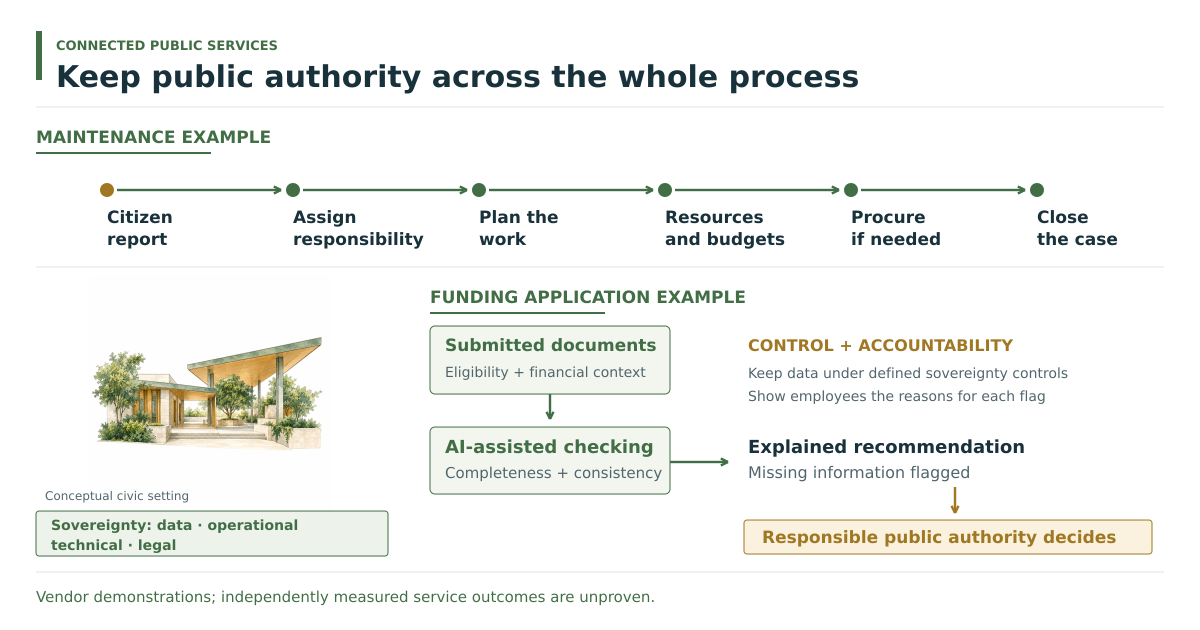
Summary: SAP's Berlin public-sector center demonstrates connected workflows rather than isolated chat. A citizen report can flow through responsibility, maintenance, procurement and finance; funding applications can be checked for completeness before an official decides; selected seaport data can be prioritized inside a sovereign environment. These are vendor demonstrations, not independently measured public-service outcomes.
Why it matters: Map one request from intake through every system, approval and final decision before adding AI. Keep source data under defined controls, show employees why information was flagged and measure accuracy and handling time without delegating public authority.
Source: The Next Leap in Public Services Starts Behind the Scenes
4. Ericsson separates proven quote digitization from exploratory agent assistance
Focus: Applied Generative AI for Knowledge Workers
Date: October 15, 2026
Topics: Contract-aware quoting, B2B commerce, Human review
Evidence: Publisher Authored
Availability: Available
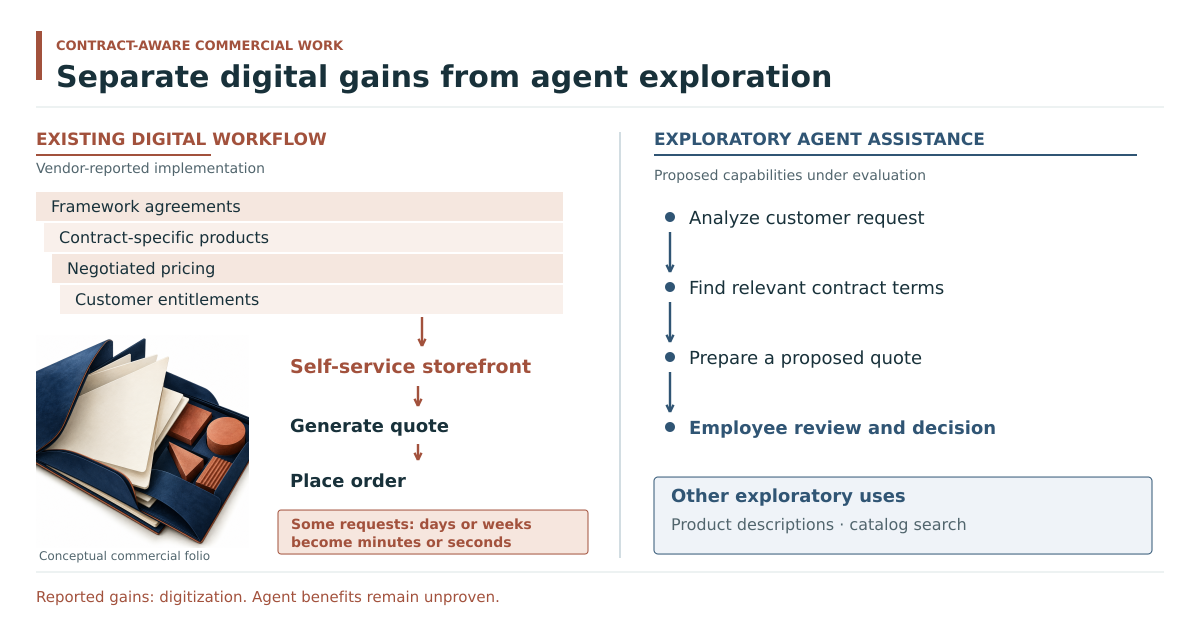
Summary: SAP says Ericsson digitized contract-specific product access, quotes and orders so some requests that once took days or weeks can now finish in minutes or seconds. Ericsson is separately exploring agents that assemble proposed quotes and improve catalog search, with employees retaining oversight. The reported speed change concerns the existing digital workflow, not a proven agent deployment.
Why it matters: Establish a correct digital process before introducing an agent. For one quote type, compare contract retrieval, entitlement checks, pricing, exception handling and approval time against the current workflow, while separating measured automation gains from proposed AI benefits.
Source: From Two Weeks to Seconds: How Ericsson Is Reimagining B2B Commerce with AI
5. A live laboratory digital twin gives scientific agents physical guardrails
Focus: Technical AI Engineering
Date: October 16, 2026
Topics: Physical agent safety, Laboratory digital twins, Closed-loop discovery
Evidence: Publisher Authored
Availability: Available
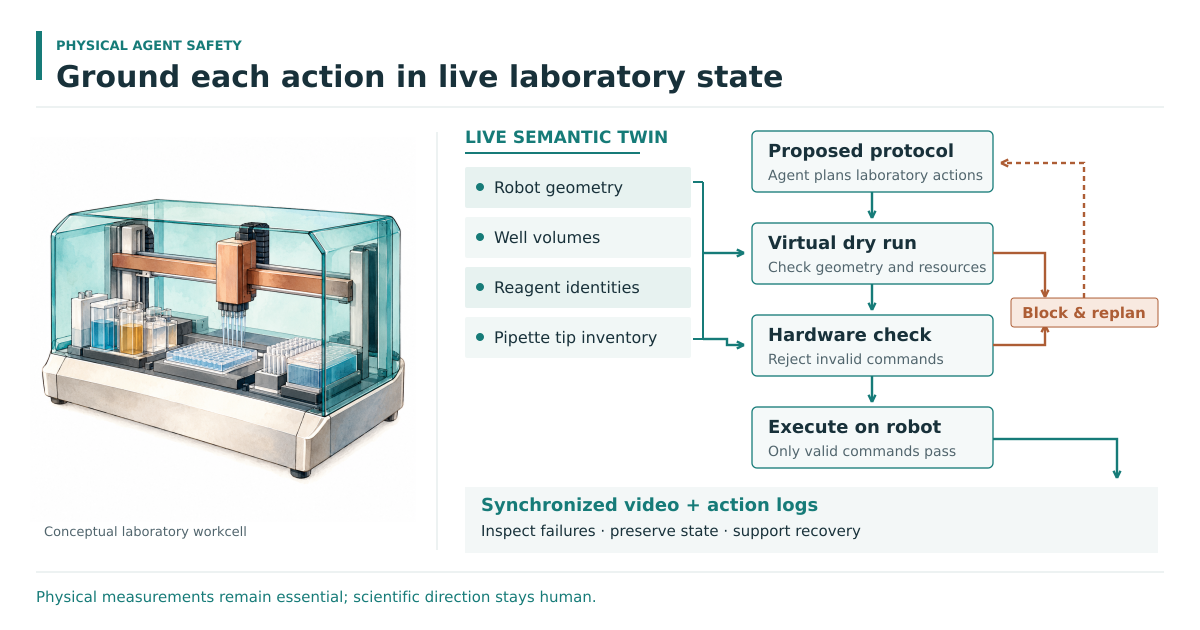
Summary: Google Research describes VERID, a semantic digital twin that tracks robot geometry, well volumes, reagents and pipette inventory before an AI agent executes laboratory protocols. Virtual dry runs and hardware checks reject impossible commands, while synchronized video and action logs support debugging. Separate closed-loop experiments improved aptamer selection, but physical readouts and human scientific direction remain essential.
Why it matters: Engineering teams can borrow the pattern without operating a lab: represent live system state, simulate proposed actions, block invalid commands and retain synchronized evidence. Evaluate recovery from depleted resources and hardware failures before granting an agent authority over physical or costly workflows.
Source: Grounding AI agents in biological reality: Building blocks for autonomous wet labs
6. GitHub makes license policy a pre-merge constraint coding agents can query
Focus: Technical AI Engineering
Date: October 16, 2026
Topics: License policy APIs, Dependency review, Agent tool constraints
Evidence: Publisher Authored
Availability: Available
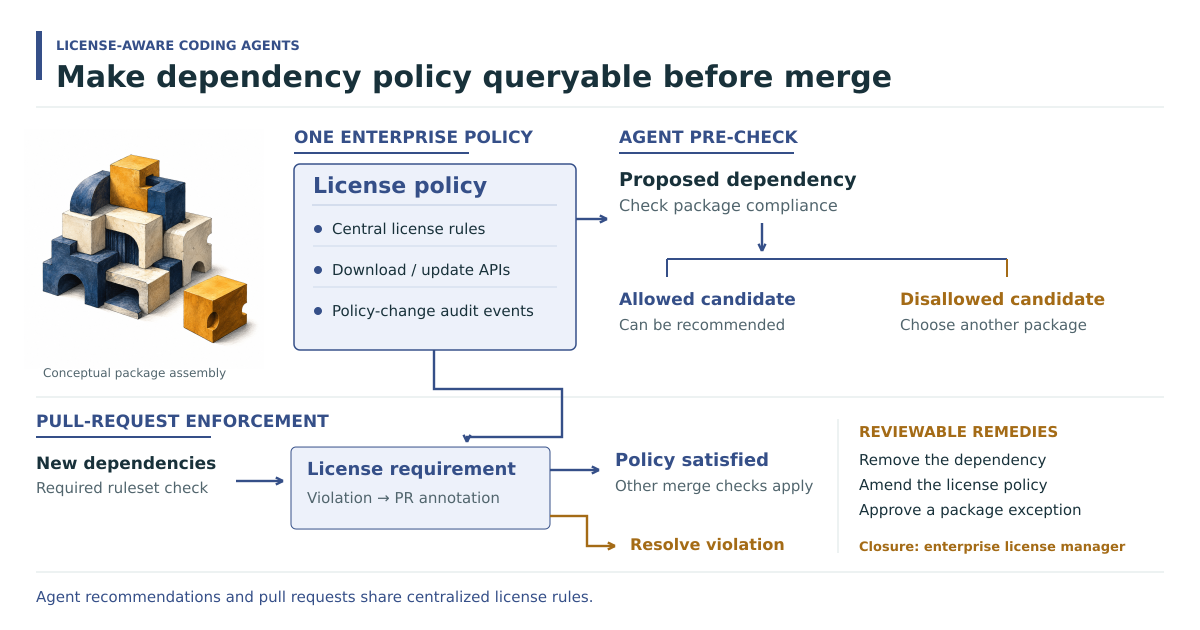
Summary: GitHub made enterprise open-source license compliance generally available. Repository rulesets can require license checks before merge, annotate newly added dependencies that violate centralized policy and route exception closures to a dedicated enterprise role. Audit events and policy APIs support external records, while a package-check endpoint lets coding agents avoid recommending disallowed dependencies.
Why it matters: Treat license policy as a machine-readable tool constraint, not a post-review checklist. Test an allowed package, a prohibited package and an approved exception, then confirm the pull request, audit log and agent recommendation all reflect the same decision.
Source: Open source license compliance generally available
Worth Watching
7. General
Navigating AI automation in Looker: Essential developer tools for agents
Open the permanent video page
Channel: Google Cloud Tech official video
Date: October 8, 2026
Duration: 5:55
Format: Video
Summary: Google Cloud developer advocate Chrissie Goodrich distinguishes five pieces of an agent-ready Looker developer stack: Looker Skills, command-line access, a managed MCP server, a database MCP toolbox and the VS Code extension. The video outlines how metadata-driven instructions can limit context load while service-account permissions govern tool access. Its practical lesson is to separate reusable analytic procedures from actual data authorization and independently verify calculations in LookML. The synopsis uses published caption-derived analysis, not playback.
Why it matters: Use narrow service accounts, explicit schemas and validation when adding Looker business intelligence tools to AI agents.
Source: Watch on YouTube
8. Agents for Everyone
Reimagine business productivity with AI agents and assistants
Open the permanent video page
Channel: IBM AI Academy
Date: March 17, 2025
Duration: 7:58
Format: Video
Summary: IBM AI Academy presenter Parul Mishra explains how AI assistants differ from AI agents and how both can support enterprise knowledge work. The episode considers choosing the appropriate form of assistance or automation for a business use case. This evergreen educational overview is not an independent productivity benchmark; the synopsis is based on IBM's published episode description.
Why it matters: Match the level of automation to one clearly defined task before deploying an agent. Use the distinction between assistants and agents to identify where employees need support, where actions require approval, and what outcomes to measure.
Replacement note: This evergreen IBM episode replaces an unavailable video. Originally published March 17, 2025; it is not an October 2026 news release.
Source: Watch on IBM AI Academy
Worth Listening — Podcasts
9. Can Open Models Keep Up With the AI Frontier? | Nathan Lambert
Open the permanent podcast page
Show: The a16z Show / Andreessen Horowitz
Host / guest: Not listed
Focus: Agents for Everyone
Date: October 14, 2026
Duration: 1:00:00
Topics:
Summary: In a discussion hosted by a16z partner Lisha Li, researcher Nathan Lambert contrasts closed frontier labs' infrastructure and capital advantages with open-model builders' ability to adapt techniques. They examine compute constraints, distillation, reinforcement-learning environments and the changing economics of post-training. Lambert also explains Trillium's ambition to make training environments and evaluations more accessible, while acknowledging uncertainty about self-improvement. The episode helps practitioners assess customization costs rather than treating open-weight availability as equivalent to frontier reliability; audio was not played.
Why it matters: Frame model choices around compute, maintainability, adaptation budgets and independent task-specific evaluation, not benchmark rankings alone.
Connection to the brief: Frame model choices around compute, maintainability, adaptation budgets and independent task-specific evaluation, not benchmark rankings alone.
Coverage: Selected for this edition.
Listen / watch: The a16z Show / Andreessen Horowitz
10. The AGORÀ Briefing — Wednesday, October 14, 2026
Open the permanent podcast page
Show: AGORÀ Intelligence — The Briefing
Host / guest: Not listed
Focus: Agents for Everyone
Date: October 14, 2026
Duration: 8:00
Topics:
Summary: AGORÀ Intelligence's October 14 briefing assembles five reported developments spanning economic conditions for AI investment, a customer-service bot designed as an agent, workplace trust questions, AI gateway access weaknesses and Asia-Pacific enterprise partnership announcements. Its publisher notes list these as individual topics without establishing the underlying claims as independently verified here. For knowledge workers the useful exercise is to separate announcements, operational risks and macroeconomic forecasts, then follow each primary source before adopting a workflow. No listening claimed.
Why it matters: Scan varied AI business risks rapidly, but verify each individual reported incident or commercial claim at its original source.
Connection to the brief: Scan varied AI business risks rapidly, but verify each individual reported incident or commercial claim at its original source.
Coverage: Selected for this edition.
Listen / watch: AGORÀ Intelligence — The Briefing
Emerging AI Watchlist
3 new today · 2 updated · 27 carried forward. 3 archived / dropped recently.
New today:
- Autonomous wet-lab agent control
- License-aware coding agent dependencies
- Governed public-service process agents
Updated today:
- Reusable agent skills become observable
- Agent safeguards tailored to the task
Carried forward: 27
Archived / dropped recently:
- Third-party Agent Skill license provenance — No new licensing audit was verified; the October 10 sample moves to monitored history while implementation guidance is tracked separately.
- Reproducible agent workflow dependencies — No separate October 15 lockfile development was verified, so the October 14 preview moves to monitored history.
- Document extraction instruction feedback — No new October 15 implementation evidence was found, while today's edition prioritizes newly documented controls and deployments.
Help choose what we investigate next. Explore emerging ideas and tell us which interest you.
Editorial takeaway
Engineering teams can borrow the pattern without operating a lab: represent live system state, simulate proposed actions, block invalid commands and retain synchronized evidence. Evaluate recovery from depleted resources and hardware failures before granting an agent authority over physical or costly workflows.